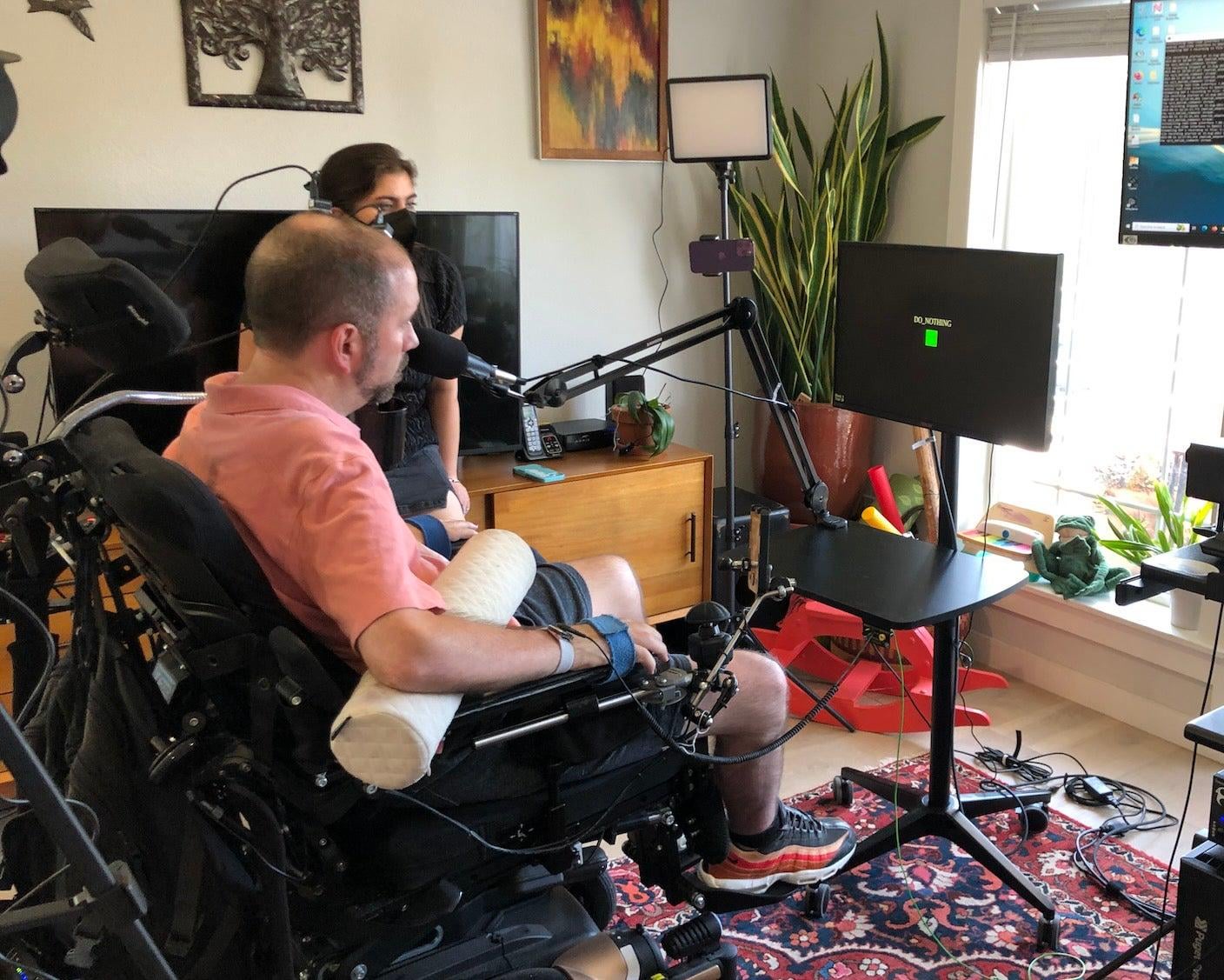
A Man With ALS Can Speak and Sing Again Thanks to a Brain Implant and AI-Synthesized Voice
https://singularityhub.com/2025/06/13/a-man-with-als-can-speak-and-sing-again-thanks-to-a-brain-implant-and-ai-synthesized-voice/

A Man With ALS Can Speak and Sing Again Thanks to a Brain Implant and AI-Synthesized Voice
https://singularityhub.com/2025/06/13/a-man-with-als-can-speak-and-sing-again-thanks-to-a-brain-implant-and-ai-synthesized-voice/
1 Comment
>At the age of 45, Casey Harrell lost his voice to amyotrophic lateral sclerosis (ALS). Also called Lou Gehrig’s disease, the disorder eats away at muscle-controlling nerves in the brain and spinal cord. Symptoms begin with weakening muscles, uncontrollable twitching, and difficulty swallowing. Eventually patients lose control of muscles in the tongue, throat, and lips, robbing them of their ability to speak.
>Unlike paralyzed patients, Harrell could still produce sounds seasoned caretakers could understand, but they weren’t intelligible in a simple conversation. Now, thanks to an AI-guided brain implant, he can once again “speak” using a computer-generated voice that sounds like his.
>The system, developed by researchers at the University of California, Davis, has almost no detectable delay when translating his brain activity into coherent speech. Rather than producing a monotone synthesized voice, the system can detect intonations—for example, a question versus a statement—and emphasize a word. It also translates brain activity encoding nonsense words such as “hmm” or “eww,” making the generated voice sound natural.