
Meanwhile in Rome, the leaders taking part in the Weimar+ meeting took part in a press conference summing up their talks.
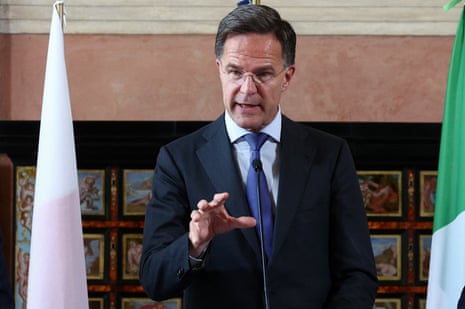
Nato secretary general Mark Rutte attends a joint press conference, on the day of a meeting to discuss the latest developments in Ukraine and security in Europe, at Villa Madama in Rome, Italy. Photograph: Guglielmo Mangiapane/Reuters
Speaking there, Nato secretary general Mark Rutte said Europe “needs to ramp up our defence spending,” noting the German chief of defence’s comments that Russia could be ready by 2029 or 2030 to test Nato’s resolve in defending its territory.
“We are safe now. We are not safe three to five years from now, so we have to spend more,” he said.
He also stressed Europe needed to increase its defence industrial production. “We need more shifts, more production lines,” he said.
On Ukraine, he said “we need to make sure Ukraine is in the best possible position to … maintain [its response] to the unprovoked Russian aggression,” and to negotiate a future peace deal so “Putin never tries this again.”
Updated at 09.22 EDT
Key events
-
2d ago
Closing summary
-
2d ago
European ministers ready to step up pressure on Russia’
-
2d ago
Time to put more pressure on Russia, Ukrainian minister says
-
3d ago
We need to put Ukraine in strongest possible position, EU diplomats say
-
3d ago
We’re safe now, but not in three-five years, Nato’s Rutte warns as he urges Europe to ramp up spending, production
-
3d ago
G7 summit this weekend about ‘aligning’ EU, US sanctions, maintaining aid to Ukraine, Germany says
-
3d ago
Denmark votes for defence bill giving US access to its airbases
-
3d ago
Russian attacks show with clarity that Putin is mocking Trump, Poland’s Sikorski says
-
3d ago
Italy needs ‘at least 10 years’ to raise defence spending in line with new Nato target
-
3d ago
Three dead after Russian attacks on Ukraine overnight
-
3d ago
Austrian authorities offer more detail on Graz attack
-
3d ago
Austrian police press conference about to start
-
3d ago
Investigation update expected in Austria
-
3d ago
Putin pays for ‘sick geopolitical fantasies’ with lives, Zelenskyy warns
-
3d ago
Ukraine is just first line of defence against Russia’s plans for aggression, Zelenskyy warns
-
3d ago
Morning opening: What’s Europe’s plan for Ukraine?
Please turn on JavaScript to use this feature
Closing summary

Jakub Krupa
… and on that note, it’s a wrap!
-
Nato secretary general Mark Rutte said Europe “needs to ramp up our defence spending,” noting the German chief of defence’s comments that Russia could be ready by 2029 or 2030 to test Nato’s resolve in defending its territory. “We are safe now. We are not safe three to five years from now, so we have to spend more,” he said (15:20).
-
Ukrainain president Volodymyr Zelenskyy criticised Russia’s Vladimir Putin for “willing to pay for their sick geopolitical fantasies” with the lives of over one million Russians killed in the war so far (10:27).
-
Polish foreign minister Radosław Sikorski said the continued Russian attacks show that “Vladimir Putin of Russia is mocking the peace efforts of president Donald Trump,” as he joined other European leaders in calls to ramp up defence spending (12:50).
-
But Italy’s foreign minister Antonio Tajani said his country needs “at least 10 years” to raise defence spending and comply with new targets to be agreed by Nato (12:46).
I will be back tomorrow with more updates from across Europe.
But for now, that’s all from me, Jakub Krupa, for today.
If you have any tips, comments or suggestions, email me at jakub.krupa@theguardian.com.
I am also on Bluesky at @jakubkrupa.bsky.social and on X at @jakubkrupa.
ShareEuropean ministers ready to step up pressure on Russia’
The ministers also adopted a statement at the end of their talks, saying they were ready to step up pressure on Russia, “including through further sanctions” involving the energy and banking sector, to weaken Moscow in its war with Ukraine, Reuters reported.
“We reiterated our readiness to step up our pressure on Russia as it continues to refuse serious and credible commitments, including through further sanctions and countering their circumvention,” the foreign ministers’ statement said.
“We are prepared to enhance our support, including through improving defence industrial cooperation with Ukraine, and exploring additional forms of security and defence cooperation,” the statement said, without elaborating.
ShareTime to put more pressure on Russia, Ukrainian minister says
Ukrainian foreign minister Andrii Sybiha largely repeated the same points from earlier intervention by the country’s president, Volodymyr Zelenskyy (10:27).
Ukraine’s foreign minister Andrii Sybiha attends a joint press conference, on the day of a meeting to discuss the latest developments in Ukraine and security in Europe, at Villa Madama in Rome, Italy. Photograph: Guglielmo Mangiapane/Reuters
He stressed that Russian losses in Ukraine have surpassed one million, and yet they “did not achieve any strategic goal.”
“Only pressure can force Russia to peace and neutralise the Russian threat to Ukraine and the rest of the world,” he said.
He noted that next week it will be 100 days since Ukraine agreed to the US proposal for unconditional ceasefire, and yet Russia continues to reject the plan.
“Diplomacy, appeasement do not work on Russia,” he warned, calling for “pressure diplomacy” and saying “only pressure can force Russia to seek peace.”
ShareWe need to put Ukraine in strongest possible position, EU diplomats say
Speaking at the same press conference, the EU’s diplomacy chief Kaja Kallas said the meeting showed “that our commitment to our defence is stronger than ever,” and “that means also stronger Europe,” as she lauded the EU’s €800bn Rearm program.
EU’s foreign policy chief Kaja Kallas and Ukraine’s foreign minister Andrii Sybiha attend a joint press conference, on the day of a meeting to discuss the latest developments in Ukraine and security in Europe, at Villa Madama in Rome, Italy. Photograph: Guglielmo Mangiapane/Reuters
“While Russia is dangerous, we all know that its behaviour is also predictable. This means that Russia responds to strength, and nothing else,” she said, talking about the latest, 18th, round of EU sanctions.
“Russia is bleeding cash, but we need to cut the flow of cash to Moscow’s army even further,” she said.
Poland’s foreign minister Radosław Sikorski stressed the need to “achieve firm commitments to boost our defence and security spending,” saying it was “key to increase the European allies’ engagment and strenghten the European pillar of our alliance.”
Poland’s foreign affairs minister Radosław Sikorski attends a joint press conference, on the day of a meeting to discuss the latest developments in Ukraine and security in Europe, at Villa Madama in Rome, Italy. Photograph: Guglielmo Mangiapane/Reuters
He spoke of the participating countries’ determination to further support Ukraine to enable it to “hold future peace negotiations from a position of strength.”
“Strategy of Putin’s regime remains unchanged and is based on feigning diplomatic efforts, escalating demands and launching barbarous attacks on Ukraine’s civilian population. These are classic Muscovite tactics and tricks, and we should not fall for them,” he said.
He added that “our unity and determination are instrumental in forcing Russia to end this horrible war.”
ShareWe’re safe now, but not in three-five years, Nato’s Rutte warns as he urges Europe to ramp up spending, production
Meanwhile in Rome, the leaders taking part in the Weimar+ meeting took part in a press conference summing up their talks.
Nato secretary general Mark Rutte attends a joint press conference, on the day of a meeting to discuss the latest developments in Ukraine and security in Europe, at Villa Madama in Rome, Italy. Photograph: Guglielmo Mangiapane/Reuters
Speaking there, Nato secretary general Mark Rutte said Europe “needs to ramp up our defence spending,” noting the German chief of defence’s comments that Russia could be ready by 2029 or 2030 to test Nato’s resolve in defending its territory.
“We are safe now. We are not safe three to five years from now, so we have to spend more,” he said.
He also stressed Europe needed to increase its defence industrial production. “We need more shifts, more production lines,” he said.
On Ukraine, he said “we need to make sure Ukraine is in the best possible position to … maintain [its response] to the unprovoked Russian aggression,” and to negotiate a future peace deal so “Putin never tries this again.”
Updated at 09.22 EDT
G7 summit this weekend about ‘aligning’ EU, US sanctions, maintaining aid to Ukraine, Germany says
On Ukraine, we are now hearing from the German government, ahead of the G7 summit starting this weekend.
A bus drives down Highway 40 that leads into Kananaskis Country, where the leaders of the G7 will meet from 15 June to 17 June, 2025 in Alberta, Canada. Photograph: Todd Korol/Reuters
An unnamed official told Reuters that there is no expectation that there will be a G7 statement on Ukraine.
They added that the summit “will be about the extent to which the EU, the US align on Russia sanctions.”
Managing the expectations, they added that “if we maintain status quo on US military aid to Ukraine at G7 summit, that is good.”
If you’re looking for the latest updates on the Air India flight to London Gatwick that crashed in Ahmedabad with more than 240 people onboard, here is our live blog:
ShareDenmark votes for defence bill giving US access to its airbases

Miranda Bryant
Denmark has voted overwhelmingly in favour of a new defence agreement giving the US sweeping powers on Danish soil, including “unhindered access” to its airbases.
Some politicians believe the new agreement could surrender Danish sovereignty and be a violation of the Danish constitution. Photograph: Philip Davali/AP
The deal, which has been strongly criticised by politicians and human rights experts, means US soldiers in Denmark will remain under US jurisdiction.
It gives US soldiers access to Danish airbases in three Danish cities – Karup, Skrydstrup and Aalborg – and grants American soldiers and military police powers over Danish civilians at these locations and outside them.
If US soldiers were to commit a crime in Denmark, they would be punished under the US, not Danish, legal system in the first instance.
The US will also be able to carry out military activities in and from Denmark – including stationing personnel, storing military material and equipment, maintenance, training and exercise activities.
Despite heightened tensions between the US and Denmark amid Donald Trump’s unprecedented push to acquire Greenland – a strategically vital part of the Danish kingdom – and reports US intelligence agencies were ordered to increase espionage in the territory, a broad majority of the Danish parliament (Folketinget) voted in support of adopting the agreement.
A total of 94 MPs voted for the bill and 11 against.
Updated at 07.24 EDT
Jakub Krupa
Speaking of defence and security in Europe, let’s go to Denmark for an update on their recent decision in this area.
Updated at 07.23 EDT
Nato secretary general Mark Rutte was also asked about the new 5% (well, 3.5% + 1.5%) Nato target for defence spending to GDP.
He said he communicated the intention, but not “anything about an end date” when countries should meet this new obligation by, and this will be discussed by the leaders at the summit in The Hague.
“I am pretty confident … that we will get to a joint position,” he said.
ShareRussian attacks show with clarity that Putin is mocking Trump, Poland’s Sikorski says
Arriving for talks in Rome, Polish foreign minister Radosław Sikorski said the continued Russian attacks show that “Vladimir Putin of Russia is mocking the peace efforts of president Donald Trump.”
He also stressed that Europe is stepping up its plans for defence, with increased spending.
Talking about the meeting ahead, he said leaders needed to “strategise about what to do to help Ukraine defend itself against this Russian onslaught,” he said.
He said he was particularly concerned about the Russian shadow fleet of ships “that carry huge amount of oil under exotic flags of convenience or no flag at all” and “pose a material danger to a shallow, closed sea like the Baltic.”