
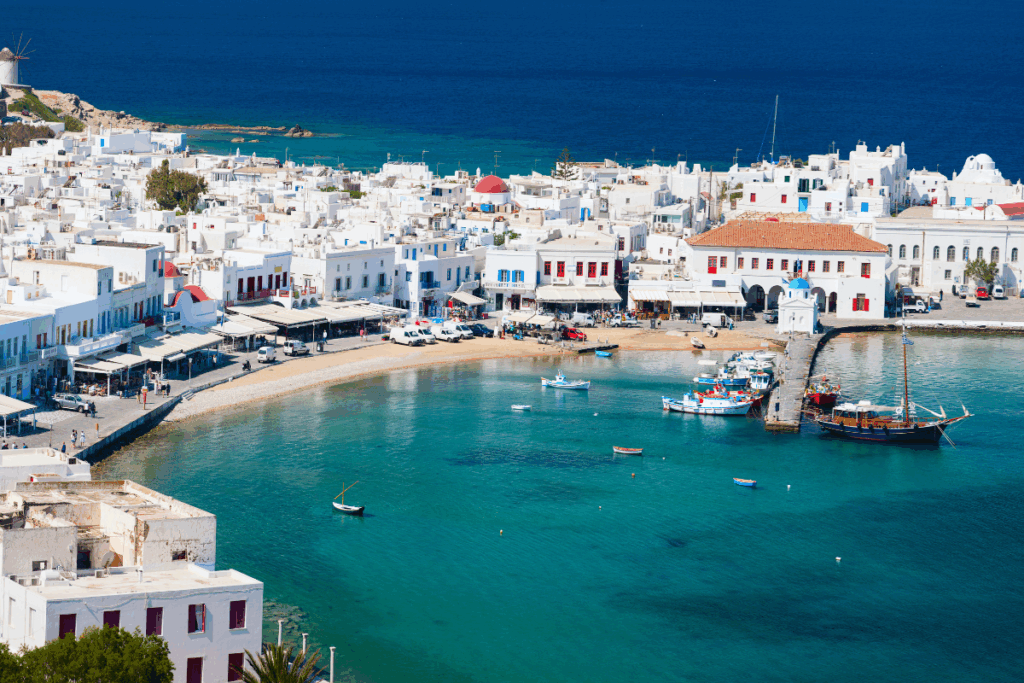
Greece’s islands are once again at the centre of a maritime standoff with Turkey. Credit: blueorangestudio via Canva.com
On 17 June 2025, Turkey handed a newly drawn maritime map to UNESCO, one that boldly redraws much of the Aegean. While presented as a spatial submission, it touches a deeper nerve — reopening long-standing arguments over who really governs these waters.
For Greece, it’s personal. It is signalling a revival of Ankara’s long-standing maritime ambitions that directly contests Greece’s own Marine spatial plan, which was filed weeks earlier. What’s at stake currently is not just the nautical lines within, but the legal precedent, access to underwater resources, and control over one of Europe’s most contested bodies of water.
Most Read on Euro Weekly News
Legal clash- UNCLOS vs Turkish doctrine
At the heart of this dispute lies one question: do Islands have full maritime rights? Greece sees this as a clear-cut issue. According to UNCLOS, the UN’s maritime treaty, islands are entitled to their own exclusive economic zones (EEZs). Greece’s entire maritime stance — from the Aegean to the Eastern Med — rests on that rule.
- That principle alone is the backbone of Greece’s maritime claims in the Aegean, as well as in the Eastern Mediterranean.
- Turkey isn’t a signatory to UNCLOS, and it’s built now on an entirely different case. They argue that uninhabited or small Greek Islands that are close to the Turkish Mainland should not generate wide-reaching Exclusive Economic Zones (EEZs).
- Instead, it should promote a median line approach that will significantly reduce Greece’s reach while boosting its own.
This legal split is what makes the new maritime map explosive. It’s a deliberate counter to Athens’ submission filed weeks ago. And the lines are different because the legal worldview is different. Until both sides agree on the rules of the sea, every map will become a battleground.
Regional diplomacy and rising tensions
It’s not the first time that the lines in that Aegean have turned political. Looking back from the Imia crisis in 1996 to the Turkey–Libya maritime deal in 2019, the sea borders have repeatedly dragged both Greece and Turkey to the edge.
Every time it escalates in these steps:
- Paperwork.
- Added patrols.
- Airspace violations.
- Competing naval exercises.
- Talks brokered by Brussels or Washington.
This time, the map has arrived at UNESCO, and Athens is expected to respond diplomatically with a possible escalation taking this matter to the UN or the EU Foreign Affairs Council.
- Publicly, the Greek officials have called the Turkish map provocative, with some media outlets comparing it to past attempts at territorial revisionism.
- Turkey has framed the move as a matter of fairness and maritime equity.
- The officials in Ankara have insisted that it is in Greece’s favour to maintain the current borders and boundaries in this proportion.
- Their claims are part of restoring that regional balance.
For NATO, it’s a familiar headache. There are two member states, both essential to Black Sea security and Eastern Mediterranean stability, that are currently embroiled in a dispute that even diplomacy will likely delay and never fully resolve.
Energy exploration at stake
The Aegean and Eastern Mediterranean are home to potential reserves of undersea minerals and natural gases. In recent years, Greece has aligned its marine conservation zones, such as the South Aegean Marine Park, with EU energy and environmental goals, as well as its claim to manage the waters sustainably.
Turkey’s new map cuts directly through those zones and reasserts Ankara’s right to explore and drill in areas that were previously considered under Greek control.
The timing comes at a crucial point, with gas exploration in the Eastern Mediterranean slowing down and energy prices being volatile; control over these waters matters more than ever.
However, with rival maps on file and no shared maritime agreement, any future discovery can reignite a far more dangerous confrontation between the two sides.
The Aegean tensions are redrawn, not resolved.
Maps like the one that is proposed will not settle arguments; they will reframe them. Turkey’s UNESCO filing may not trigger immediate conflict, but it will shift the diplomatic ground. It will force Greece to respond and pull NATO back into the middle, reopening conversations again.
In a region where history, identity, and politics intersect in every wave, and the island redraws those borders even symbolically, taking a neutral standpoint is never seen as a viable option. The question now is whether this is a slow climb towards confrontation in the Aegean, as the lines are blurring easily and it’s not always clear which side of the map the future will land on.