
![[OC] Religious Believes and Eductions From The World Values Survey](https://www.byteseu.com/wp-content/uploads/2025/06/c0kl6ubkbo7f1-1024x683.png "[OC] Religious Believes and Eductions From The World Values Survey")
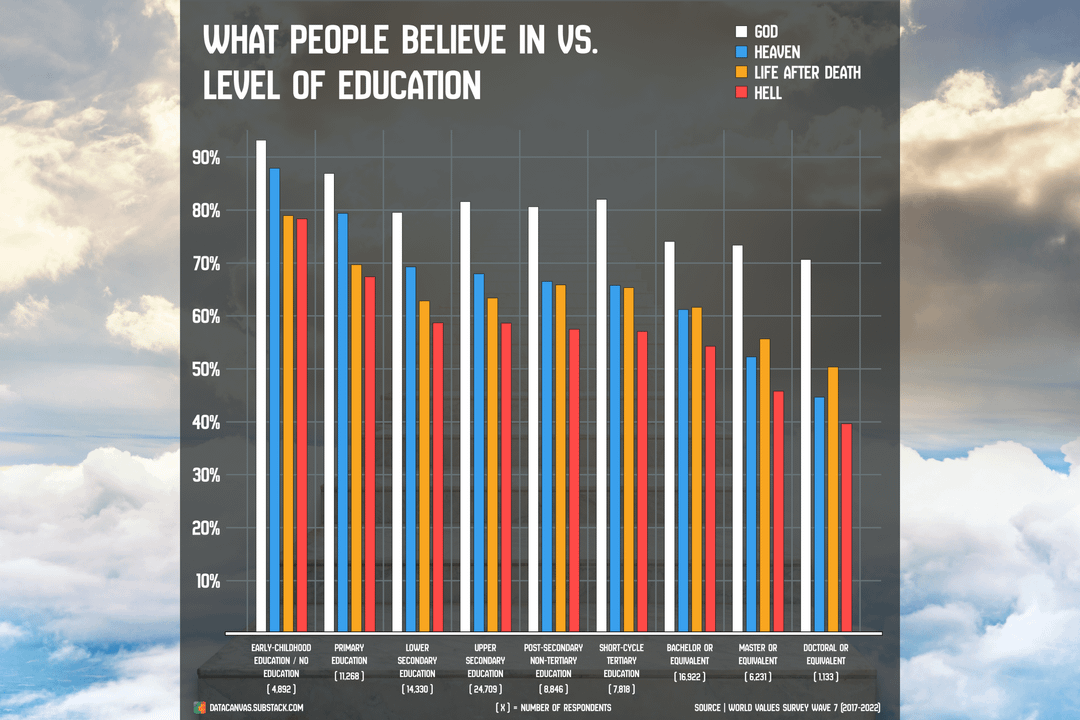
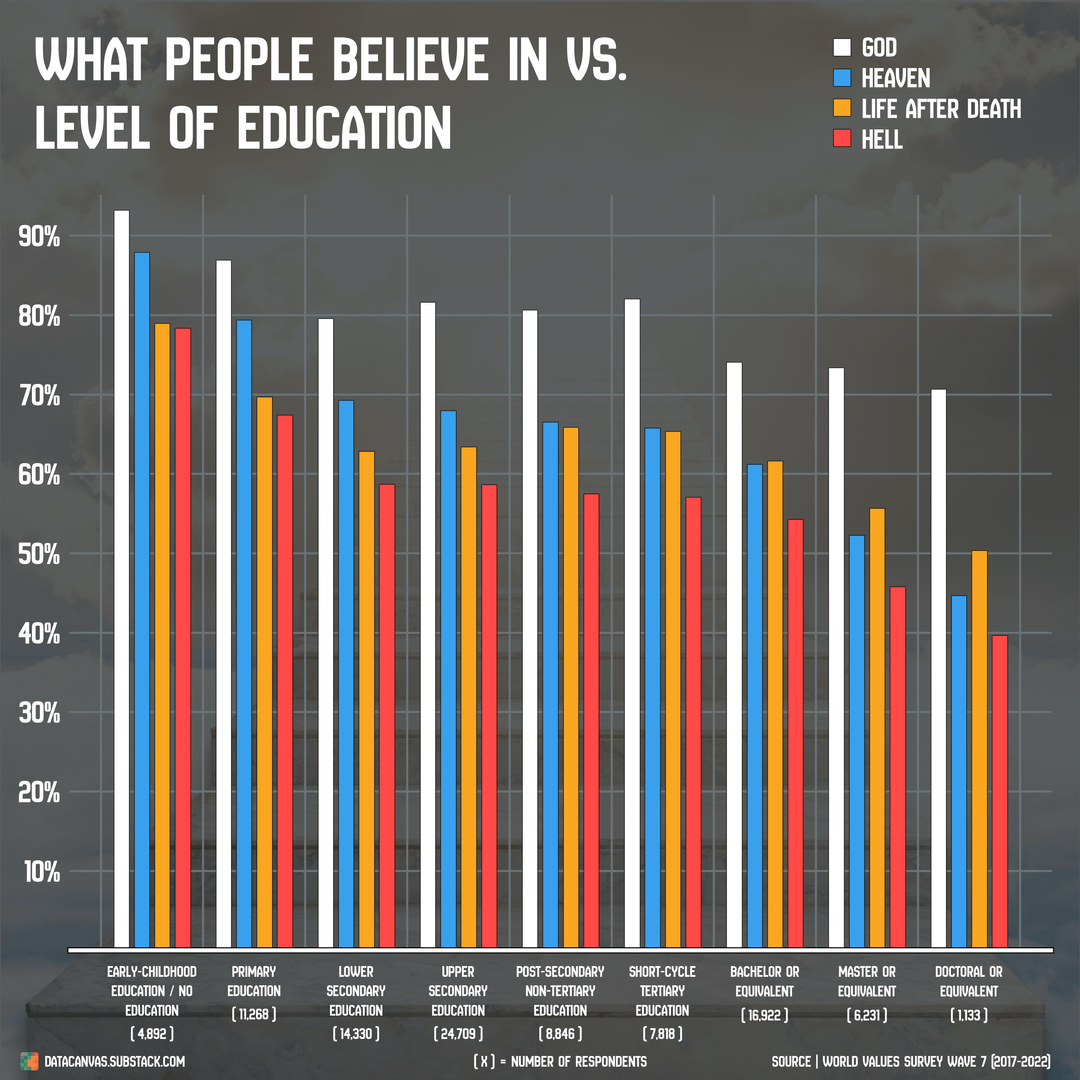
Data source: World Values Survey Wave 7 (2017-2022)
Tools used: Matplotlib
I added a second chart for those of you who prefer a square version with less of the background image.
Notes:
I looked at five different questions in the survey.
- Q275 – What is the highest educational level that you have attained?
- Q165 – Do you believe in God? (Yes/No)
- Q166 – Do you believe in Life after death? (Yes/No)
- Q167 – Do you believe in Hell? (Yes/No)
- Q168 – Do you believe in Heaven? (Yes/No)
The chart show the percentage of people that answer yes, to Q165-168 based on their answer to Q275.
Survey data is complex since people come from different cultures and might interpret questions differently.
You can never trust the individual numbers, such as "50% of people with doctors degree believe in Life after death".
But you can often trust clear patterns that appear through the noise. The takeaway from this chart is that the survey show that education and religious believes have a negative correlation.
Styling:
- Font – New Amsterdam
- White – #FFFFFF
- Blue – #39A0ED
- Yellow – #F9A620
- Red – #FF4A47
Original story: https://datacanvas.substack.com/p/believes-vs-education
Posted by oscarleo0
11 Comments
I’m surprised to see the amount of people who are actually able to accept the part of the story that they like and reject the part they don’t like.
The education effect is a lot milder than I thought.
How can you believe in heaven but not believe in life after death? 🤔
Having a hard time believing the number of doctoral level people who believe in God, heaven, hell, etc
Do you know how the question “Do you believe in God?” has been asked in different languages? In some languages the capitalized G implies a specific god, but in others there might not be such a subtle distinction.
“I know education is good because it reduces religious belief, especially Christian-coded religious belief”
This comes across as equally intelligent with statements like “i know the Bible is the word of God because it says so in the Bible”
A religious god and science don’t mix but a non intervening god and science do.. the latter is much more beautiful.
I highly doubt the correctness of these results. I believe the number of atheists should be way higher, especially among higher educated people.
Also, even if the results were correct you also need to factor in the possibility that atheists maybe are less likely to even participate in such surveys.
Keep in mind that interpretation of religious or spiritual beliefs can be very different from one person to another.
For example, some like may do believe in God but they don’t believe in him the way devout religionists do. Some believe that God is some sort of cosmic intelligence that run the universe. They may also believe that he never interfere directly in the affairs of men. That means no miracles or otherwise although it’s still possible for communication with him. Basically, a worldview that is in accordance with the laws of nature. I subscribe to this worldview as well.
As for heaven and hell, there are also many who believe that they weren’t created yet as there’s no evidence for their existence but will be at the end of time. I favour this worldview, too although I have my doubts.
I suppose educated persons also tend to agree with such worldviews as they don’t contradict the laws of nature. Beliefs about God, heaven, and hell vary a lot and aren’t the same across population. It’s very complex.
I think the presentation is awkward.
Instead of buckets by level of education, and bars for beliefs I think this is much clearer if you have buckets for beliefs and bars for education, which you’ll then be able to color gradient for additional visual context (e.g. darker bars = more education).
Based on the title, I can hypothesize where OP falls on the education scale.
Given that proofreading is a sign of intelligence