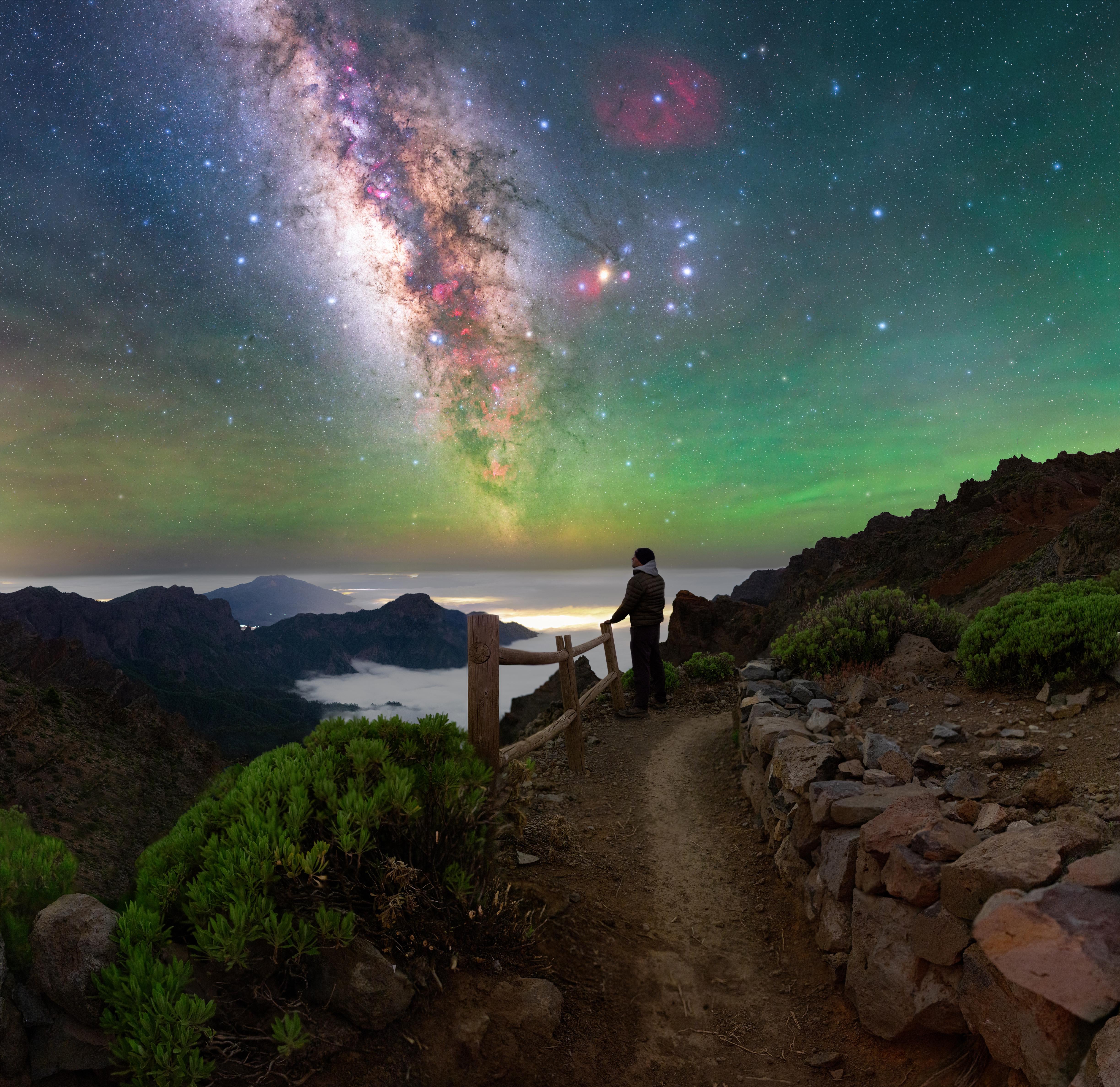
I captured this glowing Milky Way and vivid airglow over La Palma during a sleepless night under the stars
https://i.redd.it/g05xbiewwh8f1.jpeg

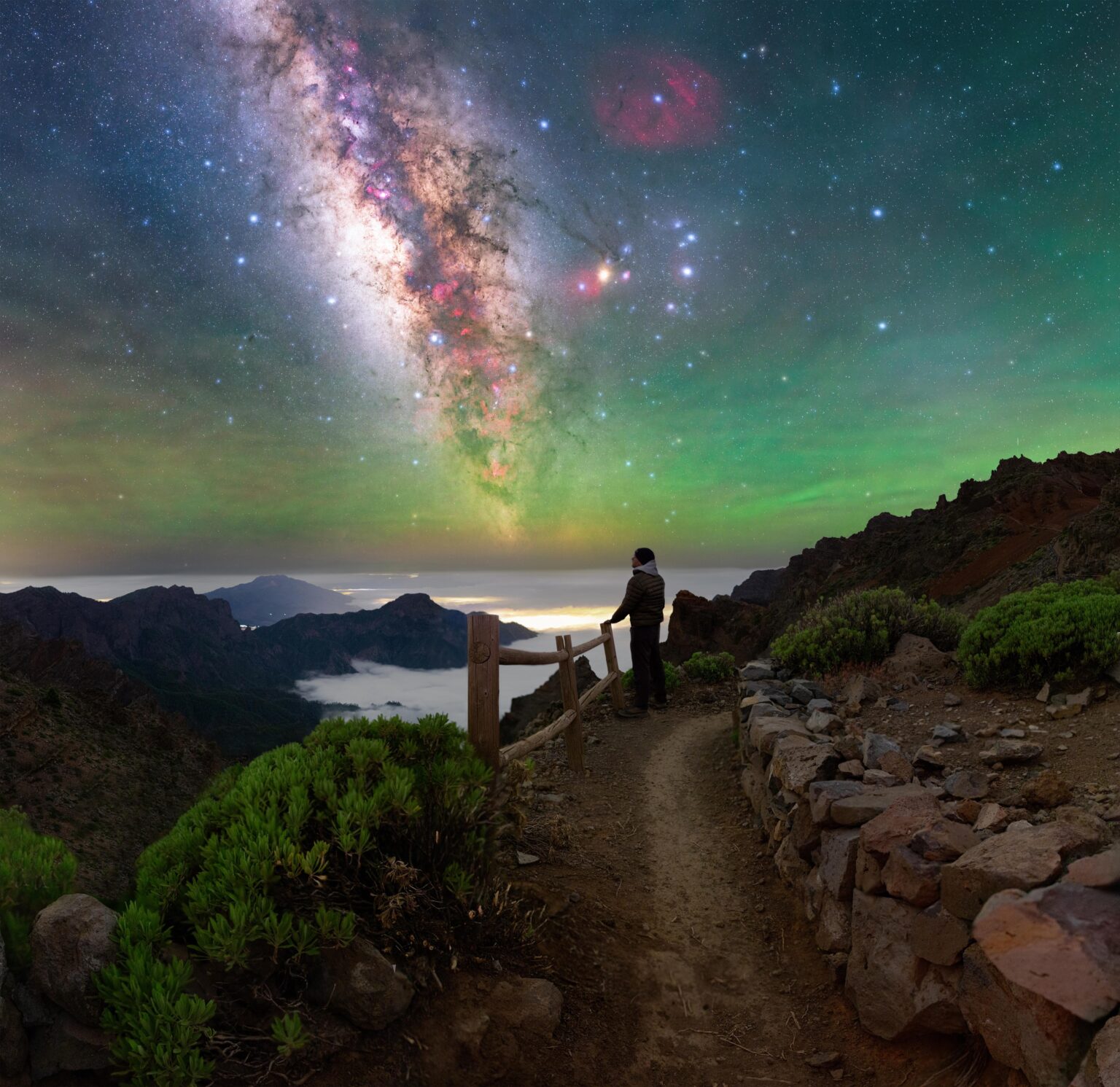
I captured this glowing Milky Way and vivid airglow over La Palma during a sleepless night under the stars
https://i.redd.it/g05xbiewwh8f1.jpeg
3 Comments
What a joy to return to the Canary Islands, on the island of La Palma, which truly deserves its reputation as one of the best night skies in the world!
If you’re interested, you can find more of my work on [Instagram](https://www.instagram.com/tinmar_g/)
This photo was taken near the Mirador de Los Andenes. I had spotted this little fence during a daytime scouting mission. It might not be obvious in the photo, but this path runs along the edge of a cliff beyond it, there’s nothing but a drop, which makes the location even more breathtaking.
The greenish glow you can see in the image is airglow, a natural phenomenon caused by chemical reactions in the upper atmosphere that create a faint light at night. Although this phenomenon occurs regularly here thanks to the quality of the sky, that night it was particularly strong!
For this shot, I wanted to capture the core of the Milky Way standing vertically. That meant waiting until it rose around 4–5 a.m. At that time, tired and sitting alone on a rock at the top of the island, with the lights of the towns 2,300 meters below, you stop thinking too much. You’re just… at peace.
On this trip, I finally got to try out some new photography techniques I’d been excited to experiment with! I used a Star Glow filter (which gives stars that sparkling effect), and an Hα filter (to reveal red nebulae). Each filter required an additional shot, so for each tile of the panorama, I captured a regular photo, an Hα photo, and one with the glow filter. I was really afraid all that effort would be for nothing but in the end, I’m so happy with how it turned out.
The final image is a panorama taken at 50mm, made up of 20 photos for the sky and 22 for the foreground.
For the foreground, I used the focus stacking technique to ensure sharpness across all planes and avoid a blurry foreground. The result wasn’t perfect, but I’m still really pleased with it.
**Note**: This image is the result of long exposures and specific techniques. While the Milky Way is indeed visible to the naked eye from La Palma, it appears with fewer details and without the colors captured in this photo.
**Sky**: f/1.8 – 45 sec – ISO 2500
**Foreground**: f/4 – 30 sec – ISO 3200
*Canon 6D (astro-modded) – Skywatcher Star Adventurer – Sigma ART 50mm*
Great work! 50mm for an ultrawide panorama must have been a lot of work to plan and execute. Did u serpentine your way across the sky frames? I always have problems with the shifting of the sky across the horizon with time, leading to problems in aligning and stitching later.
This is… awesome, in the original sense. Wow.
I don’t know much about space or the atmosphere, so if the green layer is the “airglow”, then are we seeing… clouds right under it? I see what must be some fog below it, so are all of the “clouds” actually just fog? Finally, is the light in them the lights from the town?
Thanks!