
From reproductive rights to climate change to Big Tech, The Independent is on the ground when the story is developing. Whether it’s investigating the financials of Elon Musk’s pro-Trump PAC or producing our latest documentary, ‘The A Word’, which shines a light on the American women fighting for reproductive rights, we know how important it is to parse out the facts from the messaging.
At such a critical moment in US history, we need reporters on the ground. Your donation allows us to keep sending journalists to speak to both sides of the story.
The Independent is trusted by Americans across the entire political spectrum. And unlike many other quality news outlets, we choose not to lock Americans out of our reporting and analysis with paywalls. We believe quality journalism should be available to everyone, paid for by those who can afford it.
Your support makes all the difference.
Read more
A long-dead experimental Nasa satellite suddenly emitted a powerful energy blast recently, leaving scientists perplexed.
Astronomers at Australia’s Curtin University discovered the strange pulse from the satellite, dead in space since the late 1960s, after recording a signal that briefly outshone everything else in the night sky.
At first, they thought it was coming from a pulsar or another undiscovered cosmic object. But an analysis revealed the origin of the signal was too close to the Earth.
“The 4,500km distance to the burst suggests an Earth satellite as the origin,” they concluded in a yet-to-be peer-reviewed study.
The “incredibly powerful” energy blast could have been generated by the satellite colliding with a small meteoroid or a piece of space junk.
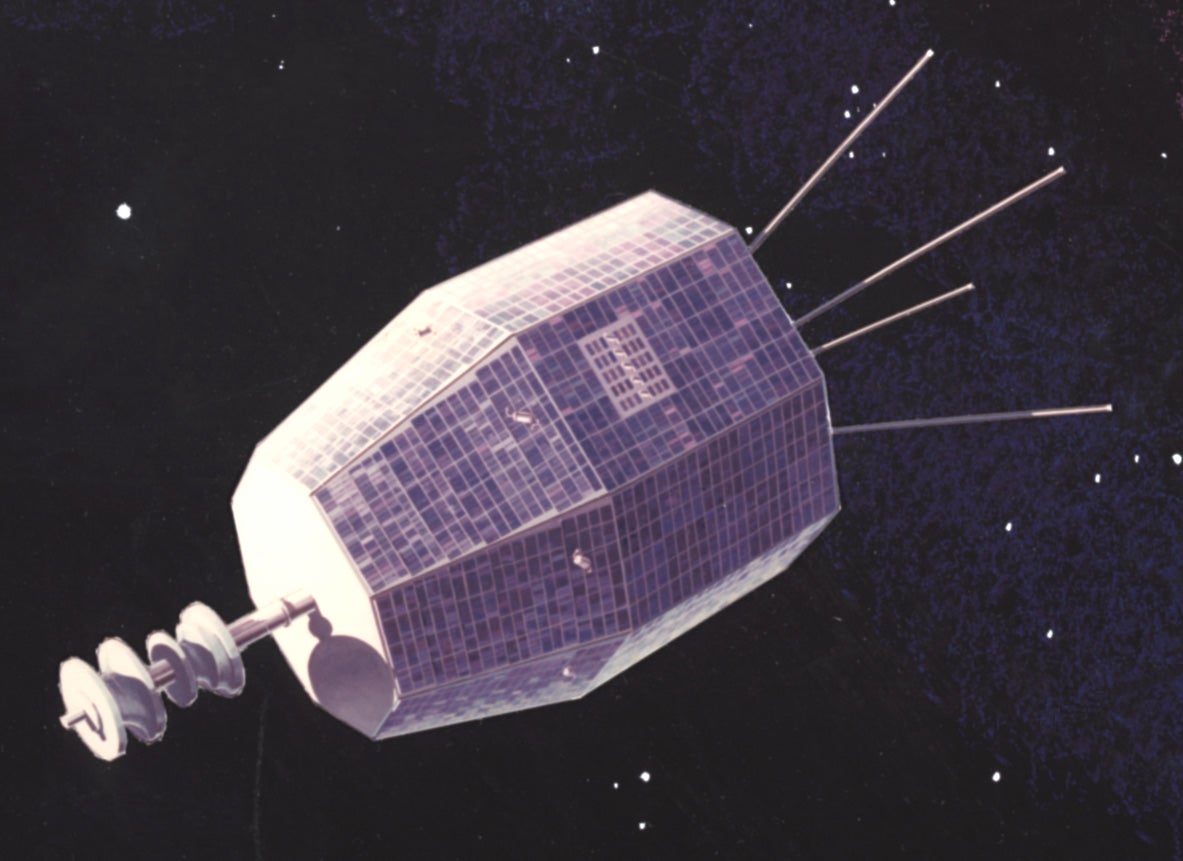
Nasa Relay 2 (Nasa)
The astronomers eventually traced the source of the pulse to Nasa‘s Relay 2, an experimental satellite that was launched in 1964 and went dead three years later.
They said electricity likely building up inside the craft for decades sparked an “electrostatic discharge” when it collided with another object.
“We consider an electrostatic discharge or plasma discharge following a micrometeoroid impact to be plausible explanations for the burst,” they wrote in the study.
Such charging of spacecraft from interactions with their space environment is well documented. It happens due to the accumulation of electrons and charged particles within spacecraft, leading to large voltage differentials between their surfaces and between the craft and space. “Spacecraft primarily charge through the accumulation of electrons through interactions with plasma in the space environment,” they explained. “When sufficient voltage is achieved, electrostatic discharge occurs, typically between nearby surfaces/materials on the spacecraft.”
Energy released from such charged space probes was thought to last at least several microseconds. In the latest discovery, however, the high-energy discharge was sharp, lasting only a billionth of a second.
“We suggest that the burst originated from an electrostatic discharge event, or potentially a micrometeoroid impact, and consider that such events may be relatively common,” the astronomers concluded.
They hoped future space probes and sky monitoring equipment could be “appropriately retrofitted” to better detect such energy discharge events.