
![[OC] Map showing tanker traffic through the Persian Gulf and Strait of Hormuz](https://www.byteseu.com/wp-content/uploads/2025/06/fk3w8r2hcp8f1-1536x1299.png "[OC] Map showing tanker traffic through the Persian Gulf and Strait of Hormuz")
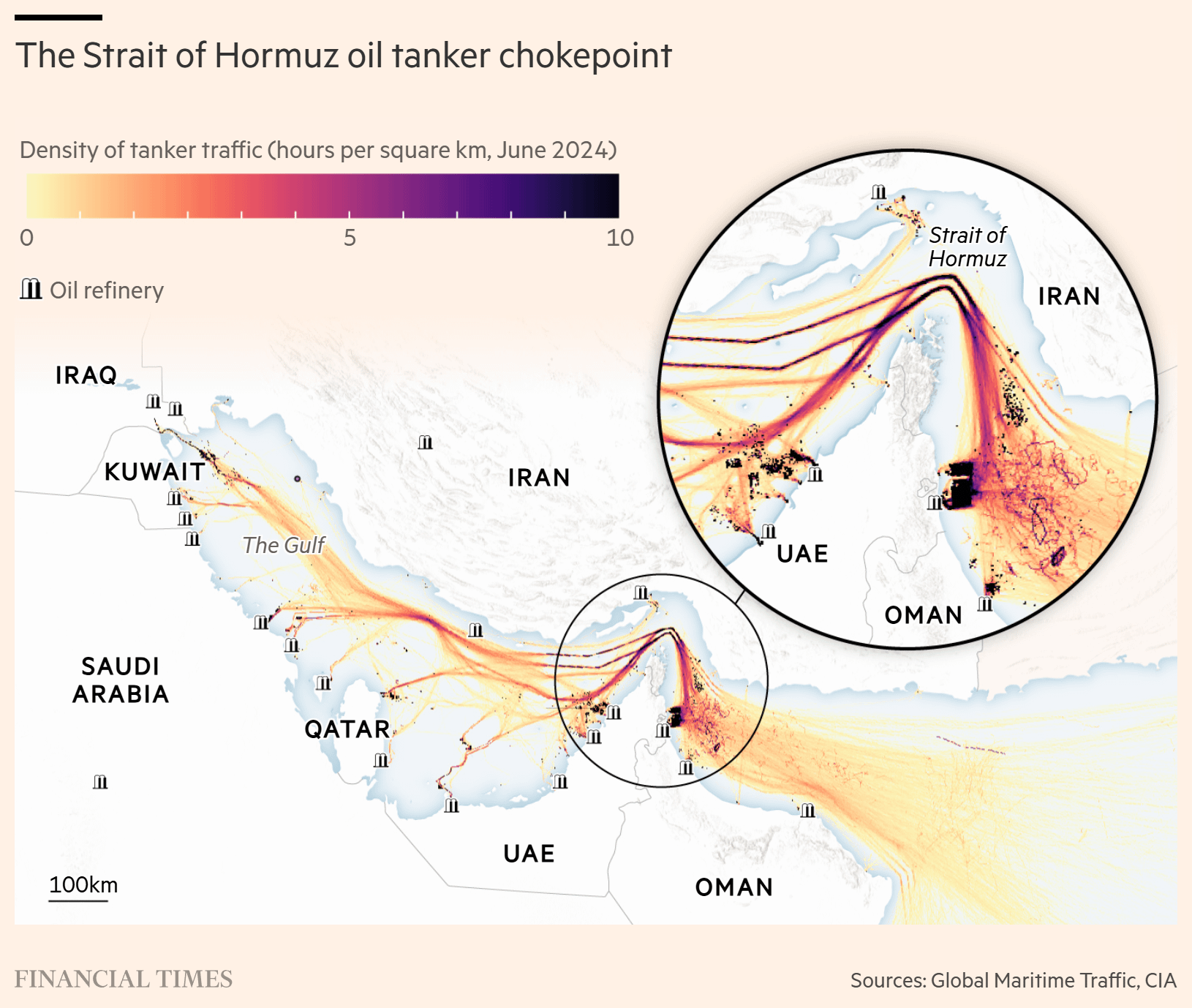
Will Iran use the Strait of Hormuz and disrupt the world's oil supply?
This map with data from Global Maritime Traffic shows just how busy the Strait of Hormuz is and how much of a chokepoint it is
Read our Military Briefing on whether Iran will start a new ‘tanker war’ (first 300 visits)
Posted by sdbernard
7 Comments
Interesting how Iran doesn’t have any ports east of the straight either.
They’re going to shoot themselves in the foot to do basically nothing to the US and Israel?
The U.S. is energy-independent, relying primarily on domestic production and imports from Canada and Latin America. Only a small portion (~0.5 million barrels per day) comes via Hormuz.
However, all the oil in the US is priced according to the global market price, and this could remove over 20 million barrels per day of oil from the global supply, which will likely spike prices and create shortages.
Ultimately the US would not be affected by the straits closing nearly as much as it would have been 20 years ago. And Israel would not be effected at all. In fact, it would most heavily hurt China, Saudi Arabia, and Qatar. Iran really can’t meaningfully respond to the US now, especially with the axis of resistance dead and Israel having destroyed so much of their assets.
Hence the symbolic token missile barrage that they coordinated with Trump on, then the “we accept a ceasefire”.
Instead of building all those silly buildings. The Arabs should build a pipeline so they don’t need to use the straits of Hormuz
The Financial Times has absolutely the best data visualisations of any publication I’ve found.
It’s beautiful, but I don’t get it. Hours per square km? WTF? The original article doesn’t explain it either.
Bernoulli would like to have a talk.