
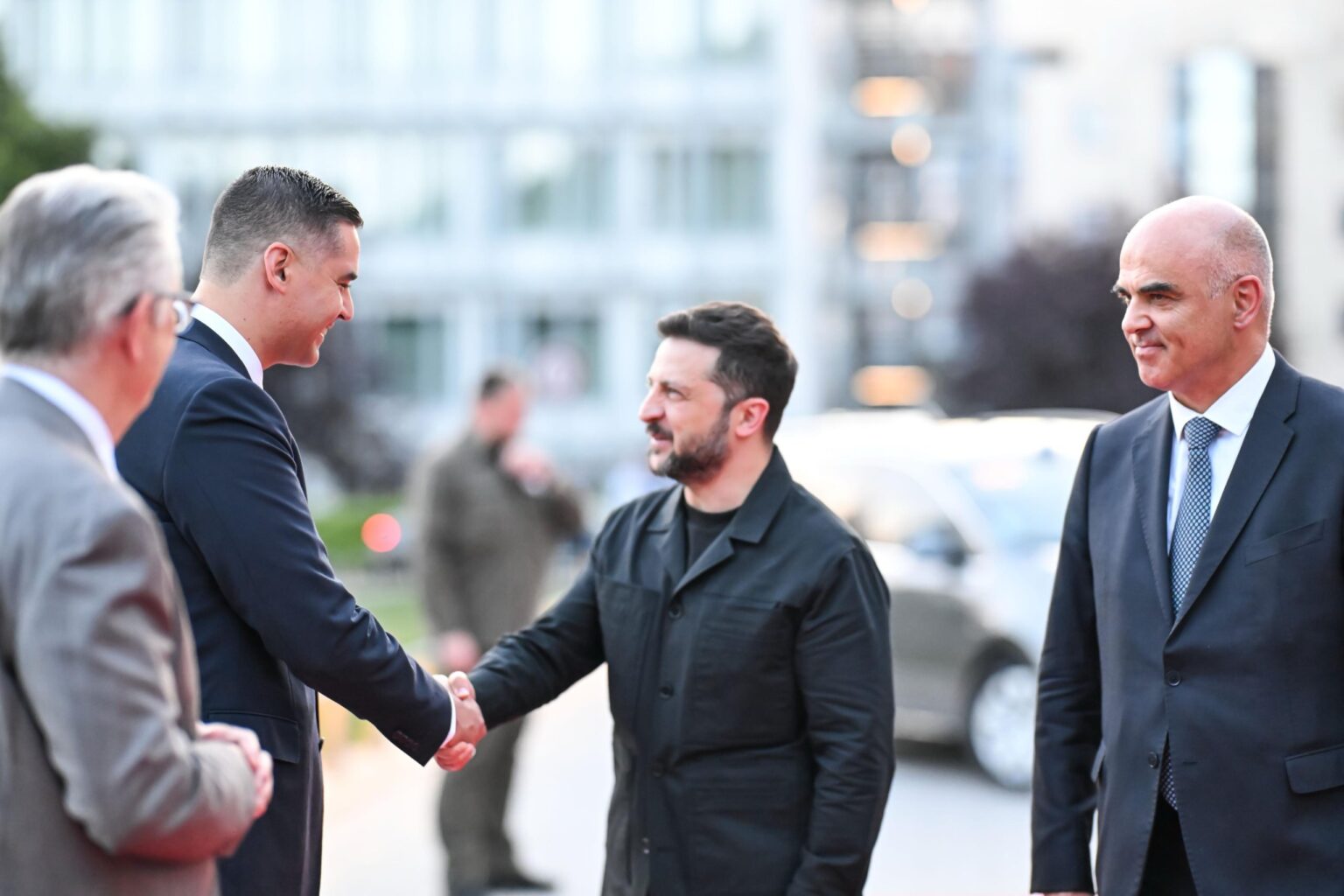
 Ian Borg (left) with Ukrainian president Volodymyr Zelenskyy (centre) and Council of Europe secretary-general Alain Berset in Strasbourg – Photo: ODPM-MFT
Ian Borg presided over the historic signing of an agreement establishing a Special Tribunal for the Crime of Aggression against Ukraine on Wednesday evening, marking a significant milestone in Malta’s current presidency of the Council of Europe.
Malta’s foreign minster, serving as President of the Council of Europe’s Committee of Ministers, chaired the ceremony in Strasbourg where Ukrainian president Volodymyr Zelenskyy and Council of Europe secretary-general Alain Berset signed the bilateral agreement creating the first dedicated international tribunal to address the crime of aggression.
“I am deeply honoured that this step is being taken under Malta’s Presidency,” Borg said, emphasising Malta’s commitment to international justice. “Following our recent tenure at the United Nations Security Council and the OSCE, as well as the hosting of the Ukraine Peace Formula talks in 2023, Malta is once again putting Ukraine at the top of its multilateral agenda.”
The agreement’s signing came after Borg chaired an extraordinary session of the Committee of Ministers on Tuesday, which approved the bilateral agreement by an overwhelming majority.
Borg highlighted the tribunal’s significance in addressing one of international law’s gravest violations. “This Tribunal will confront one of the gravest violations of international law: the crime of aggression. And it will do so by ensuring that those who wield power are not shielded by it. They will be held to account – not through retaliation, but through law.”
The Special Tribunal will prosecute senior political and military leaders responsible for the crime of aggression against Ukraine, defined as the decision to use armed force against another state in violation of the UN Charter. Unlike the International Criminal Court, which handles war crimes, crimes against humanity, and genocide, this tribunal will specifically address the leadership crime of launching or planning a war.
Secretary-general Berset described the development as groundbreaking, stating: “For the first time, a dedicated international tribunal is being created to address the crime of aggression. Established within the framework of the Council of Europe, this tribunal will hold to account those who have used force in violation of the UN Charter.”
The tribunal creation follows three years of complex legal and diplomatic negotiations led by a Core Group of nearly 40 states, chaired by Ukrainian Ambassador-at-large Anton Korynevych. The initiative gained momentum after the Parliamentary Assembly of the Council of Europe became the first international body to call for such a tribunal in April 2022, just two months after Russia’s full-scale invasion.
Malta’s role in the process reflects its broader commitment to Ukraine’s cause. Under the Maltese presidency, the Council of Europe will focus on operationalising the tribunal and supporting Ukraine through coordinated multilateral initiatives, including establishing a Claims Commission and Compensation Fund.
The tribunal will complement existing international justice mechanisms, including the Council of Europe’s Register of Damage, which has already received over 34,000 claims from Ukraine. The European Court of Human Rights continues to be the only international court adjudicating human rights violations in the context of Russia’s war against Ukraine.
The agreement establishes an Enlarged Partial Agreement enabling a wide range of parties – including Council of Europe members and non-members, as well as the European Union – to support and help manage the tribunal. The tribunal will be financed by participating states and will follow internationally recognised standards of due process and rule of law.
While the tribunal faces practical challenges, including obtaining custody of potential defendants and issues of immunity for sitting heads of state, it can conduct investigations, gather evidence, and prepare indictments. Trials in absentia will be possible under certain circumstances, with appropriate procedural safeguards.

