
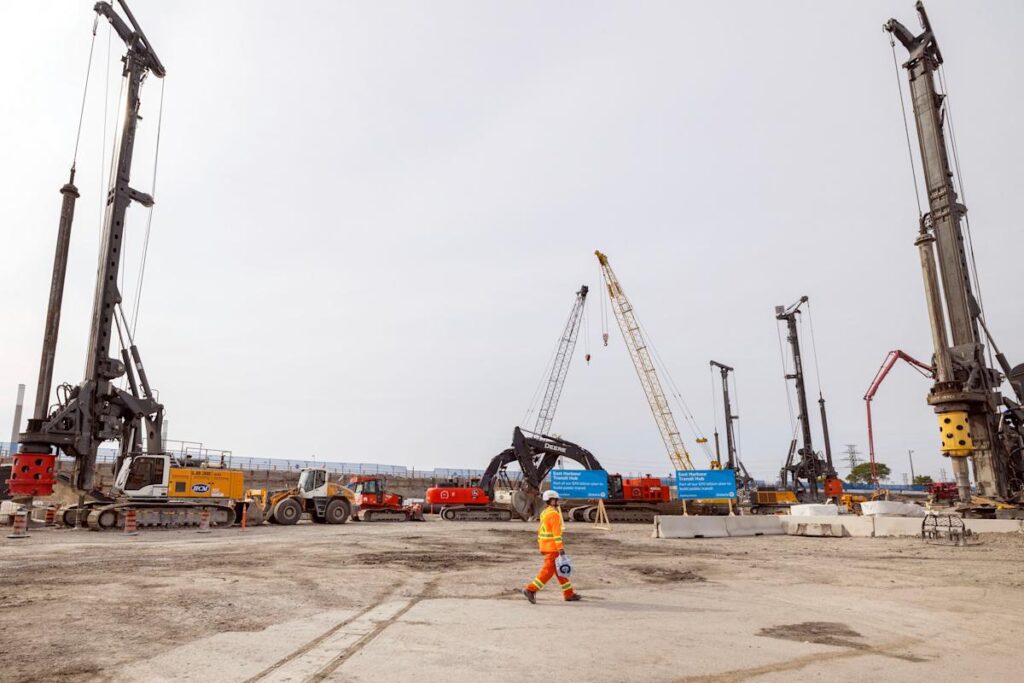

Construction begins on the East Harbour Transit Hub in Toronto. (Andrew Francis Wallace/Toronto Star via Getty Images) · Andrew Francis Wallace via Getty Images
Canada’s economy shrank 0.1 per cent on a monthly basis in April, Statistics Canada said on Friday, a slower pace than analysts had expected. The contraction was largely the result of broad-based weakness in the manufacturing sector during a month characterized by heightened trade tensions with the U.S.
Economists had estimated Canadian real gross domestic product (GDP) would remain unchanged from March, according to consensus estimates published by BMO Economics. Statistics Canada’s flash estimate for April, published at the end of May, was for growth of 0.1 per cent.
Although the data fell short of muted forecasts and underlined the ongoing pressure on Canada’s economy, economists mostly agreed that it was likely not decisive enough to spur an interest rate move by the Bank of Canada (BoC).
“The resilience that the Canadian economy was previously showing in the face of U.S. tariffs and related uncertainty appears to be fading,” CIBC economist Andrew Grantham wrote in a note following the data release.
Grantham assessed the April decline as “only marginal,” and wrote that “the economy is certainly not falling off a cliff,” but appears headed for a 0.3 per cent contraction in the second quarter. Although an interest rate cut from the BoC at the end of July remains possible, Grantham wrote, “upcoming employment and inflation data will be more important in determining whether policymakers feel comfortable making a move at that time.”
Douglas Porter, chief economist at the Bank of Montreal, writes that GDP for the second quarter may be down 0.5 per cent from the year before, and could see a similar contraction in the third quarter. This, he says, is “certainly not good news, but also a less dire outcome than expected a few months back at the height of the tariff drama.”
BMO’s second-quarter expectations put GDP in between the BoC’s more optimistic 0.0 per cent and more pessimistic -1.3 per cent outlined in April, Porter notes. “We suspect that the underlying softness in growth and employment will eventually pave the way for additional rate relief,” he wrote, but higher core inflation figures might prevent a rate cut in the short term.
Statistics Canada’s flash estimate for May forecasts another 0.1 per cent monthly drop in GDP, with preliminary data showing slowdowns in mining, quarrying, and oil and gas extraction, public administration and retail trade. Friday’s numbers come after data on Tuesday showed inflation remaining flat from the previous month at 1.7 per cent annualized.
Story Continues