
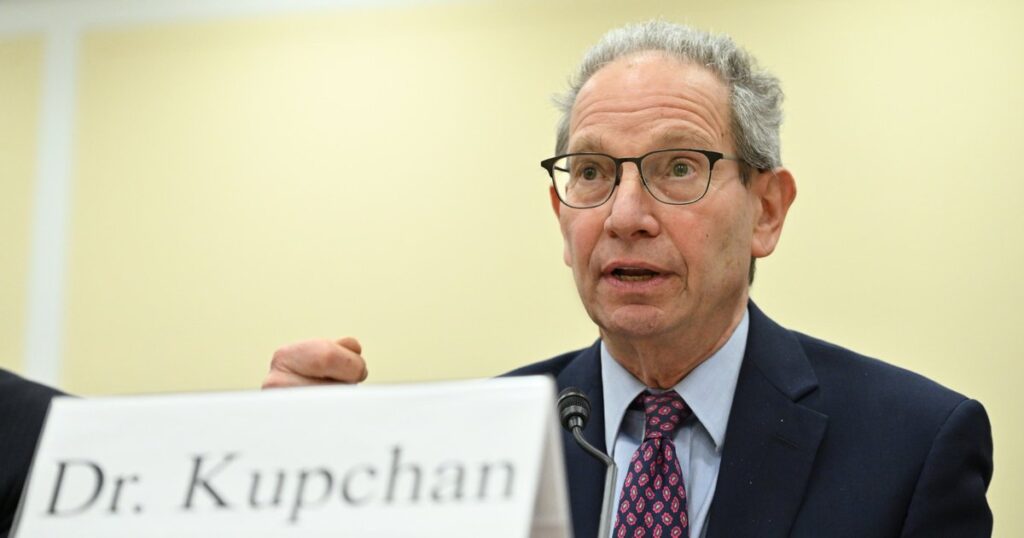
Kupchan: US will re-engage in Kosovo-Serbia dialogue, Trump will bring leaders of both countries to the Oval Office

Express newspaper
29/06/2025 7:56
In the coming months, there may be a re-engagement of the United States on the issue of the Kosovo-Serbia dialogue and a meeting at the Oval Office of the leaders of the two countries. This was warned by Charles Kupchan Charles Kupchan, from the Council on Foreign Relations in the US.
The former advisor to former US President Barack Obama spoke about what could happen in the Balkans but also in the global arena.
“In his first term, he made progress in relations between Kosovo and Serbia and the recognition of Israel. Europe should think about leading this process. For its own security and for the US to be freer to stay in the Indo-Pacific. In the next 6-8 months, you will see a reduction in the military presence in Europe. I think you will also see a re-engagement of Washington in the Kosovo-Serbia dialogue and Trump to bring the leaders of the two countries to the Oval Office, Trump sees himself as a peacemaker.”, he said on “Off the Record” on A2 CNN.
Kupchan expressed confidence in achieving the difficult and painful compromise, as he described it – of peace between the two countries.
“We still have on the table a perspective that offers light at the end of the tunnel and it is the agreement that the EU negotiators and the parties agreed to although they did not sign it. But so far we are in a difficult position without political stability in Belgrade and the same in Pristina. I think that a day will come and not too far in time for both countries to make the difficult and painful compromise to achieve peace. Kurti has made some mistakes during his mandate, that he has taken actions although they are consistent with Kosovo’s right to sovereignty, they were provocative and took steps back in the dialogue. But it is not Kosovo’s responsibility that the party that has dragged its feet is Serbia, but Belgrade and Pristina must make the difficult compromise”, he said.
Kupchan expressed optimism about the integration of the Balkans into NATO and the EU and does not see the return of large-scale conflicts.
“We still have a lot of work to do in the Balkans. Pristina has undergone great development, but relations with Serbia remain weak. In Bosnia and Herzegovina, the government remains divided along ethnic lines, Republika Srpska remains a difficult actor, Russia uses this space in Serbia to take advantage of these gaps in the region. I do not expect a return to a large-scale conflict, but it is very important for the US and the EU to lead and use diplomacy to push Pristina and Belgrade to move forward. There is still a lot of work to do, but I am optimistic about the final outcome. I foresee the full integration of the Balkans into the EU and NATO.”