We get the best of both worlds in the northern hemisphere–summer’s when the sun is at its farthest, and winter when it’s at its closest.
Unusual_Lobster2004 on
Space: Putting our daily problems into a universal perspective.
Any_Bet_8919 on
Space where even the ordinary days have extraordinary names.
jaa101 on
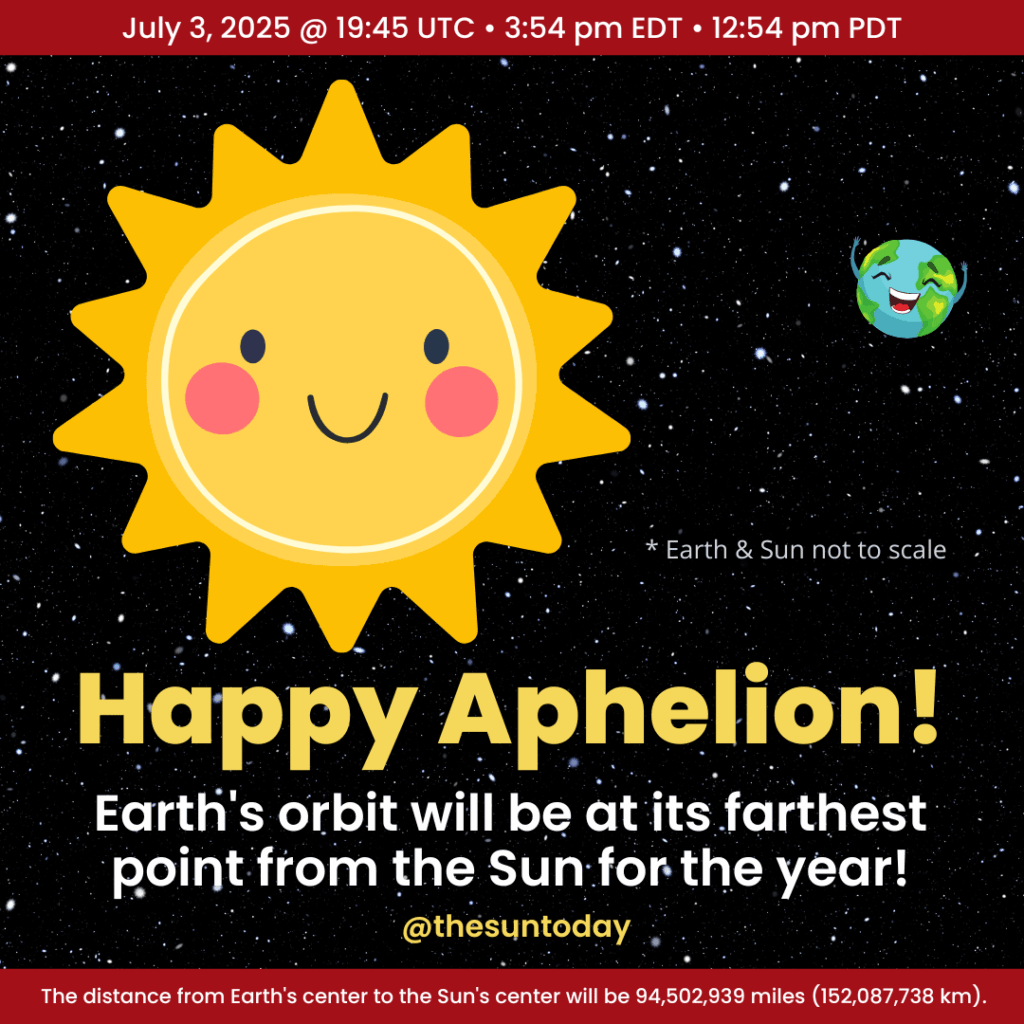
The anomalistic year—the interval between one aphelion and the next—currently averages 365.259636 days. In comparison, our calendar year averages 365.2425 days exactly. The difference between the two means that aphelion drifts back about 25 minutes per year, or 1 day about every 58 years.
The date varies from year to year, depending on your time zone, because of the way leap years work, and because the moon moves the earth a little; [see here](https://astropixels.com/ephemeris/perap/perap2001.html). 2067 will be the first year (for over 21 000 years) when aphelion will fall on 7 Jul and 2098 will be the last year (for the same, very long time) when it falls on 4 Jul, in the UTC+0 time zone (GMT).

4 Comments
We get the best of both worlds in the northern hemisphere–summer’s when the sun is at its farthest, and winter when it’s at its closest.
Space: Putting our daily problems into a universal perspective.
Space where even the ordinary days have extraordinary names.
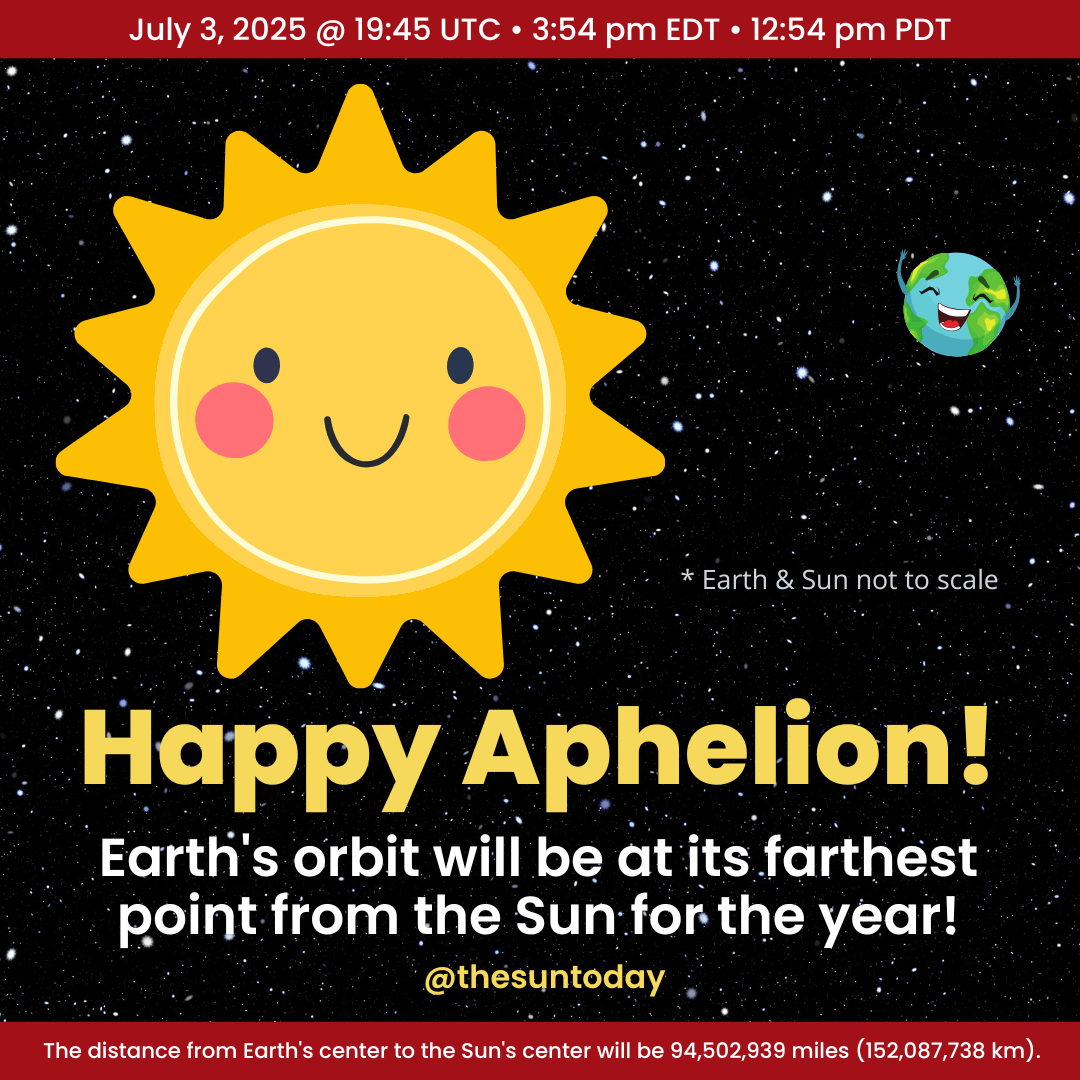
The anomalistic year—the interval between one aphelion and the next—currently averages 365.259636 days. In comparison, our calendar year averages 365.2425 days exactly. The difference between the two means that aphelion drifts back about 25 minutes per year, or 1 day about every 58 years.
The date varies from year to year, depending on your time zone, because of the way leap years work, and because the moon moves the earth a little; [see here](https://astropixels.com/ephemeris/perap/perap2001.html). 2067 will be the first year (for over 21 000 years) when aphelion will fall on 7 Jul and 2098 will be the last year (for the same, very long time) when it falls on 4 Jul, in the UTC+0 time zone (GMT).