
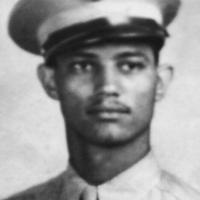

SSGT. BILL MOORE
PFC NORMA KATHERINE DEFREESE MOORE
Editor’s note: Melissa Holcomb Henderson of Warren County, granddaughter of SSgt. Bill Moore and PFC Norma Katherine DeFreese Moore, earlier this year provided the newspaper with a copy of her grandmother’s account of her experiences in World War II and the 6888 Central Postal Directory Battalion. The week of July 4 provides a fitting time to reflect on the lives of this couple and an opportunity to take a more in-depth look at a couple who served their country with patriotism and devotion during a pivotal time in Unites States and world history.
SSgt. Bill Moore and PFC Norma Katherine “Kay” DeFreese Moore, who moved with their family to Warren County in 1979, both served their country during World War II.
Their granddaughter, Melissa Holcomb Henderson, described the story of their lives as one of patriotism and love.
Background
SSgt. Bill Moore from Tuskegee, Ala., graduated from Tuskegee Institute High School and served in the 348th Quartermaster Corps. He joined the military in 1941 when he was 18 years old. He and his wife grew up in rural areas.
PFC Moore from Upstate New York served in the US Army and also joined the military in 1941 when she was 18. PFC Moore ultimately served with the 6888th Central Postal Directory Battalion, which became the subject of Tyler Perry’s movie, “The Six Triple Eight.”
Henderson said that descriptions of the unit as the only all-Black women’s unit of World War II are not correct. Referring to her grandmother’s Native American/Dutch ancestry, Henderson said that the 6888th is more correctly described as a unit of non-white women.
Bill and Kay married six months after they enlisted. Shortly after they married, they deployed to different parts of Europe. Henderson said that on PFC Moore’s first Christmas away from home, she was on KP duty cutting potatoes. Today, Henderson still thinks of her grandmother whenever she cuts potatoes.
SSgt. Moore was on the front line in France and Germany.
The Moores completed their military service in 1945. Henderson said that hearing about their part in history was something she grew up with.
“They were always talking about it,” she said.
Her uncle, Christopher Paul Moore, whom she described as “one of the main family historians” frequently spoke about the family history as well. He went on to write the book, “Fighting for America: Black Soldiers — The Unsung Heroes of World War II,” which was published in 2005. A copy is available in the Warren County Memorial Library.
Christopher Paul Moore is one of the curators of the Schornbury Center for Research in Black Culture at the New York Public Library.
The movie, “The Six Triple Eight” inspired Henderson to take another look into her family’s history through her uncle’s book and her grandmother’s account of service in World War II. Henderson hopes that more local residents will want to explore their family’s history.
“I know there are many descendants of many soldiers,” she said. “I would love for people to have an interest in their family history in Warren County.”
Henderson treasures a letter written in 2022 by Congresswoman Anna G. Eshoo of California regarding the Six Triple Eight Congressional Gold Medal Act, with a reference to the service of PFC Norma Katherine DeFreese Moore. The letter states the following about the women who served in the Six Triple Eight:
“These Extraordinary women designed innovative and efficient filing systems to organize ‘undeliverable’ mail and track individual servicemembers. The unit cleared backlogs of mail at a record pace, setting an example of dedicated service to our country. The Six Triple Eight Congressional Gold Medal Act recognizes the important role of the women of the 6888th Central Postal Directory Battalion curing Word War II by awarding them the Congressional Gold Medal, one of the highest civilian honors that Congress can bestow.”
A World War II account
PFC Norma Katherine DeFreese Moore wrote an account of her experience in World War II and the 6888th Central Postal Directory Battalion in a small spiral notebook. After graduating from high school, she returned as a post graduate. She was at a cousin’s 16th birthday luncheon when the attack on Pearl Harbor was announced on the radio. “From then on, my life became entangled with World War II,” she wrote. Her brothers and other young men where she lived were being drafted for military service. Good-byes were difficult.
Moore, along with her sister and her friend, applied for jobs in a defense plant, choosing the Wright Aeronautical Plant in Paterson, N.J. Her work was drilling oil holes into the aluminum airplane pistons. At that time, many of the people who worked at the plant were women. Moore said that they developed a camaraderie with each other. Older men also worked at the plant, often in supervisory positions. When Moore left to join the WAC (Women’s Army Corps), the men gave her a good-bye gift of a leather writing portfolio.
At that time, her brothers served in different areas abroad, including the Philippines and Europe. One was among the soldiers working to build the Burma Road.
Moore and other women boarded a train to Des Moines, Iowa, for WAC basic training. Training covered everything from night patrols to wearing gas masks. Moore also recalled learning Army regulations for making bunks neatly. She had left home on Dec. 14, and she spent Christmas Day on KP duty. That was a day she felt homesick.
Moore was then stationed at Fort Jackson, S.C., a medical post where she was a secretary typing doctors’ reports on drafted recruits sent to the facility for physicals. Later, she was placed in a dental clinic. She remembered that she was sitting in a chair reading a magazine on Easter Sunday when she heard someone say hello to her. It was a staff sergeant from the Quartermaster Corps who sat down beside her chair. Moore described the man as “tall, slender and quite handsome.” The Staff Sergeant began to visit her when he wasn’t busy with his duties. They would often talk about their families. This man, Bill, the man whom she would later marry, would visit her often. Bill would arrive in a jeep, and the two enjoyed riding in the South Carolina countryside.
The future Mrs. Moore described Bill as a gentleman. “Marriage just seemed to be logical especially since his turn to be sent overseas to the war in Europe was fast approaching,” she wrote. The couple were married in the post chapel. After the wedding, Bill Moore was stationed at Camp Shanks before his unit was sent to Europe to serve under General Patton.
At Fort Jackson, Norma Katherine DeFreese Moore accepted a new job as company clerk. “I was the person who saw that every person was accounted for each day, and, in addition, any orders that came down from above had to be noted in each one of four barracks,” she wrote. While the company clerk’s position was designated with a corporal rank, promotions had been frozen, so Moore remained a private first class.
She was then assigned to the 6888th Central Postal Directory Battalion and was among some 800 women sent to Europe. “The mail with no special delivery status had become very, very delinquent and we were sent to straighten it out,” Moore wrote.
She left for Europe from Camp Shanks, and landed in Ireland before traveling to Birmingham, England, by train. The war in Europe ended while she was in England. However, Moore wrote, “The mail, though, was still piling up and it was decided to send us on to where it was — France.”
After crossing the English Channel, the 6888th landed in Le Havre, France, and traveled to Rouen where the mail work assignment was. Moore had heard where her husband’s unit was, but had not heard anything new by June 12, her first wedding anniversary. That changed when she was notified, “Staff Sgt. Moore is here to see you.” He brought a small container of chocolates. Norma Katherine DeFreese Moore learned that her husband’s unit would be sent to Japan and would have to leave the following day. However, after the atomic bomb was dropped, the war there ended. SSgt. Moore was mustered out of the Armory. He returned to his family in Alabama and registered for a course at Tuskegee University.
PFC Moore was still working with the mail. Her unit left Rouen for Paris. Moore wrote, “We worked hard for a while – I was on the night shift- 24 hours a day we were at it, but then things began to lighten up.” With the end of the war, the men in the armed forces were going home, but, as Moore wrote, “…we were not allowed to forget that we were still in the Army.”
Throughout her account, Moore wrote about the counties and cities that she was able to see while serving in the Army. She ended her small notebook with the words:
“And then, in due time-December 1945, almost exactly 2 years from the time I entered the Army, I became separated from the service at Fort Dix, NJ and finally joined my waiting husband so we could, at last, start a life together.”