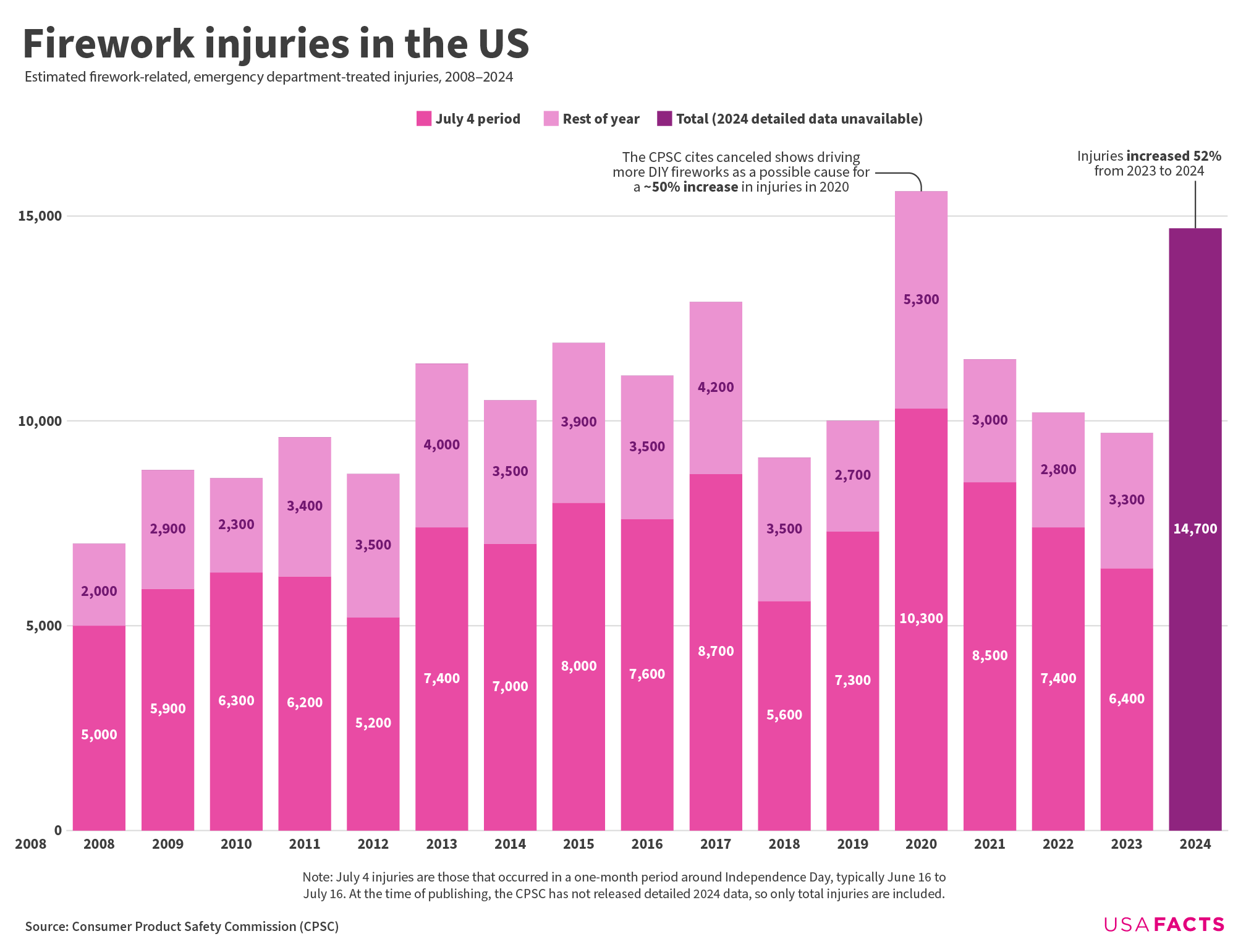
Nearly 15,000 people landed in the ER with fireworks injuries last year — a 52 % jump over 2023 and the second-highest total the Consumer Product Safety Commission (CPSC) has reported since at least 1991. The agency hasn’t offered a cause, but the last time we saw a spike like this was 2020 (also the year with the most total injuries since ’91), when the CPSC cited canceled public shows pushing more DIY backyard displays as a potential reason.
I combed through every CPSC report back to 2008 for a few more super fun firework facts. Some of these might not come as a surprise:
* About two-thirds of all injuries happen in the four weeks around July 4.
* In 2024, 1,700 firework-related injuries involved sparklers.
* Men made up 67% of July 4 injuries in 2023.
* Teens and young adults get injured most by fireworks. The 15–19 age group had the highest injury rate in 2023 at 4.5 per 100K.
* The oldest group in the data (65+) had an injury rate of 0.5, while the youngest (0–4) had a rate of 3.1.
* There were 8 firework-related deaths in 2023 and 11 in 2024. Most involved misuse and device misfire/malfunctions.
* If you’ve got a bit of morbid curiosity, the CPSC reports include brief descriptions of the events leading up to some of the deaths. I
Sorry for all the bummer data. I still plan to have a good time this weekend, but with the added goal of staying out of next year’s statistics. Happy Fourth of July!
KTPChannel on
We need information from the mid 90’s to mid 00’s so we can see the effect Joe Dirt had on firework injuries.
I’d imagine there was a decline.
purrdinand on
i feel like theres gotta be a high correlation between having low intelligence and being really into fireworks.
pervocracy on
Okay, so in 2020 there’s a spike because unused professional-grade fireworks found their way into amateur hands, and a lot of bored teenagers played with fireworks to pass the time during COVID. But what happened in 2024?
00100011-01010111 on
I’m pretty certain someone near me needed to be airlifted last night for a firework injury. We live in the country and that’s the common EMS response and there were a lot of fireworks last night.
OtterishDreams on
I dont care if they blow they hands off as long as they dont hurt anyone else, do it safely and dont start fires.
ACorania on
I volunteer as a firefighter in a rural area and we get a LOT more busy around the 4th. It kind of sucks.
However, I would say injuries are relatively uncommon… like I get roughly the same number of ‘I was just cleaning my gun and it went off and me’ injuries as firework ones. Most the increase in how busy we are is brush fires.
ToonMasterRace on
Mass immigration is unironically fueling this, people from those countries love to play with fireworks.
suicidemachine on
Eh, 2020 doesn’t surprise me. I guess teenagers wanted to vent their frustrations after having to spend 5-6 months locked in their houses

![[OC] Firework injuries in the US](https://www.byteseu.com/wp-content/uploads/2025/07/kzfnqngihoaf1-1536x1173.png "[OC] Firework injuries in the US")
11 Comments
Source: Consumer Product Safety Commission
Tools: Datawrapper, Illustrator
Notes:
* July 4 injuries are defined by the CPSC as those that occurred in a one-month period around Independence Day. Typically, that’s June 16 to July 16, but it shifts by a few days in their reporting some years.
* At the time of publishing, the CPSC has not released detailed 2024 data, so only total injuries are included in the chart. It also made my legend a bit complicated.
* 2024 data is [here](https://www.cpsc.gov/Safety-Education/Safety-Education-Centers/Fireworks), and the historical totals (2008 to 2023) were pulled from the CPSC’s annual firework report PDFs. I’m not sure how many I can link here in a single comment, but let’s see how far I get: [2023](https://www.cpsc.gov/s3fs-public/2023-Fireworks-Annual-Report.pdf); [2022](https://www.cpsc.gov/s3fs-public/2022-Fireworks-Annual-Report.pdf); [2021](https://www.cpsc.gov/s3fs-public/2021-Fireworks-Annual-Report.pdf); [2020](https://www.cpsc.gov/s3fs-public/2020-Fireworks-Annual-Report_0.pdf); [2019](https://www.cpsc.gov/s3fs-public/2019-Fireworks-Annual-Report.pdf); [2018](https://www.cpsc.gov/s3fs-public/Fireworks_Report_2018.pdf); [2017](https://www.cpsc.gov/s3fs-public/Fireworks_Report_2017.pdf?Jr0lMG0Z5QYQMTyUtYr_3GR.991BKn4l#:~:text=CPSC%20staff%20received%20an%20average,year%20between%202002%20and%202017.&text=emergency%20departments%20during%20calendar%20year,individuals%20in%20the%20United%20States.); [2016](https://www.cpsc.gov/s3fs-public/Fireworks_Report_2016.pdf); [2015](https://www.cpsc.gov/s3fs-public/Fireworks_Report_2015FINALCLEARED_0.pdf); [2014](https://www.cpsc.gov/s3fs-public/Fireworks_Report_2014_0.pdf); [2013](https://www.cpsc.gov/s3fs-public/2013FireworksReport_2.pdf?VersionId=wJGwHGoxBYA6rFEZYb3Fw7DjkyYGXsiO); [2012](https://www.cpsc.gov/s3fs-public/pdfs/Fireworks_Report_2012.pdf); [2011](https://www.cpsc.gov/s3fs-public/pdfs/2011fwreport.pdf); [2010](https://www.cpsc.gov/s3fs-public/pdfs/2010fwreport.pdf); [2009](https://www.cpsc.gov/s3fs-public/pdfs/2009fwreport.PDF); [2008](https://www.cpsc.gov/s3fs-public/pdfs/2008fwreport.PDF)
* As you’ll see in in the 2008 PDF (if you get that far) the historical data actually goes back to at least 1991 (10,900 injuries in ’91). Why isn’t that in this chart? At a certain point I ran out of time and patience, but I think I’ll go even further back next year and/or learn how to use the CPSC’s NEISS data and avoid PDFs altogether.
Nearly 15,000 people landed in the ER with fireworks injuries last year — a 52 % jump over 2023 and the second-highest total the Consumer Product Safety Commission (CPSC) has reported since at least 1991. The agency hasn’t offered a cause, but the last time we saw a spike like this was 2020 (also the year with the most total injuries since ’91), when the CPSC cited canceled public shows pushing more DIY backyard displays as a potential reason.
I combed through every CPSC report back to 2008 for a few more super fun firework facts. Some of these might not come as a surprise:
* About two-thirds of all injuries happen in the four weeks around July 4.
* In 2024, 1,700 firework-related injuries involved sparklers.
* Men made up 67% of July 4 injuries in 2023.
* Teens and young adults get injured most by fireworks. The 15–19 age group had the highest injury rate in 2023 at 4.5 per 100K.
* The oldest group in the data (65+) had an injury rate of 0.5, while the youngest (0–4) had a rate of 3.1.
* There were 8 firework-related deaths in 2023 and 11 in 2024. Most involved misuse and device misfire/malfunctions.
* If you’ve got a bit of morbid curiosity, the CPSC reports include brief descriptions of the events leading up to some of the deaths. I
Sorry for all the bummer data. I still plan to have a good time this weekend, but with the added goal of staying out of next year’s statistics. Happy Fourth of July!
We need information from the mid 90’s to mid 00’s so we can see the effect Joe Dirt had on firework injuries.
I’d imagine there was a decline.
i feel like theres gotta be a high correlation between having low intelligence and being really into fireworks.
Okay, so in 2020 there’s a spike because unused professional-grade fireworks found their way into amateur hands, and a lot of bored teenagers played with fireworks to pass the time during COVID. But what happened in 2024?
I’m pretty certain someone near me needed to be airlifted last night for a firework injury. We live in the country and that’s the common EMS response and there were a lot of fireworks last night.
I dont care if they blow they hands off as long as they dont hurt anyone else, do it safely and dont start fires.
I volunteer as a firefighter in a rural area and we get a LOT more busy around the 4th. It kind of sucks.
However, I would say injuries are relatively uncommon… like I get roughly the same number of ‘I was just cleaning my gun and it went off and me’ injuries as firework ones. Most the increase in how busy we are is brush fires.
Mass immigration is unironically fueling this, people from those countries love to play with fireworks.
Eh, 2020 doesn’t surprise me. I guess teenagers wanted to vent their frustrations after having to spend 5-6 months locked in their houses
Trump derangement syndrome.