
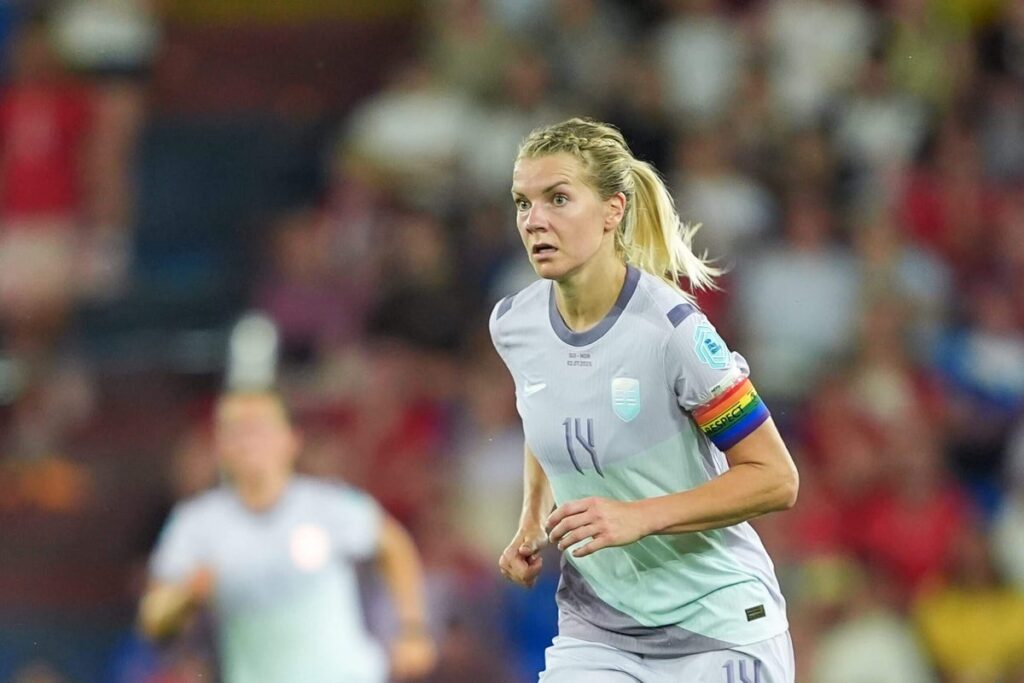
At half-time in the bowels of St Jakob-Park in their Euro 2025 opener, the Norway players stared into a haunting mirror.
The previous 45 minutes wasn’t them — at least, not the Norway this talent-rich side and new manager Gemma Grainger had convinced themselves they were.
The visitors slumped into the break 1-0 down against hosts Switzerland — the fourth-lowest ranked nation at the tournament behind Finland, Poland and Wales — courtesy of Eintracht Frankfurt wing-back Nadine Riesen’s deserved goal in the 28th minute.
In one sense, fortune was kind. Powered by the stadium’s guttural fervour, Switzerland had been running rampant down Norway’s exposed right flank — yet Grainger’s side were only one goal down, despite existing in mostly bystander mode. Towards the end of the opening half, Norway striker and Champions League record goalscorer Ada Hegerberg stretched her arms wide in the direction of Switzerland’s goal, an ineffable attempt to remind her team of the assignment, of who they are: Norway.
This was precisely the question being asked as Grainger was appointed in January 2024. In the hours before kick-off, a kind of Norwegian football war planning event took place in Basel’s Marriott Hotel, UEFA’s base in the city and the place where the Norway team were staying. As Grainger went through team meetings, elsewhere in the hotel, Lise Klaveness, the first female president in the Norway Football Federation (NFF)’s 120-year history, led a summit between club officials, grassroots organisations and other members of UEFA and the NFF. Klaveness, a member of UEFA’s executive committee, has been one of the key driving forces behind Norway’s mission to return to greatness, when gracing the final stages of major tournaments was not so much demanded as expected.
Discussions on Wednesday focused on more holistic measures, including how to fully professionalise the Toppserien, Norway’s semi-professional top flight, with teams such as Brann, Valerenga, Rosenborg and LSK Kvinner dominating on and off the pitch. Other conversations focused on the grassroots game and how they can better produce talent pathways to feed into the top-flight and the national team.
The past decade has made untangling what exactly Norway are a maddening mental journey.
The squad list presents a team of high-performance players: Hegerberg, Caroline Graham Hansen, Guro Reiten, Ingrid Engen, Frida Maanum.
But the past decade presents the 1995 world champions in an increasingly fading light. Norway have crashed out of the group stages from the past two Euros. The World Cup stage has been kinder but only just — two last-16 berths and a quarter-final at the 2019 World Cup in the past decade.
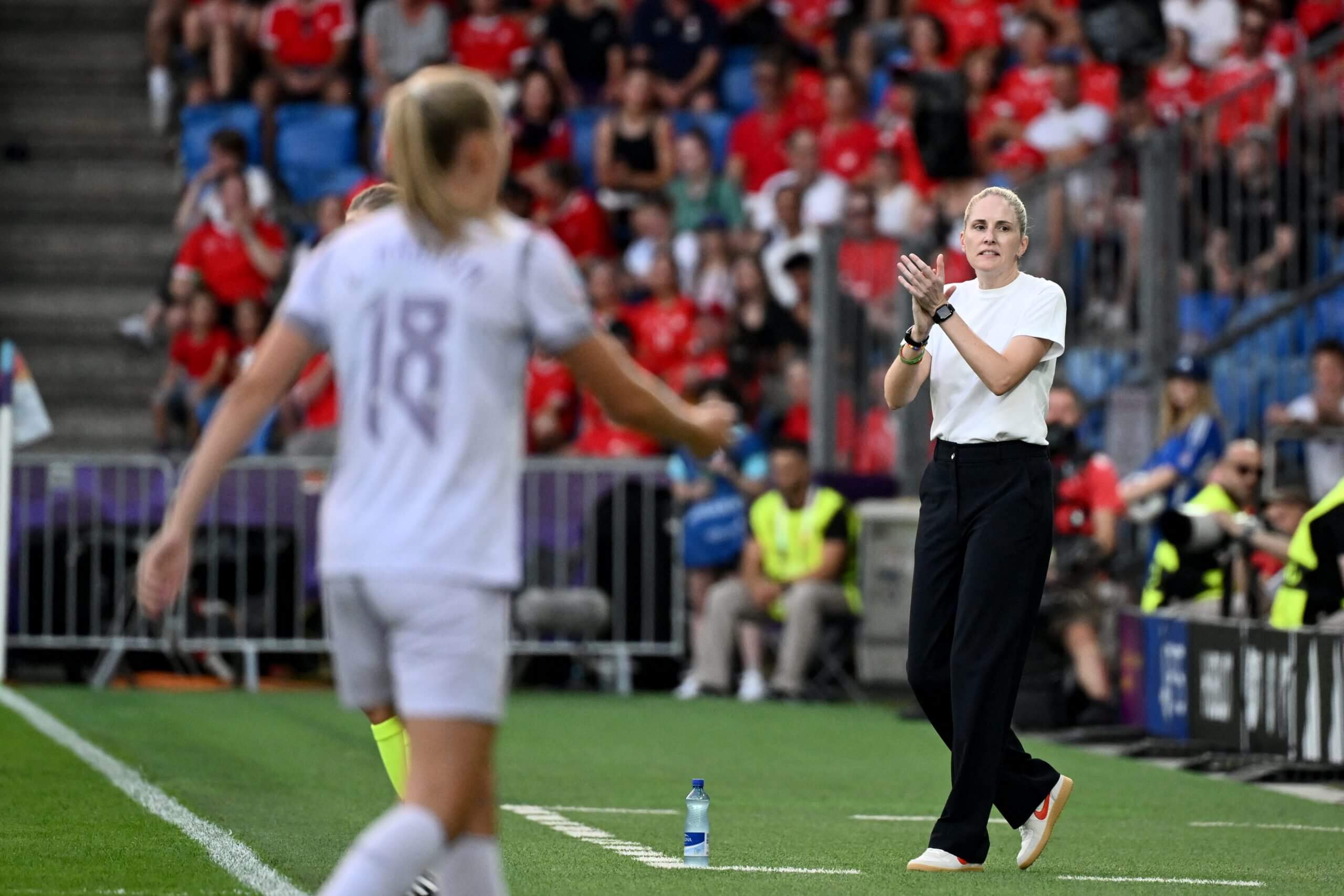
Gemma Grainger applauds her team (Sebastien Bozon/AFP via Getty Images)
In 2017, Hegerberg, one year before winning the first Ballon d’Or Feminin, ceased representing her national side in protest over perceived inequalities within the Norwegian Football Federation and “a huge difference over evaluations and how we should move forward”. In the following years, Norway have toiled for consistency. Grainger is the team’s third head coach in three major tournaments. Martin Sjogren left after losing 8-0 against England in the Euro 2022 group stage and his successor, Hege Riise, stood down after the 3-1 last-16 defeat against Japan at the World Cup a year later, leaving the impression of a rotating carousel of doctors called to address the torment of a comatose giant.
It is why the first-half display in Basel inspired such introspection. Yet, less than 15 minutes after the interval, as Norway had turned it around to 2-1 in their favour, the feeling was that, perhaps, something is finally in the works.
“The thing that we pride ourselves on in this team is our work rate, our ability, and that wasn’t the level that we wanted it to be,” Grainger told The Athletic when asked about the lethargic first half.
“We said it from the start. It’s important to be honest, and when there needs to be trust and honesty, we’re very comfortable doing that. It’s not about how people are to the whole team. It’s about being honest, it’s about changing games at half-time. That’s what the players did and they take all the credit for that.”
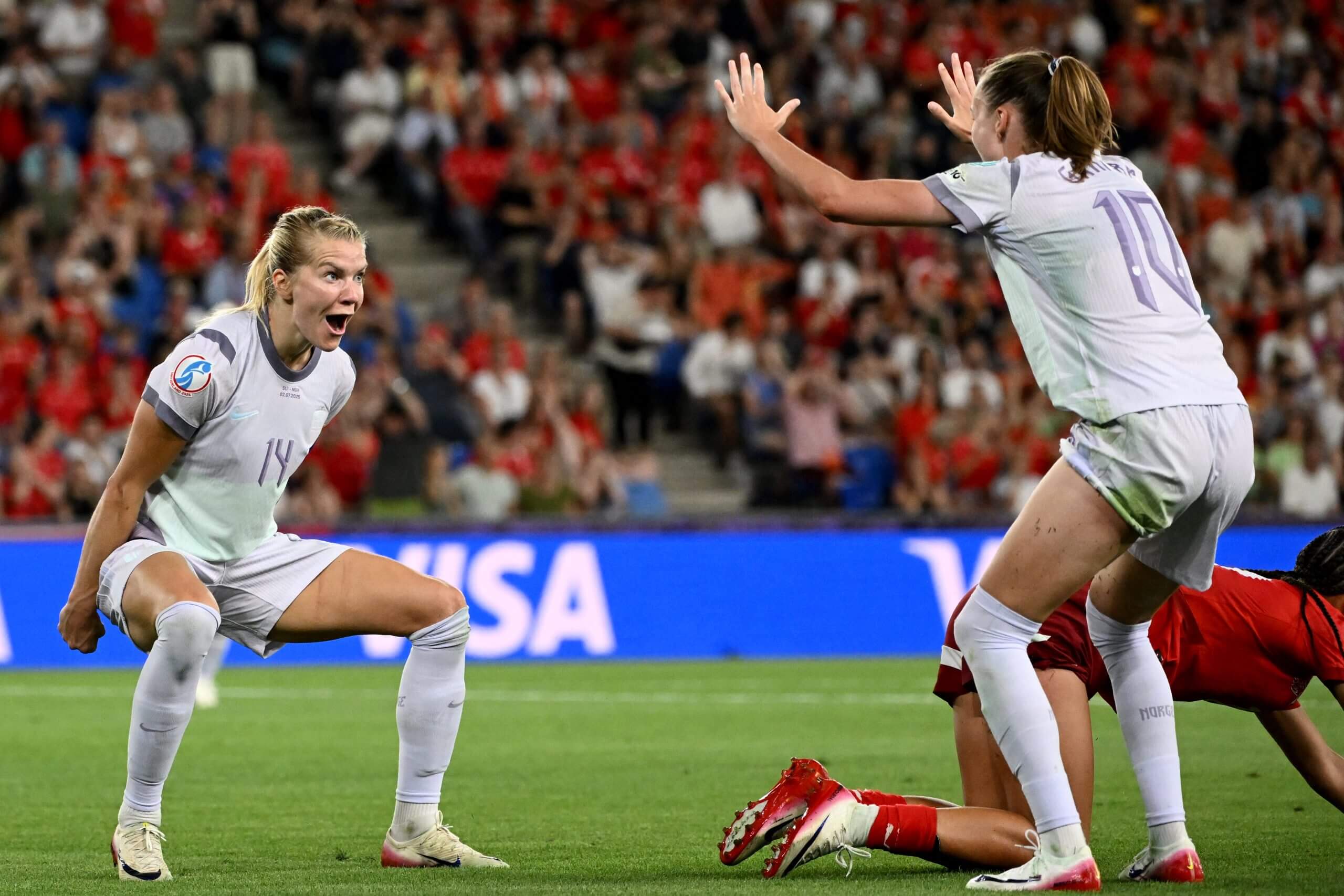
Ada Hegerberg (left) celebrates with Caroline Graham Hansen after scoring Norway’s equaliser against Switzerland (Sebastien Bozon/AFP via Getty Images)
To call Norway’s win a smash-and-grab would be a disservice. In truth, they adjusted smartly at half-time, moving Vilde Boa Risa further wide to close the right channel that Riesen had been regularly exploiting — but it was Swiss naivety and two moments of brilliance that secured Norway their first victory against a host nation at a European Championship. First from Hegerberg, so often a moth to the tournament flame, then Graham Hansen, whose wiliness forced Swiss defender Julia Stierli into an own goal. Hegerberg then missed a chance to score from the penalty spot after a Swiss handball.
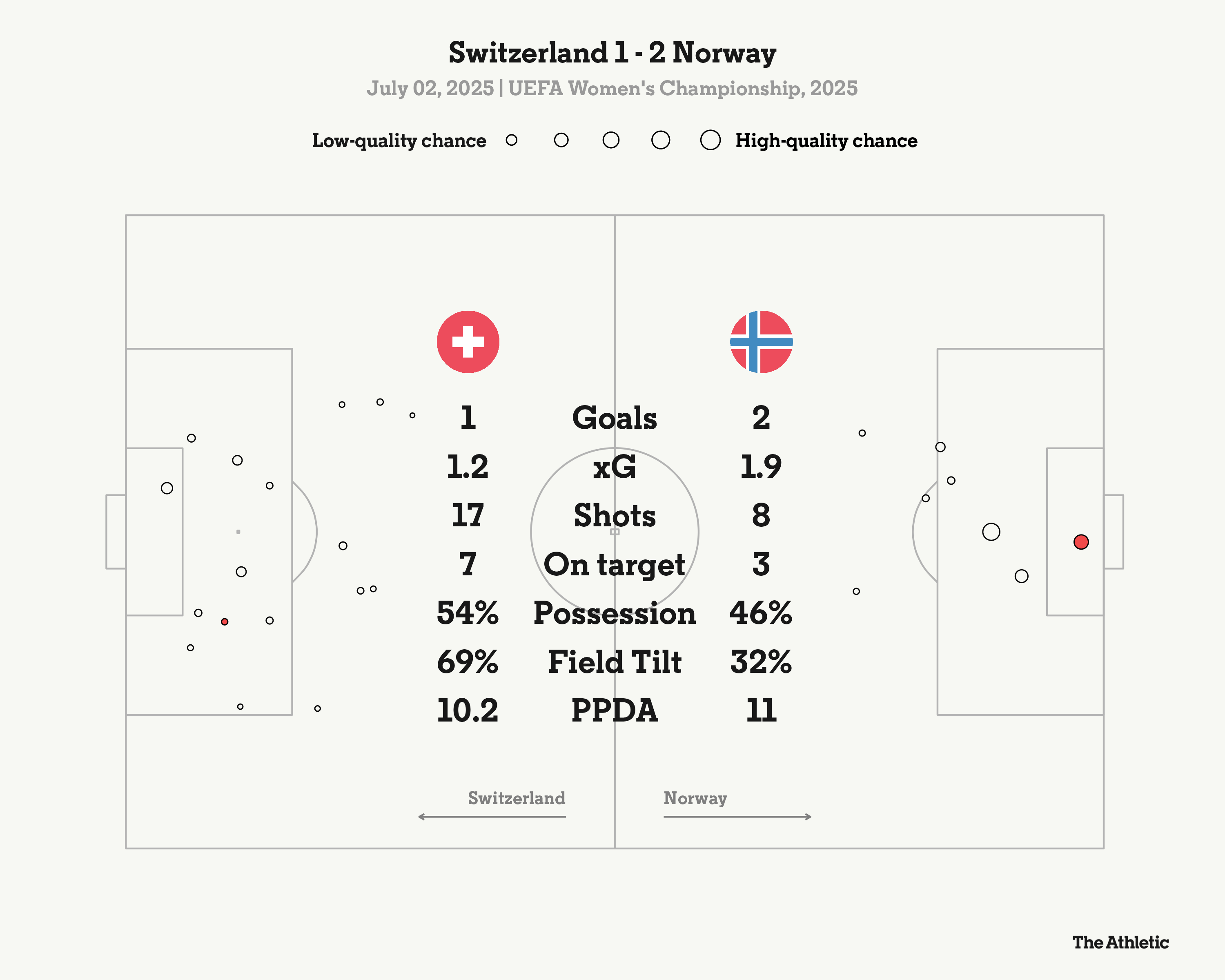
Post-match sentiments from players were mixed. Boe Risa spoke about a sense of relief. Lyonnes midfielder Ingrid Engen refuted suggestions that any pressure was off. Norway, including that penalty, managed just eight shots (three on target), while Switzerland produced 17 (seven on target, illustrated below).
Yet, Grainger chose to consider the win with more optimism. “The biggest strength I have with this team is the recent history doesn’t sit with me,” she said. “I watched them in 2023, I watched them in 2022, but I don’t feel any of it. I feel a team who I look at, and I’m proud to work with. We have unbelievable players. So to win this game, it shows we’ll find a way to win.”
Any progress from the conversations that happened before, during and after the opening match will be felt long after this tournament’s conclusion. But there is no doubting the influence a successful Euros campaign could have. On Sunday, Norway face Finland, who beat Iceland in a gripping opening match. Victory would confirm Norway’s place in the knockouts, their first time doing so since 2013 when they reached the final in Sweden, losing 1-0 against Germany.
Speaking to The Athletic before this summer’s Euros, Grainger recalled that while in Nyon for the draw, a high-ranking member of a fellow national association quipped that there were no big teams in Group A. Norway’s mission is simple: to re-establish themselves as a major footballing nation.
Wednesday was a step in the right direction, but doing so will take more than a bright 14-minute cameo in the group stages.
(Top photo: Daniela Porcelli/Getty Images)