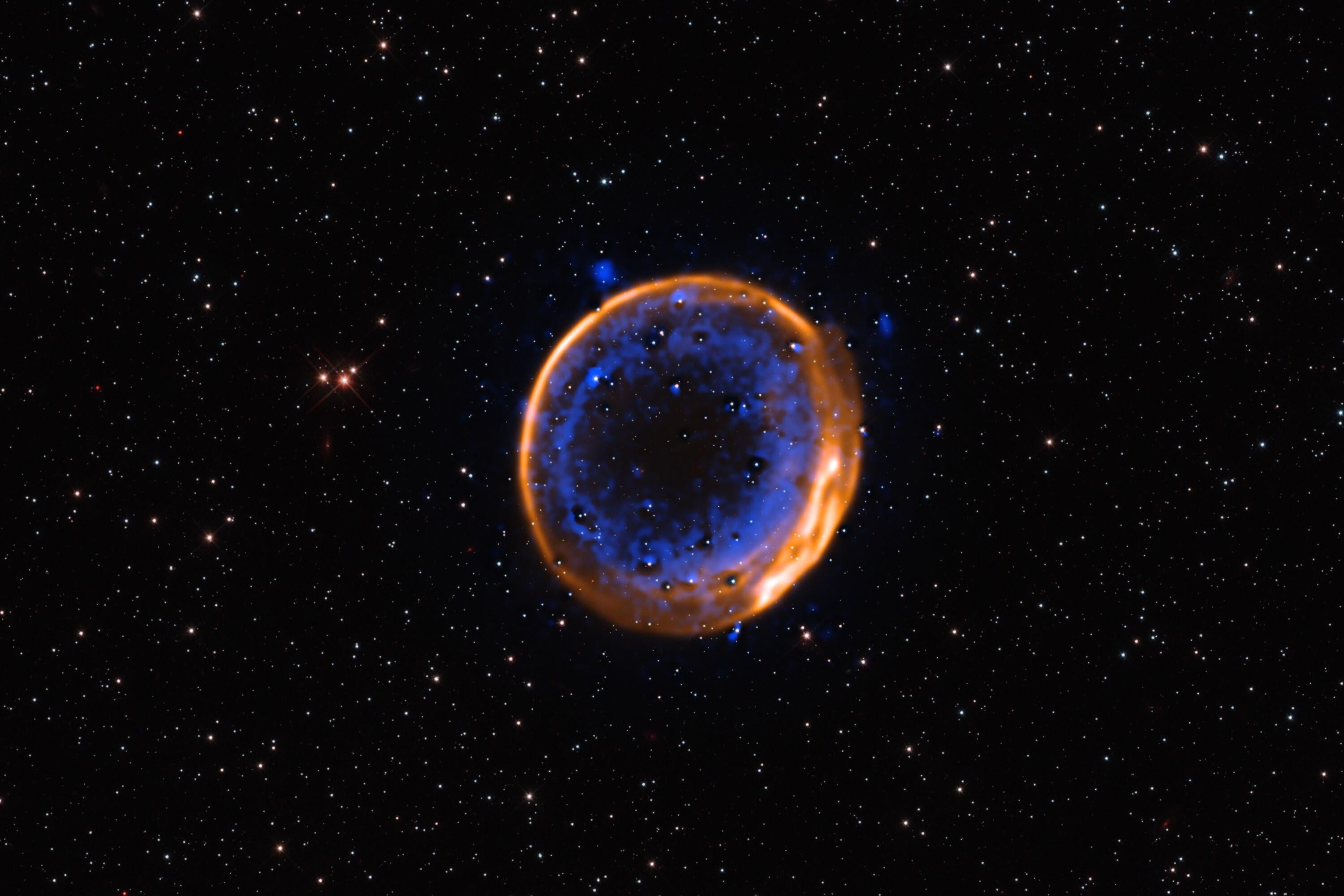
Supernova SNR 0509-67.5, imaged with ESO’s VLT, provides the first photographic evidence of a double-detonation supernova.
https://i.redd.it/zcwrtt4xw8bf1.jpeg

Supernova SNR 0509-67.5, imaged with ESO’s VLT, provides the first photographic evidence of a double-detonation supernova.
https://i.redd.it/zcwrtt4xw8bf1.jpeg
3 Comments
Image from here
[https://www.eso.org/public/images/eso2511a/](https://www.eso.org/public/images/eso2511a/)
This image, taken with ESO’s Very Large Telescope ([VLT](https://www.eso.org/public/teles-instr/paranal-observatory/vlt/)), shows the supernova remnant SNR 0509-67.5. These are the expanding remains of a star that exploded hundreds of years ago in a double-detonation – the first photographic evidence that stars can die with two blasts.
The data were captured with the Multi-Unit Spectroscopic Explorer ([MUSE](https://www.eso.org/public/teles-instr/paranal-observatory/vlt/vlt-instr/muse/)) instrument at the VLT. MUSE allows astronomers to map the distribution of different chemical elements, displayed here in different colours. Calcium is shown in blue, and it is arranged in two concentric shells. These two layers indicate that the now-dead star exploded with a double-detonation. Hydrogen (H alpha) is shown in orange.
**Credit:** ESO/P. Das et al. Background stars (Hubble): K. Noll et al.
Longer article by ESO about the image and the publication describing the evidence of the double-detonation
[https://www.eso.org/public/news/eso2511/](https://www.eso.org/public/news/eso2511/)
This research was presented in a paper titled “Calcium in a supernova remnant shows the fingerprint of a sub-Chandrasekhar mass explosion” to appear in *Nature Astronomy* at [https://www.nature.com/articles/s41550-025-02589-5](https://www.nature.com/articles/s41550-025-02589-5) (doi: 10.1038/s41550-025-02589-5).
Wow! Very cool! Like a fancy firework with a double detonation.
Curious why though!
Very cool, but hard to see the double shell. Is there a better illustration of the two layers?