
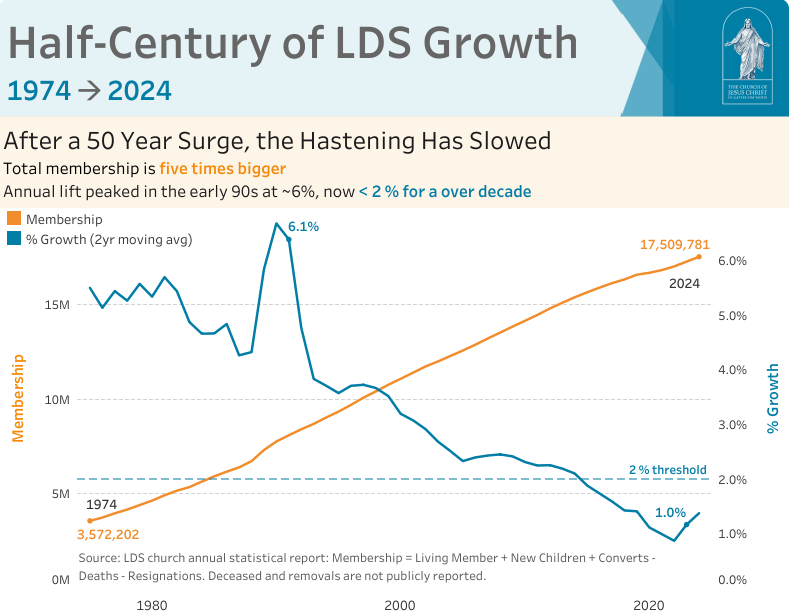
I looked into LDS growth stats after an apostle claimed, “In the last 12 months ending May 31st, the Lord’s hastening of his work resulted in the largest number of convert baptisms in any 12-month period in this dispensation.”
Dispensation = one of seven gospel eras (Adam → Joseph Smith) in LDS belief.
By including 'dispensation' in the description, the LDS Church touts record-breaking convert totals as proof that God is ‘hastening His work’, yet the percentage growth rate has flat-lined for over a decade. Those raw numbers hide stagnation rather than a surge. Slower growth aside, based on this new data, there will likely still be impressive absolute growth in 2025.
Orange line = Total Membership = Living Members + New Children + Converts – Deaths – Resignations. Deceased and record removals are not publicly reported.
Blue line = 2-year moving-avg annual % growth.
- Membership climbed 3.6 M → 17.5 M since 1974 (~5×).
- Growth rate peaked ~6% in early 90s. It hasn’t cracked 2% since 2013 and was 1.4% last year.
Sources
Tool
- Tableau Public – here (other charts too)
Posted by Browningtons1
4 Comments
It would be nice if they actually showed active members instead of including the guy who hasn’t been to church since 2004
What is the 2% threshold signify?
So it wasn’t the OLympics. What accounts for that weird spike? An extra-good missionary class? Doubtful.
A 2019 Harvard study provides details on data used to grow the LDS roster, following the theory that padding the congregation size increases eligibility for various religious org write-offs.
>
“Today, the LDS church claims to have the records of over 12 billion deceased people, some going all the way back to the 1st century CE. Data-gatherers on 220 teams in 45 countries, along with hundreds of thousands of Mormon volunteers are digitizing millions of paper records, photos, microfilm, and more. By 2014, the church records were 32 times the size of the data recorded by the US Library of Congress. Each year, they add a quantity of data equal to another Library of Congress, all of which is stored in their International Genealogical Index (IGI). Mormons have free access to the IGI through the church’s FamilySearch website and 4,600 Family History Centers, Mormons’ public genealogical library system. Due to the IGI, the best records for many countries across the world are in Utah. However, many people object to this mass collection of personal data, because its primary purpose is proxy baptisms. In the late 1990s, the Jewish community was offended to learn Mormons were giving proxy baptisms to Holocaust victims, which to many Jews echoed their terrible history of forced baptisms by Christians. In response to these concerns, the church promised to end the collection of Holocaust victims’ names for proxy baptisms, but the practice continued. In 2008, the Vatican instructed Catholic clergy to deny Mormon data collectors access to parish records, in order to prevent future proxy baptisms of Catholics. ”
>
Source: [https://rpl.hds.harvard.edu/religion-context/case-studies/technology/mormons-genetics-digitized-data](https://rpl.hds.harvard.edu/religion-context/case-studies/technology/mormons-genetics-digitized-data)
Years ago, the public was warned that some DNA tests came with questionable TOS, including LDS membership. Fast forward to 2021-25 bankruptcies where DNA databases are being sold off as assets to data brokers and [private equity firm](https://healthjournalism.org/contest-entry/is-your-dna-safe-in-blackstones-hands/)s. Inflated member #s aren’t the only crime in LDS unethical use of tech.