
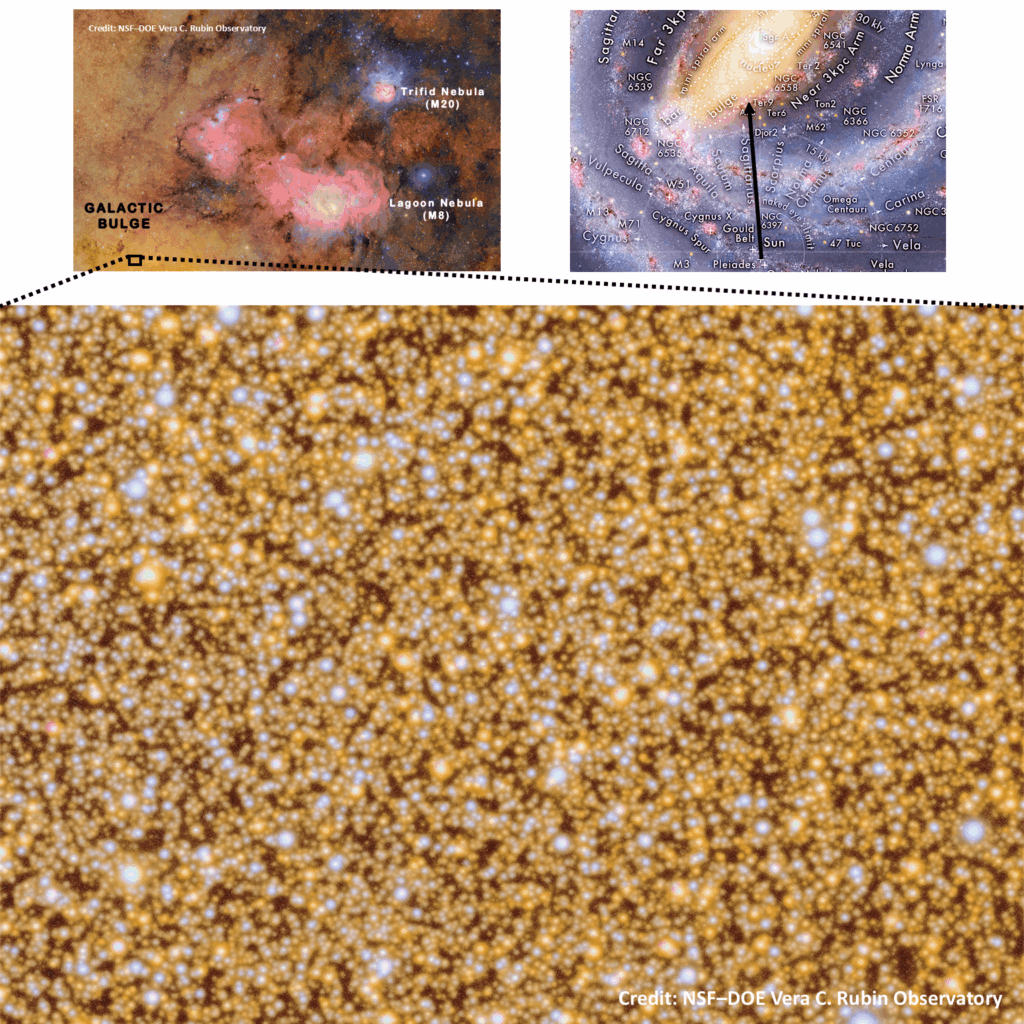
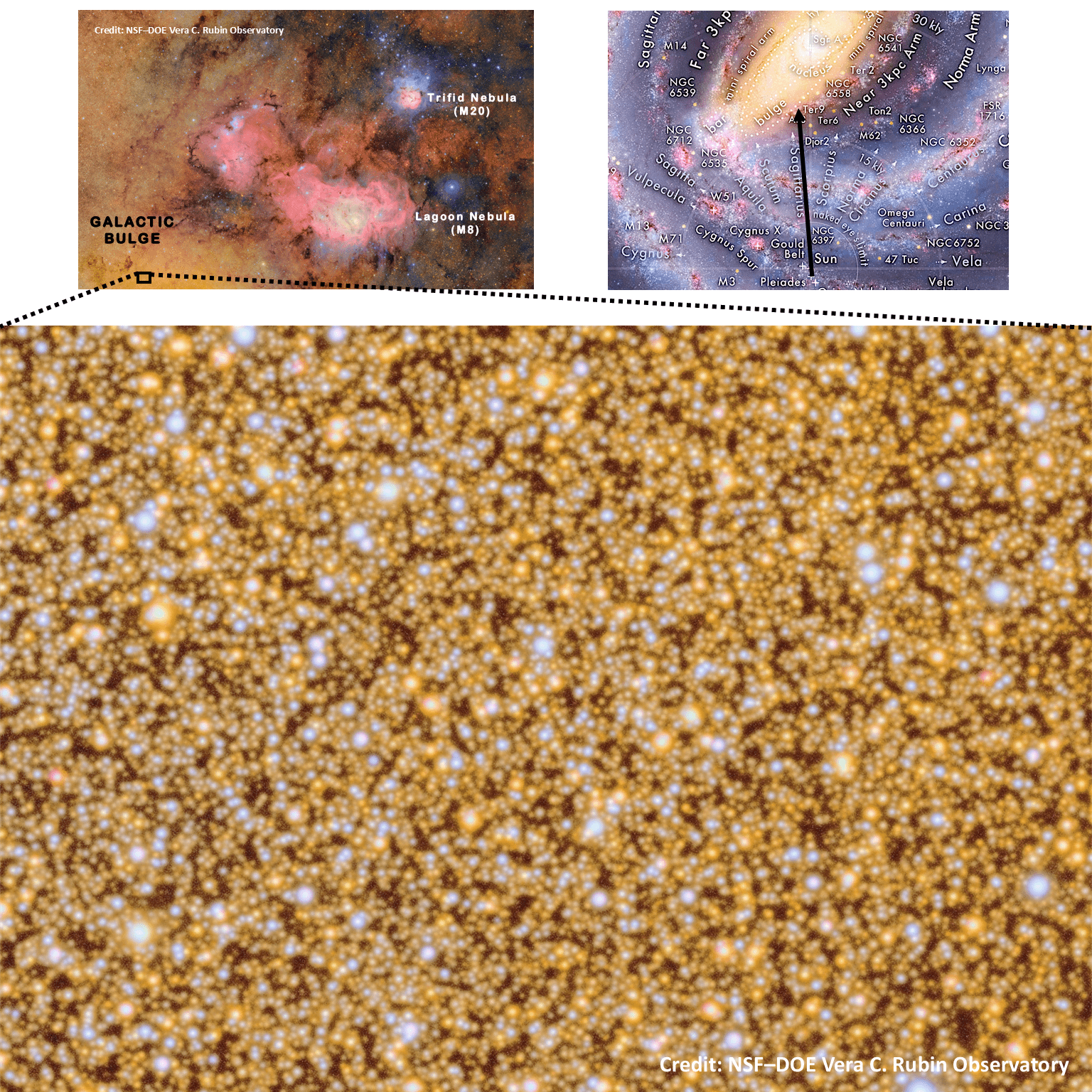
This dense field of bright stars is a view into the Galactic Bulge, near the center of our galaxy, where the average distance between stars is 2-3 light years, less than the 5 light year average distance in the Sun's neighborhood.
Imagine what the night sky might look like on a planet orbiting one of these stars. (Click on the image for larger size.)
This particular view is just a tiny crop from the full resolution image (84000×51500 pixels) taken recently by the Vera Rubin Observatory of the Lagoon and Trifid Nebulas in Sagittarius.
Specifically, it is part of the large bright expanse of stars just to the left of those nebulas which looks toward the Galactic Bulge unobstructed. When you look at Sagittarius, generally, you are looking in the direction of the Galactic Bulge and the center of the galaxy (see galactic map insert), so many views of objects here typically show a portion of this "star cloud".
https://i.redd.it/rjyfq0zbu8bf1.png
13 Comments
Thanks, i wasnt feeling small and insignificant enough today. Now i do.
[deleted]
WOW! incredible stuff keep posting! This resolution is outstanding
How bright would the night sky be in that area if you were on a planet that orbited one of those stars?
Given that ancient folk drew constellations in the sky- How many horoscopes would humanoid life forms have living in this densely populated area?
I asked chatgpt to create a rendering of what the night sky would look like if you were on a planet in the bulge: https://ibb.co/qYXydZnp
How does this image compare to something JWST could produce?
Anyone else want to meet me there in Elite Dangerous this week?
Is that in the same neighbourhood near the galactic core where things start to get spicy in the radiation sense?
Imagine the density of population in these clusters, the cross-cultural richness, chaos, economies, bizarre “oil & water” species froth. What an incredible place to live in our Galaxy! Comparatively, we’re in “the sticks”
that close to one another? how have they not all colided yet?!
Alnasl, the star at the tip of the spout of the Teapot asterism in Sagittarius, points at galactic center, just to its right.
Alnasl is the tip of the arrow that Sagittarius is shooting with his bow. The bow is formed by the three stars to Alnasl’s left/east—Kaus Borealis at top, Kaus Media in the middle, and Kaus Australis at bottom right of the Teapot. ‘Kaus’ means Bow.
# OwO, what’s this? *notices your galactic bulgy wolgy*