


The winners and losers in the ‘big beautiful bill’
These are the potential winners and losers from the tax bill, which President Donald Trump has dubbed the ‘big beautiful bill’.
- President Trump’s spending and tax bill stands to significantly impact Arizona’s energy and economic landscape, particularly the clean energy and electric vehicle sectors.
- The bill rolls back tax credits for solar and wind power, reflecting a shift away from initiatives that aimed to support a clean energy transition.
- Various analyses show electric bills could rise as a result of the legislation, but the exact numbers are squishy.
- The bill could spell trouble for electric vehicle manufacturers and clean technology companies. Arizona has established itself as a hub for those industries.
President Donald Trump’s massive federal spending and tax bill stands to have far-reaching impacts on Arizona’s energy and clean technology landscape.
The legislation — pushed through U.S. Congress last week by Republicans — could cripple the clean energy industry by sharply rolling back tax credits for solar and wind. It contains longer phase-outs for hydropower, nuclear energy and some other carbon-free forms of generation, but still reflects a seismic shift away from initiatives designed to support a national transition to renewable power.
That is widely expected to have a plethora of downstream effects, many of which will be amplified in the desert.
Early studies suggest that the legislation will hit Arizonans’ pocketbooks. The state is experiencing rising energy demand, which was already expected to drive up electric rates in coming decades. But some experts say other factors, such as the price of natural gas and success of initiatives that support nuclear generation, could help mitigate the expected cost increases.
“I would take it with a large grain of salt,” said John Godfrey, senior government relations director at the American Public Power Association.
The bill also hits key advanced manufacturing sectors that employ thousands of people statewide. Officials had invested heavily in developing a clean technology hub in Arizona, but local solar companies and electric vehicle manufacturers are now left with an uncertain future.
Those shifts could also impact battery and charging infrastructure suppliers. In total, the state’s economic development arm estimated the legislation could threaten tens of billions of dollars in potential investments, and tens of thousands of future jobs.
“All in all, it’s going to raise energy prices, kill jobs and reduce economic growth,” said Alyce Neal of Veregy Solar and EV Solutions, a Phoenix-based company that builds clean energy infrastructure for its clients. “And there you have it.”
It remains unclear how the changes might translate to utilities’ sustainability goals. Power suppliers have plans in place to reduce carbon emissions, fight climate change and meet growing energy needs by moving toward renewables in coming decades.
Spokespeople for the state’s two largest electric utilities — Arizona Public Service Co. and Salt River Project — suggested their respective utilities remained committed to mixed energy portfolios to meet future power needs.
Mike Philipsen of APS stressed that the company would continue to consider all types of energy generation projects through a competitive bid process as it seeks to meet growing demand.
“This process allows the market to determine the resources that are the most economical for our customers following passage of the legislation,” he said in a statement. “We are committed to thoroughly reviewing all future generation proposals through this process to ensure we continue to deliver reliable service at the most affordable price for our customers.”
Jennifer Schuricht of SRP said utility officials were still reviewing the bill to determine whether it could impact planned projects and initiatives, but noted that its long-term planning roadmap called for a combination of natural gas, energy storage and renewables.
“SRP is committed to serving its customers with reliable, affordable power while making progress toward its sustainability goals,” she said in a statement.
Experts largely believe utilities’ public commitments will be difficult to immediately roll back, but leaders’ long-term strategies for getting to their goals may shift. They have already begun the process of moving away from coal-fired generation, and that is unlikely to reverse. They could now choose to focus on different forms of renewable power, or opt to lean more heavily on fossil fuels like natural gas, which produces less carbon than coal when burned but still has major environmental impacts.
Utility officials can still build solar and wind farms if there’s public buy-in for such projects. But unless they move quickly, there won’t be any tax credits available for them.
Diane Brown, executive director of the Arizona Public Interest Research Group, said state officials may ultimately map the waters for utilities. She said there is “momentum” behind clean energy goals from businesses and residential power users, and noted that the industry has created jobs that politicians may be motivated to save.
“Policymakers often see and hear local impacts in a way that individuals in Washington, D.C., may not, and recognize the need to advance projects that have already been started,” she said, adding that she hoped utilities stuck to existing clean energy goals.
There’s also the threat of continued whiplash. Utilities are highly regulated, and political headwinds could change with every election cycle.
“The fate of energy tax credits has ebbed and flowed over time,” said Godfrey, the public power lobbyist. “I don’t know that this is the last chapter of the book.”
Analyses show electric bills rising. How much more will consumers pay?
Various analyses show electric bills are poised to rise across the country — but the exact numbers are squishy.
A report from Princeton University offers some of the most recent estimates. It predicts an average household’s energy bills will increase by about $284 per year by 2035, although it notes that is an “approximate” figure given “significant uncertainty about future outcomes.”
That represents an increase of more than 13%. Other groups, largely affiliated with the clean energy industry, had also forecasted a wide range of future cost bumps.
The numbers will almost certainly fluctuate by state. Brown said she expects that the legislation’s impacts on electric bills could be amplified in Arizona.
“The analyses that we’ve seen from across the country tend to highlight the expected population growth and the growth of data centers as factors that may contribute to consumers here paying more than in many other places,” she said.
But much is still unknown about how utilities statewide may respond to the federal bill’s passage. Godfrey said it contains some provisions that could mitigate how much customers end up paying.
The legislation preserves longer phase-outs for credits bolstering nuclear, hydropower and other projects. Godfrey and other lobbyists also fought to maintain a mechanism called “elective payment,” which allows public power utilities to directly receive and monetize energy tax credits for certain projects. That creates savings that can get passed down to customers.
“There’s such a huge amount that goes into what your total bill is,” Godfrey said.
Investor-owned utilities can’t participate in that mechanism — but there may be other benefits for them in the legislation. The Edison Electrical Institute, a trade organization for power companies, noted in a policy briefing earlier this year that for-profit utilities had benefitted from corporate tax reductions passed during Trump’s first term. The new legislation extends those tax cuts, which were set to expire.
The organization estimates that those cuts resulted in nearly $62 billion being returned to customers nationwide. In a statement, CEO and President Drew Maloney said there were “many provisions” in the newly passed bill that will help utilities deliver “affordable, reliable energy” and “grow our economy.”
Will Arizona’s energy mix change?
The state’s largest utilities have plans in place to increase power supply while pursuing a cleaner energy mix in coming decades.
APS, which serves 1.4 million customers statewide, needs to increase its energy supply by close to 60% to meet demand in 2038. Its plan included dramatically upping solar and wind generation, as well as its battery storage capabilities. The utility aimed to transition its power mix to be entirely clean and carbon-free by 2050.
SRP had similar goals. The nonprofit utility said it wanted to cut carbon emissions by 82% from 2005 levels over the next decade, and it hoped to reach net-zero by 2050. Its roadmap called for investments in renewable power sources, as well as bringing about 2,000 megawatts of new natural gas online.
U.S. Energy Information Administration data shows more than 50 generation projects in the works statewide. Of those, all but a handful are solar or battery storage projects. Nearly two dozen have yet to start construction, and six are scheduled to enter operation in 2028.
If construction begins within the next year, those projects will be eligible to claim tax credits. Otherwise, the projects must be placed into service by the end of 2027 to qualify.
That timeline may work well for smaller, rural utilities, according to Godfrey. He said there’s still “good opportunity” to develop small-scale solar projects that won’t take years to complete, such as adding panels to a water treatment plant or carports.
For larger utilities, the picture appears less clear. Godfrey said utilities will “have to make adjustments,” but what those changes will look like depends on a host of factors beyond just the new legislation. He expects reliability, available technology and customer demand for certain types of energy could play a role.
“The price of wind and solar is declining substantially over time, and people are getting more vocal about what they want,” he said, adding that consumers are increasingly asking where their energy comes from. “I think there’s just a lot of variables to play out.”
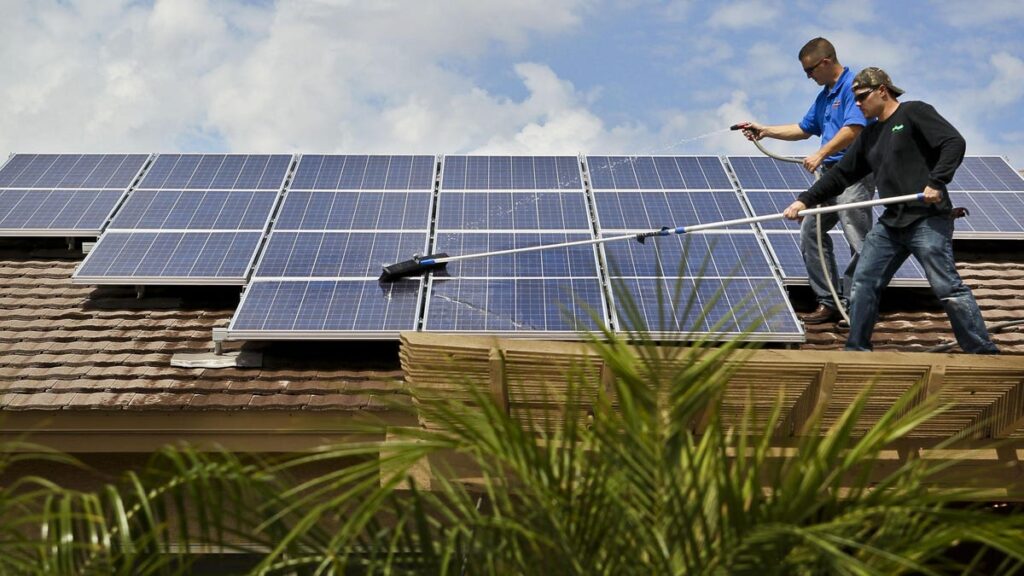
Meanwhile, solar and wind companies were bracing for impact in the days leading up to the bill’s passage. The legislation stands to gut residential solar in particular, an industry that was already facing significant headwinds.
“My company and I feel like we’re going back to 2005,” said Joy Seitz, CEO of American Solar and Roofing in Phoenix. “We have to build it all back up again.”
Still, some saw the bill’s passage as a potential turning point — a moment for the industry to reignite grassroots support and focus on making progress on the local level.
“It’s just incredible that we’re living in such a robust state with all of this economic growth and we’re not doing things at the state level that we should be doing,” said Neal of Veregy, noting a lack of solar-friendly policies in Arizona. “So, I would say that we can do it here. If the federal government is not going to support it, then let’s do it ourselves.”
What the legislation means for electric vehicles, clean tech
It’s not just the solar and wind industries raising red flags about the spending and tax bill. The legislation will also end tax credits for the purchase of electric vehicles after September, drawing that industry’s ire.
The Zero Emission Transportation Association was among the lobbying groups that bashed the legislation last week. Executive Director Albert Gore, the son of the former vice president and climate activist, said in a statement that the bill does “significant harm” to the speed at which the domestic electric vehicle and battery companies can scale up capacity to compete on the global stage.
It could spell trouble for a prominent sector in Arizona that is already facing headwinds from supply chain challenges, the threat of tariffs and a tough auto market.
Officials with Lucid Group, the state’s most prominent electric vehicle manufacturer, declined to comment on what the legislation could mean for the company. But CEO Marc Winterhoff said in an interview with an industry publication leading up to the bill’s passage that the tax credit issue would make it difficult for many budding electric vehicle companies to compete with industry juggernauts that have long benefitted from the existing policies.
The challenge comes as the company looks to dip into the mass market with a new vehicle late next year. The car, which the company has teased but not yet unveiled, is poised to come in with a price tag of about $50,000 and introduce the luxury manufacturer to a wider range of consumers. Up until now, its cars have remained out of reach for most drivers.
Those impacts may also trickle downstream to battery and charging infrastructure suppliers. Antoine Mistico, head of strategy at BreatheEV, said his industry is facing “similar downward pressure” to solar power businesses.
The company is a homegrown startup, the type of business that state leaders are increasingly focusing on cultivating as they seek to establish the desert as a major technology hub.
“We’re concerned that jobs may be at risk, or businesses may be in limbo regarding expansion,” said Brown of the Public Interest Research Group. “We hope that state policymakers will recognize the benefits these industries have brought to our state and work with them to figure out how they can continue to have successful operations here.”
Sasha Hupka covers utilities and technology for The Arizona Republic. Reach her at sasha.hupka@arizonarepublic.com or 480-271-6387. Follow her on X: @SashaHupka. Connect with her on LinkedIn: Sasha Hupka. Follow her on Instagram or Threads: @sashahupkasnaps. Follow her on Bluesky: @sashahupka.bsky.social.