
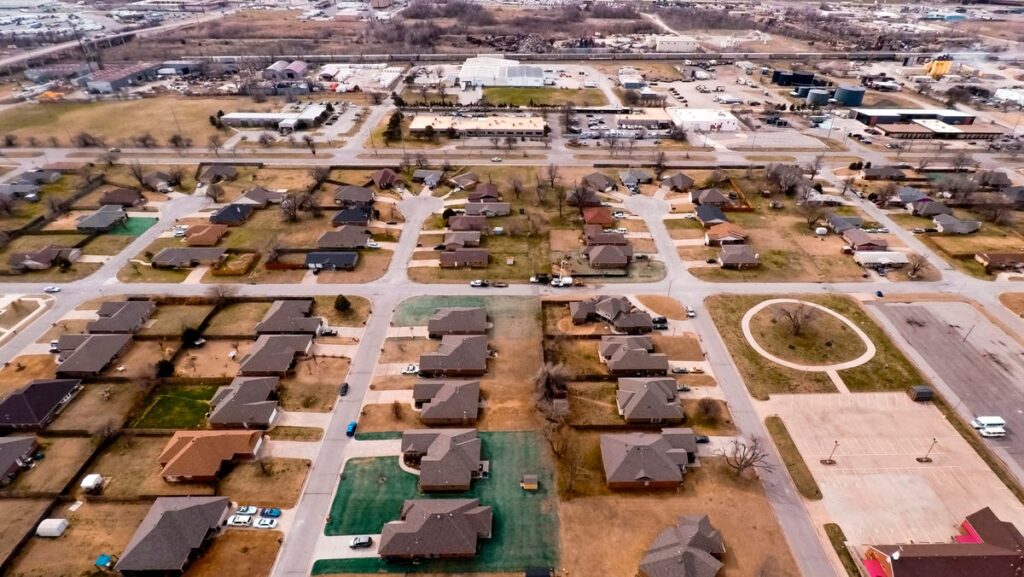
Zoning has consistently shunted the poor and marginalized into neighborhoods and municipalities with the most environmental hazards and the worst public services.


A human response to climate change
As the earth continues to warm, how will mankind respond? Author Kate Marvel wrestles with her anger in her new book, “Human Nature.”
“Environmental Justice” may be a term you’re unfamiliar with. It essentially means that everyone — regardless of race, color, national origin or income — has the right to the same environmental protections and benefits, as well as meaningful involvement in the policies that shape their communities. But rarely has this been the reality for people of color and those with low incomes.
For example, majority-White and affluent communities are where expenditures in infrastructure tend to be made, where environmental regulations are more likely to be enforced, and where polluters are most likely to be held responsible or kept away entirely. By comparison corporations, regulatory agencies and local planning and zoning boards disproportionately target low-income communities of color when siting polluting facilities like landfills, incinerators, smokestack industries, industrial hog and chicken processors, oil refineries, chemical manufacturers and radioactive waste storage areas.
To a large extent this was accomplished by once legal race-based exclusionary tactics in real estate called “redlining” which was used to perpetuate racial segregation.
Redlining leaves Black residents with worse living conditions
Between 1935 and 1940, an agency of the federal government, the Home Owners’ Loan Corp. (HOLC), graded the “residential security” of thousands of American neighborhoods. HOLC also evaluated and assigned grades to neighborhoods based on the perceived risks to lenders. The agency deemed northeast Oklahoma City, an area of mostly Black residents, as “hazardous” and due to the perceived risks, residents of this redlined neighborhoods could not secure mortgages from HOLC or the Federal Housing Administration (FHA).
Although with The Fair Housing Act redlining has been outlawed since 1968, pernicious modern-day zoning and permitting by local and state agencies around the country reinforce historical patterns and both preserve and perpetuate a uniquely American form of apartheid. Zoning has consistently shunted the poor and marginalized into neighborhoods and municipalities with the most environmental hazards and the worst public services.
The systemic problems contributing to environmental justice issues are also found at the federal level. For decades, EPA has effectively failed to enforce Title VI of the Civil Rights Act of 1964, designed to protect people of color and immigrants from discrimination by federally funded programs.
Ignoring environmental laws worsens environmental racism
This situation has now become a moot point since the Trump Administration has abolished the historic Office of Environmental Justice and External Civil Rights at the EPA which was responsible for addressing the disproportionately high levels of pollution facing poor and minority communities. The EPA is also in the process of canceling nearly 800 environmental justice grants. The grants were designed to boost access to clean air, water and land in communities living in substandard conditions or bearing a disproportionate burden of pollution.
Combined with the Trump administration’s intent to lower environmental regulations across the board, the closure of these offices is a double blow to environmental equity, a basic human right.
Environmental laws are often not enforced by local agencies, and environmental policies often fail to protect vulnerable communities. A review of the Oklahoma Department of Environmental Quality (DEQ) organizational chart shows divisions dedicated to air quality, water quality, and waste management, but no mention of a division, office, or even staff specifically dedicated to environmental justice or civil rights.
One of Oklahoma City’s oldest Black neighborhoods, the JFK neighborhood, stretching from NE Fourth to NE Eighth streets and Martin Luther King Avenue to Lottie Avenue, knows environmental injustice since for decades it has endured explosions from two scrapyards, family-owned Standard Iron & Steel and the Paris-based Derichebourg Recycling facility. So far this year residents have reported 14 explosions.
The complaints about Derichebourg and Standard Iron & Steel are old news at City Hall. Six successive city council members for the Ward 7 neighborhood have listened to the residents’ pleas — dating back to when the late Goree James was the councilman in the early 1990s.
The Oklahoma Department of Environmental Quality has responded that it can’t do anything because of state air quality exemptions given to scrapyards and difficulty proving any contaminants generated by the blasts are from the scrapyards.
Code inspectors argue they can’t issue noise violation citations unless they witness explosions happening. The residents have been told repeatedly the city wanted to help but couldn’t because the area is zoned for heavy industry and inspectors do not have enforcement jurisdiction.
Discriminatory exposure to environmental ills is so common in the United States that rectifying it won’t be easy, let alone in an era where the Supreme Court is rolling back equal-rights protections and Republican opposition is a given. But no one should have to live with greater environmental or health risks because of the color of their skin or how much money they have.
Mike Altshuler is a retired educator and environmental activist who lives in Edmond.