
Kyle Patrick Camilleri
Friday, 11 July 2025, 15:46
Last update: about 10 hours ago

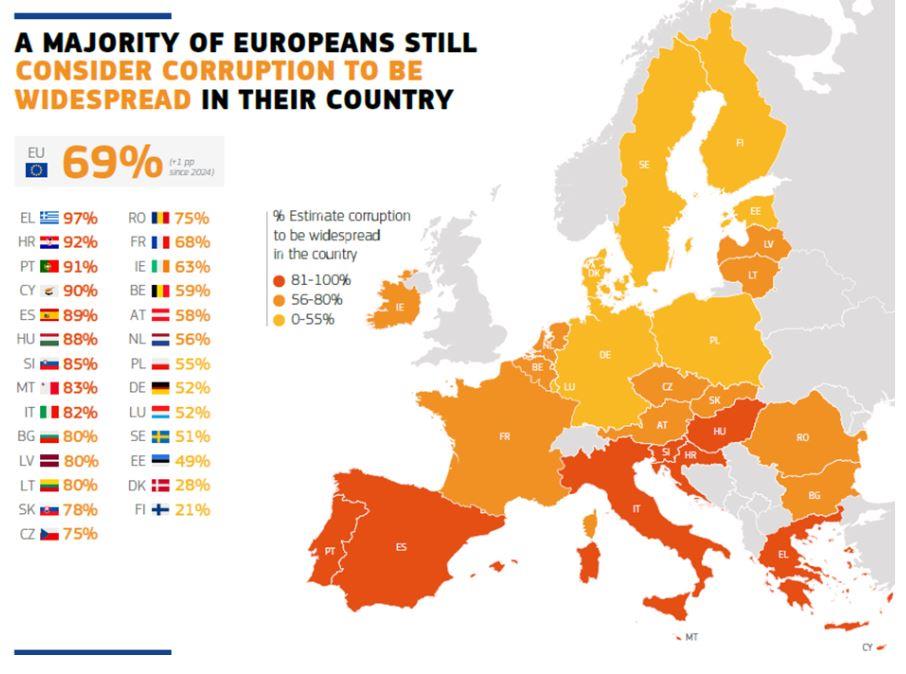
A Eurobarometer survey has found that 83% of Maltese believe that corruption is widespread across the Maltese islands. In contrast, 69% of respondents from other EU Member States, on average, believe corruption to be widespread in their respective countries.
This Special Eurobarometer was published this month. The survey data was collected between January and February of this year.
During this survey, which was conducted to gather general European perceptions on corruption, respondents were asked to state how widespread they think the problem of corruption is in their country.
In total, over four fifths of Maltese respondents (83%) perceive corruption to be widespread in the Maltese islands, just 9% think it to be rare, 7% said that they did not know, and 1% responded, despite this not being a prompted answer, that there is no corruption in Malta.
In terms of EU citizens and their home countries, an average of 69% of EU respondents believe that corruption is widespread in their home country, while 26% believe it is rare, and 5% said they lacked the knowledge to respond to this query.
Despite 83% already being significantly higher than the EU average response, this marks a 12% reduction since this same question was posed a year prior, in February/March 2024. The reduced percentage was evenly distributed between the “rare” response (+6%) and the “don’t know” response (+5%).
More Maltese generally believe that corruption is present within their national public institutions (82% v 73%) and within their local/regional public institutions (79% v 70%) than the EU average.
This Special Eurobarometer found that on every listed metric, more Maltese people think that “the giving and taking of bribes and the abuse of power for personal gain” are widespread when compared to the EU average.
At least half of Maltese respondents believe that such is the case among political parties (60%), among politicians at national, regional, or local levels (56%), among officials issuing building permits (58%), and among officials awarding public tenders (50%). The percentages for Malta were higher in all of these categories when compared to the EU average.
Aside from the four categories listed above, Maltese also have a higher perception when compared to the EU average on the presence of bribes and abuses of power for personal gain within private companies (35% v 31% EU average), regarding officials issuing business permits (47% v 21% EU average), the healthcare system (30% v 25% EU average), police and customs (41% v 22% EU average), tax authorities (33% v 17% EU average), Court tribunals (35% v 17% EU average), the public prosecution service (31% v 15% EU average), and in others.
Maltese believe corruption affects their daily lives, Europeans disagree
Maltese also believe that corruption impacts their daily life on a greater scale than the EU average. When asked this query, a majority of Maltese (52%) said that it does, in contrast to just 30% of EU citizens on average. On the other hand, 64% of EU citizens disagreed with this statement – a stark difference to just 40% of Maltese.
The demographic to relate mostly to this sentiment amongst locals were youths between the ages of 15-24 years old; 68% of these respondents feel that corruption personally affects their daily lives. The EU average for this demographic stood at just 29%.
It also appears that tolerance to corruption in the Maltese islands has marginally increased. A 6% increase was observed by this Special Eurobarometer in the percentage of Maltese that said they tolerate corruption, up to 24%. The EU average tolerance in this regard remained unchanged, at 30%.
This tolerance index also reads that 64% of Europeans and 74% of Maltese deem corruption to be unacceptable.
In addition, nearly double the number of Maltese respondents admitted to have either witnessed or experienced a case of corruption in the previous 12 months. While one in every twenty Europeans made this admission (5%), just under one in every ten (9%) Maltese related to this. 1% of Maltese respondents outright refused to answer this question.
The portion of Maltese to personally know anyone who takes or has taken bribes was also significantly higher than the EU average: 23% to the EU average of 9%.
This study has found that perceptions of corruption in Malta in business and politics are also more widespread than the rest of Europe. 59% of Maltese agreed with the statement that the only way to succeed in business in Malta is to have political connections – a 5% increase.
Notably less Maltese in this recent survey (-9%) agreed with the statement that “high-level corruption cases are not pursued sufficiently” in Malta. In spite of this significant decrease, 70% of Maltese respondents still agreed, which is still higher than the EU average of 66%.
Biggest deterrence for Maltese to report corruption is fear of being persecuted by law enforcers or in the workplace
This Special Eurobarometer asked respondents to outline some possible reasons behind why people may decide against reporting a case of corruption.
While 43% of EU citizens on average cited that it would be difficult to prove such claims, the most common answer amongst Maltese was that “there is no protection from retaliation for those who report corruption, including in the work context” (40%).
The next most common reason amongst Maltese was that reporting such a case would be pointless as those responsible would not be punished (36%), narrowly followed by fear that “those who report cases get into trouble with the police or with other authorities” (35%).
That being said, most EU citizens (61%) and Maltese, although to a significantly lesser extent (41%), trust the police to deal with such a case, when asked to select from a number of options.
Maltese stated to have more trust in specialised anti-corruption agencies (30%), the national ombudsman (25%), the media, newspapers, and journalists (21%), and NGOs (16%) to deal with such matters over their own justice system, which includes the law courts, tribunals, and public prosecution services (15%).
This Eurobarometer was based off of 26,354 interviews across the EU’s 27 Member States, 503 of which were with Maltese respondents.