
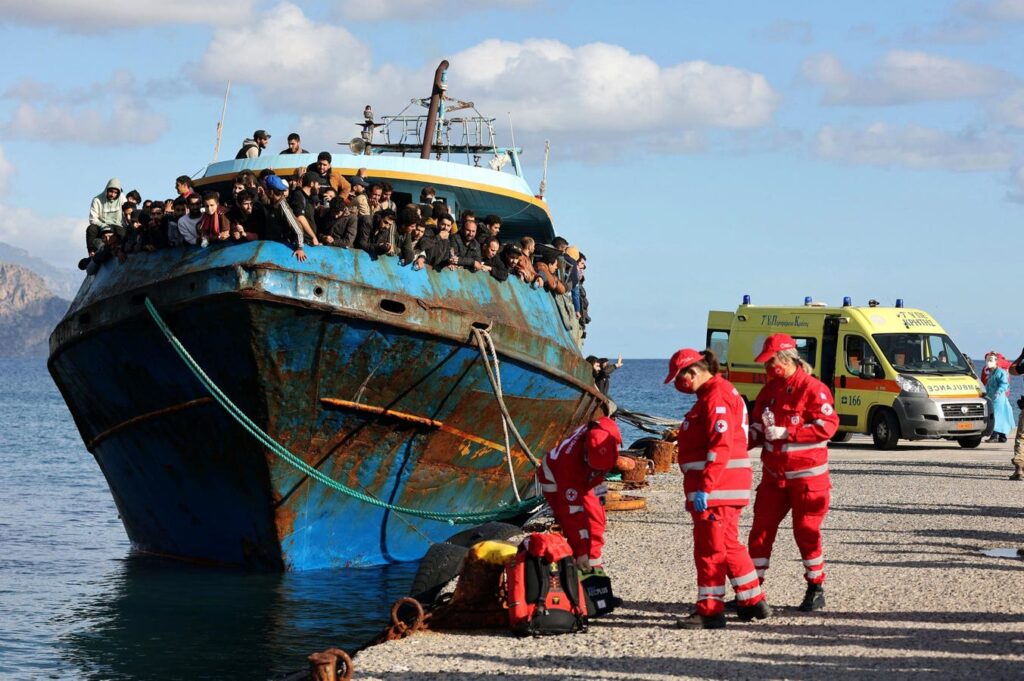
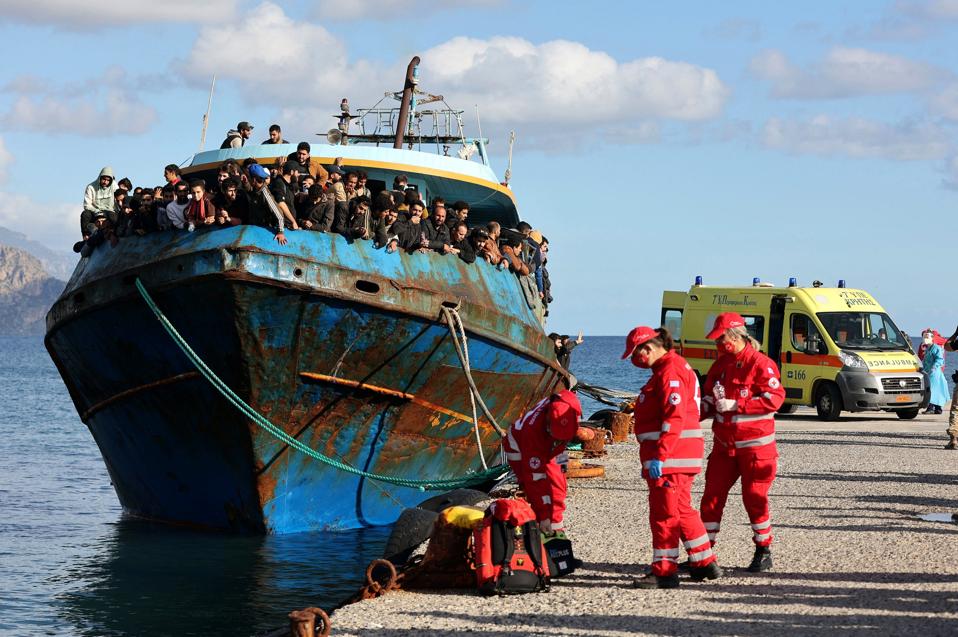
Rescuers and health workers stand by a boat carrying some 400 people on Crete. (Photo by Costas … More METAXAKIS / AFP) (Photo by COSTAS METAXAKIS/AFP via Getty Images)
AFP via Getty Images
The Greek parliament has approved a measure to suspend the registration of people arriving to Greece by boat in order to claim asylum. The move – which comes just weeks after the swearing-in of a new right-wing migration minister and an increase of arrivals on the Greek island of Crete – has been condemned by NGOs and civil society organizations. The NGOs say the move is contrary to the human rights of people seeking shelter and also that it is counter-productive.
The 90-day suspension of asylum registrations essentially means that nobody arriving by boat in the next three months will be able to claim asylum, no matter their origin or situation, and the government has said they will be deported to their country of origin as soon as possible. It was first announced by Prime Minister Kyriakos Mitsotakis, and later approved by parliament as an amendment to an unrelated law (something migration policy expert Manos Moschopoulos notes is a common strategy in Greece).
It comes amid a noted increase in arrivals on the Greek islands of Crete and Gavdos. The perceived crisis is exacerbated by a lack of reception and processing facilities on those islands – because of a historically small amount of arrivals and local resistance to building such facilities. Images of people being temporarily housed in a local stadium and exhibition center have spread widely, and the Greek government have argued the situation is an emergency which justifies the radical measure. Critics have pointed out, however, that denying people access to asylum – regardless of the way they arrive – is a violation of various EU and international refugee and humanitarian legal frameworks. They have also pointed out the impracticability – impossibility even – of returning people without first registering them (and thereby learning where they are from), and absent the cooperation of many countries of origin.
“Denying the right to seek asylum based on how someone arrives is discriminatory and violates the core principles of refugee protection,’” said Adriana Tidona with Amnesty International. “International law strictly prohibits returning people without first assessing their circumstances. The Greek government should immediately reverse this decision.”
The Greek legal aid charity the Human Rights Legal Project called the move “a gross violation of fundamental human rights.” The Council of Europe Commissioner for Human Rights, Michael O’Flaherty, said the amendment “would legalize returning people to face a risk of torture and other serious violations, in breach of obligations under the European Convention on Human Rights, the 1951 Refugee Convention (…) and the EU Charter of Fundamental Rights.”
While completely suspending access to asylum and the registration of people arriving on boats seems like a radical policy step for an EU member state, it is in keeping with a general policy trend seen around Europe. Lithuania and Poland have similarly suspended the right to asylum for ‘irregular’ arrivals, though with various exceptions for certain groups of people. At the same time, Germany has put in measures to forcibly prevent people reaching its territory, and Italy has pursued a controversial scheme to intercept people seeking shelter and take them to Albania, outside of EU jurisdiction. The European Commission itself is laying the groundwork for more such schemes, which would see people denied the ability to claim asylum on European territory.
This overall policy trend – blocking people from seeking asylum on Europe’s territory – was in previous years something typically only advocated by those on the fringe of European politics. It is, however, rapidly becoming mainstream. This latest move from Greece is certainly a step further, but in no way marks Greece as an outlier.