
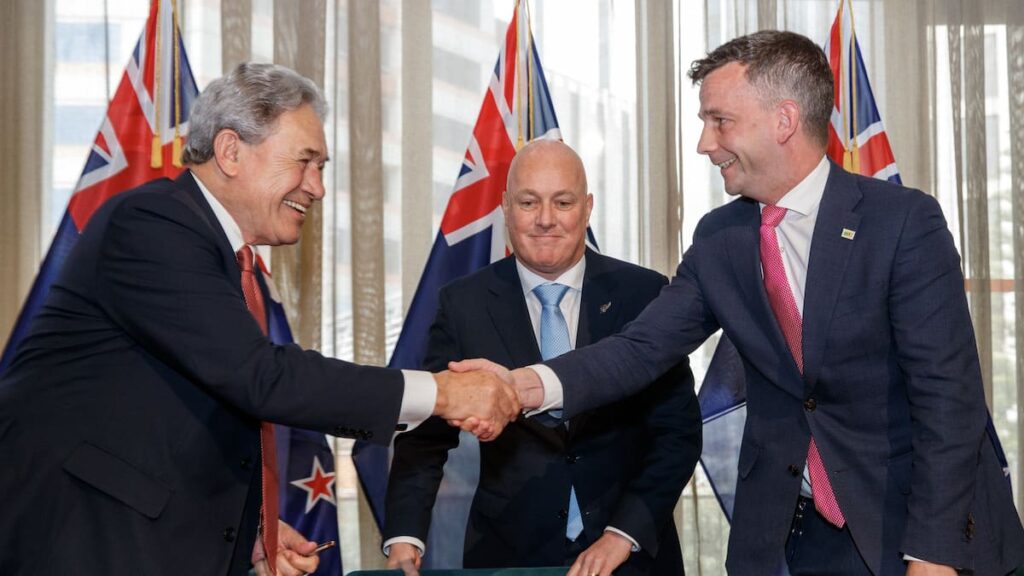
Seymour believes it will carry the “same message” as his now-withdrawn correspondence did and that “everyone agrees” with what he had said.
Peters told reporters the new letter is still being written and consulted on but a “key difference” would be that his letter will be factual and accurate.
The Herald understands the formal Government response won’t mirror Seymour’s letter in saying the special rapporteur’s actions were an “affront to New Zealand’s sovereignty”.
New Zealand is a founding member of the United Nations, which has special rapporteurs who regularly report on countries’ adherence to human rights, such as indigenous rights.
Labour leader Chris Hipkins said this was “another absolute debacle from the Government”. He said Seymour was “undercutting” Peters and it was “embarrassing” for the Government, something the coalition leaders dismissed.
The tit-for-tat broke out after the Herald first reported on Sunday that Barume had written to the Government with his concerns about some domestic matters, including Seymour’s Regulatory Standards Bill, which he said excluded Māori tikanga and failed to uphold the Treaty of Waitangi.
Seymour wrote back as Minister for Regulation, saying the letter was “presumptive, condescending, and wholly misplaced” and Barume’s “insistence on interfering in matters of domestic law is an affront to New Zealand’s sovereignty”.
On Tuesday morning, Prime Minister Christopher Luxon said while he agreed with the substance of Seymour’s letter and believed Barume’s comments were a “waste of time”, it should have been Peters who responded to the UN.
Seymour subsequently said he stood by the contents of the letter, but had been “too efficient in my correspondence” and acknowledged the response should have come from Peters.
“Winston and I have fixed the problem. I’m going to withdraw my letter so that the Government can send one response, I expect that letter to make the same points,” he said.
Speaking to reporters, Seymour insisted he was not embarrassed by the U-turn and the Government’s new letter would be “united with the same message”.
Asked by the Herald whether everyone agreed with the message, Seymour responded: “What I have heard is very strong support for the message”.
“My discussions with the Foreign Affairs Minister, he said, ‘yep, you won’t be disappointed. It will have the same points on it’.”
He believed his relationship with Peters was “dangerously strong”.
Seymour said he met with the Prime Minister following his discussion with Peters, and “what I took from it was, love the message, but it’s important that we have one response”.
He stood by making the comment about an “affront to New Zealand’s sovereignty”.
“I think everyone agrees, including the Prime Minister this morning, with what I said in the letter. The only thing that anyone is disagreeing about is whether we should send separate letters about our areas or one as a Government. To be honest, I don’t really mind either way, we are now doing it together.”
Peters said he was preparing the Government’s response to Barume when he found out that “other ministers were involved”.
“My reaction? Well, I went to find out. I had a talk with David about who is responsible, how it works. This is a matter of experience here and it’s called diplomacy. The matter has been totally resolved.”
He again said the issue had been handled when asked if it looked messy for the Government.
But Peters said the new letter would “of course not” include the same points as Seymour’s letter did. That was because the letter was still being “crafted”.
Later, Peters said it was “not true” his letter would be the same as Seymour’s.
Asked what the key difference would be between the two letters, Peters responded: “I can’t entertain the idea of megaphone diplomacy, but it will be factual and it will be accurate. Those will be the key differences.”
Was Seymour’s factual and accurate?
“Well, why is it being withdrawn?” Peters said.
In his letter, Barume said he was “particularly concerned” with the Regulatory Standards Bill, which he said “excludes Māori traditions [tikanga] and fails to uphold the principles of partnership, active protection and self-protection guaranteed under the Treaty of Waitangi”.
“I am preoccupied that the bill threatens Māori-specific laws that address structural inequalities in matters relating to, for example, land, language and environmental stewardship, and because it seems to impose a monocultural legal standard, marginalising Māori as legal subjects without respecting their own governance frameworks”.
Seymour hit back, writing in his capacity as the Minister for Regulation, saying he found the letter “presumptive, condescending and wholly misplaced”.
“As an indigenous New Zealander myself, I am deeply aggrieved by your audacity in presuming to speak on my behalf and that of my fellow Māori regarding legislation that aims solely at ensuring clarity, consistency and accountability in regulatory processes.”
Seymour said Barume’s characterisation of the Regulatory Standards Bill’s approach to tikanga was “not only incorrect but offensive” because the bill “neither undermines nor overrides” current Treaty settlements or ”statutory protections afforded to Māori”.
Jamie Ensor is a political reporter in the NZ Herald press gallery team based at Parliament. He was previously a TV reporter and digital producer in the Newshub press gallery office. In 2025, he was a finalist for Political Journalist of the Year at the Voyager Media Awards.