
Breadcrumb Trail Links
Wildfire smoke from forest fires in northern Ontario has drifted to the region
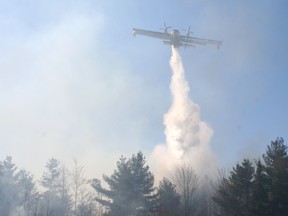 A special air quality statement has been issued for areas across Ontario, including Perth and Huron counties, due to wildfire smoke. (Postmedia Network file photo) Photo by Postmedia Photo
Article content
Wildfire smoke from northern Ontario has drifted into the Perth and Huron counties region, prompting Environment Canada to issue a special air quality statement.
Advertisement 2
Article content
This statement encompasses a broad swath of the two counties, including Wingham, Blyth, northern Huron County, Goderich, Bluewater, southern Huron County, Listowel, Milverton, northern Perth County, Stratford, Mitchell and southern Perth County, Huron Perth public health officials said in a release.
Article content
Recommended Videos
Article content
The smoke from these ongoing forest fires is causing — or is expected to cause — poor air quality and reduced visibility in the region. This poor air quality, officials said, is expected to persist into Tuesday in some areas of the region.
As noted in the Huron Perth public health release, wildfire smoke can be carried thousands of kilometres from the source, impacting the air quality in areas far from the blaze.
Advertisement 3
Article content
Residents are urged to visit www.airhealth.ca or www.airqualityontario.com for current and expected air quality health index values, information on potential health risks and recommended actions to reduce exposure to poor air quality.
Public health officials acknowledged there are no air-quality measuring stations in Huron or Perth counties, but noted there are stations in Grand Bend, Kitchener-Waterloo and London that can provide an overview of general air-quality trends in the region.
As the air quality declines from the increasing smoke levels, health risks do increase. Although wildfire smoke can be harmful to everyone’s health, there are people, including older adults, pregnant women, infants, young children, smokers, outdoor workers, the chronically ill and the homeless, who are more likely to be affected.
Advertisement 4
Article content
People can lower the risk of respiratory problems from poor air quality by:
- Monitoring for symptoms, such as coughing, throat irritation, shortness of breath, dizziness or chest pain and seeking medical attention if needed;
- Staying indoors when the AQHI is 7 or greater (high risk), and reducing or stopping strenuous outdoor activities;
- Checking on people in your care and those around you who may be more susceptible to air pollution;
- Taking a break from the smoke at a location in your community where you can find clean, cool air, such as a library or community centre;
- Drinking plenty of water; and
- Protecting the indoor air in your home by keeping windows and doors closed, and using air conditioning, or fans; properly sealing windows and doors with weather stripping; setting your ventilation system to recirculate when outdoor air is poor; and using a clean, good quality air filter.
For people who must spend time outdoors during periods of poor air quality, public health officials recommend using well-constructed and well-fitted respirator-type masks to reduce exposure to the fine particles in the smoke. Huron Perth public health does have a limited supply of N95 respirators available for at-risk residents.
Article content
Share this article in your social network