Source: Census Bureau (Current Population Survey, Annual Social and Economic Supplement)
Tools: Datawrapper, Illustrator
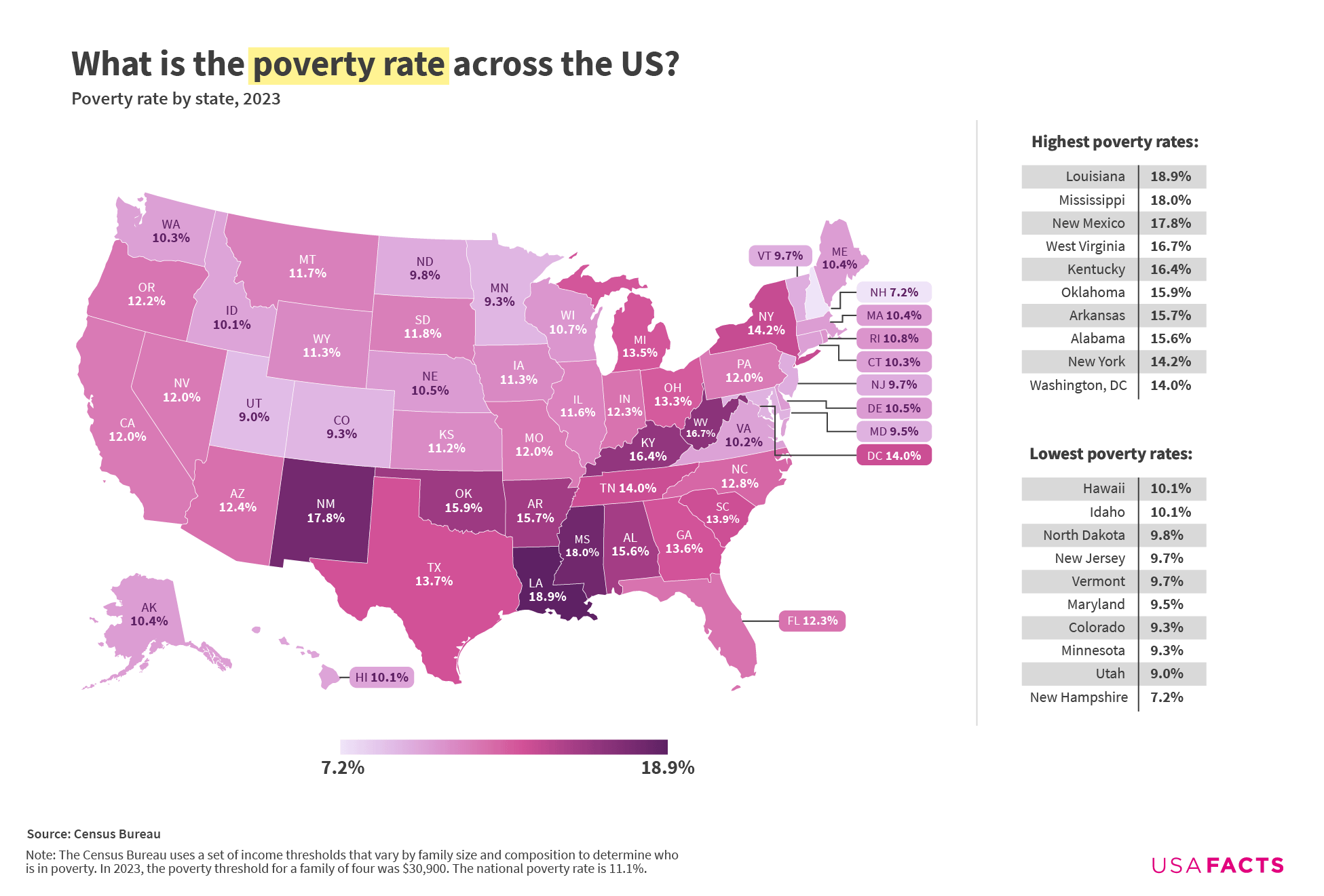
Note: The Census Bureau uses a set of income thresholds that vary by family size and composition to determine who is in poverty. In 2023, the poverty threshold for a family of four was $30,900. The national poverty rate is 11.1%.
Kinda surprised to see Mississippi isn’t last in a chart like this. I mean, it’s close! But not last.
USAFacts on
In 2023—the most recent data available—36.8 million people in the US lived in poverty, or about 11.1% of the population.
The national poverty rate was first officially recorded in 1959 at 21.9%. It has generally declined since then, with spikes during economic downturns. The last time the rate rose above 15% was in 2010, following the Great Recession.
The 2023 rate of 11.1% was a slight decrease of 0.4 percentage points from 2022. However, the poverty rate for children under 18 increased from 15% to 15.3%. The rate for adults under 65 decreased from 10.6% to 10.0%, and the rate for over-65s decreased from 10.2% to 9.7%.
At the state level, poverty rates ranged from 18.9% (Louisiana) to 7.2% (New Hampshire) in 2023.
So it’s set by national poverty rates which don’t adjust for cost of living? Feels like we should adjust for that. It’d also be neat to see that side by side with effective poverty rate since states vary in their welfare levels
domainmaker on
Poverty rate without adjusting for cost of living is meaningless.
Sam_Fear on
Others have pointed COL out. We’ll just take the two favorites, MS and CA. MS has a COL index of 88% of US average and CA 145%. So in MS you only need to make $27,200 to meet basic needs but in CA it’s $44,500. Using adjusted numbers that map would look wildly different.
Danyboii on
Alternate title, “Salaries are higher in places with high cost of living.” No kidding.
sambes06 on
EU map for comparison would be nice
MR_Se7en on
Always make me wonder why people don’t move to the next state for a better life.
fedricohohmannlautar on
Why is the Southern half poorer?
veggie151 on
Reminder:
Capitalism promotes poverty. People who start with less will be less likely to get a share of the economic pie, and the cycle perpetuates.
mjdefaz on
but the internet told me my home state of new jersey is too expensive to stay in
Grumdi_Blackdiamond on
There are large portions of this nation that are in fact more 3rd than 1st world. I have lived in a few of them. My wife is from Iberia parrish. Poor is an understatement.
Its_Pine on
Maybe a dumb question, but doesn’t this say it is based on a single national cost of living?
So wouldn’t that just mean that New Hampshire just has more people in it who make enough money to qualify by the national metric as “above poverty” than other states in New England?
>The wide chasm between the the BLS’s measure of unemployment and its true rate of unemployment is also concerning, according to Ludwig.
>
>”If you say there’s 4.2% unemployment, which makes political folks happy because it’s a low number, it causes all kinds of poor policy decisions and assumes we are better off than we are,” Ludwig said. “There’s less energy and less of a push to improve employment, and the people who get hurt are middle- and low-income Americans.”
>BEFORE every flight, pilots reset the altimeter of their aircraft to match the elevation of the local airport. If they didn’t, the altimeter reading would gradually diverge from the true measure, endangering the safety of all aboard.
>It’s no different for economic statistics. When they are not updated, the subjects they once measured can become obscured.
>
>A good example is the poverty line, the nation’s official measure of need. Economists have long argued that the poverty line should be revised to provide an accurate picture of who is actually poor. Yet it has remained essentially untouched since 1963, when Mollie Orshansky, an economist at the Social Security Administration, first came up with it.
>
>Today, there is a consensus among economists that it is no longer on the mark. “Everyone agrees we need a better measure,” said Douglas J. Besharov, a resident scholar at the American Enterprise Institute and a professor of public policy at the University of Maryland.
>
>To him and many others, the public lacks an accurate test of who is poor, making it far harder to justify actions, whether by government or by individuals, intended to alleviate poverty.
>
>No one blames Ms. Orshansky. She devised a simple and elegant measure of poverty based on the data available at the time. And she never expected that it would be used today as a trigger for billions of dollars in government spending.
… That was published in 2006.
The info on the link from MIT is much more accurate.
>Killett said that, from her experience, people who are in poverty have absolutely nothing left over to put into savings. If basic needs such as food, housing, health care, and child care are being addressed, she said, then a person in poverty can absolutely save money, but right now every penny in their tight budgets is already spoken for by the basic needs. Poor people are not able to build toward anything that resembles wealth because there is nothing left over every month to put towards those savings.
>
>While food and housing are obviously important, people should not have to choose whether they need one over the other.
>
>When asked what resources were most important to prioritize, Killett responded that food would likely be the priority, but pointed to a larger reality. People in poverty are asked to prioritize what they need to survive, but the question should be more focused on what people need to thrive, Killett said. She said that while food and housing are obviously important, people should not have to choose whether they need one over the other.
>
>“The intersectionality of all of these systems, including housing, food, and health care are drivers [of inequality],” Killet said. “If we want to stop this, we must be courageous, we must have the will, and we must be bold, because that is what it is going to take.”

![[OC] Poverty rates in the US](https://www.byteseu.com/wp-content/uploads/2025/07/n6e0ov1052df1-1536x1040.png "[OC] Poverty rates in the US")
15 Comments
Source: Census Bureau (Current Population Survey, Annual Social and Economic Supplement)
Tools: Datawrapper, Illustrator
Note: The Census Bureau uses a set of income thresholds that vary by family size and composition to determine who is in poverty. In 2023, the poverty threshold for a family of four was $30,900. The national poverty rate is 11.1%.
More data [here](https://usafacts.org/answers/what-is-the-us-poverty-rate/country/united-states/)
Kinda surprised to see Mississippi isn’t last in a chart like this. I mean, it’s close! But not last.
In 2023—the most recent data available—36.8 million people in the US lived in poverty, or about 11.1% of the population.
The national poverty rate was first officially recorded in 1959 at 21.9%. It has generally declined since then, with spikes during economic downturns. The last time the rate rose above 15% was in 2010, following the Great Recession.
The 2023 rate of 11.1% was a slight decrease of 0.4 percentage points from 2022. However, the poverty rate for children under 18 increased from 15% to 15.3%. The rate for adults under 65 decreased from 10.6% to 10.0%, and the rate for over-65s decreased from 10.2% to 9.7%.
At the state level, poverty rates ranged from 18.9% (Louisiana) to 7.2% (New Hampshire) in 2023.
Here’s a [guide](https://www.census.gov/topics/income-poverty/poverty/guidance/poverty-measures.html) on how the Census Bureau measures poverty, including a link to its poverty thresholds. Here’s what they looked like in 2023:
https://preview.redd.it/7xf4qkqg72df1.png?width=1497&format=png&auto=webp&s=a898d1eeecdbdb0831341a754bb967b6288f9c40
So it’s set by national poverty rates which don’t adjust for cost of living? Feels like we should adjust for that. It’d also be neat to see that side by side with effective poverty rate since states vary in their welfare levels
Poverty rate without adjusting for cost of living is meaningless.
Others have pointed COL out. We’ll just take the two favorites, MS and CA. MS has a COL index of 88% of US average and CA 145%. So in MS you only need to make $27,200 to meet basic needs but in CA it’s $44,500. Using adjusted numbers that map would look wildly different.
Alternate title, “Salaries are higher in places with high cost of living.” No kidding.
EU map for comparison would be nice
Always make me wonder why people don’t move to the next state for a better life.
Why is the Southern half poorer?
Reminder:
Capitalism promotes poverty. People who start with less will be less likely to get a share of the economic pie, and the cycle perpetuates.
but the internet told me my home state of new jersey is too expensive to stay in
There are large portions of this nation that are in fact more 3rd than 1st world. I have lived in a few of them. My wife is from Iberia parrish. Poor is an understatement.
Maybe a dumb question, but doesn’t this say it is based on a single national cost of living?
So wouldn’t that just mean that New Hampshire just has more people in it who make enough money to qualify by the national metric as “above poverty” than other states in New England?
Edit: [yeah, NH has higher poverty when adjusted for cost of living](https://nhfpi.org/blog/low-poverty-rate-in-new-hampshire-does-not-rank-lowest-among-states-by-all-estimates-of-poverty/). Not terrible, but definitely not the lowest.
It almost seems like the numbers are adjusted in order to keep them in line with the historical average…:
`{this is where the infographic would go if reddit wasn’t janky. instead, see next comment}`
[https://www.irp.wisc.edu/resources/how-is-poverty-measured/](https://www.irp.wisc.edu/resources/how-is-poverty-measured/)
^-source for the infographic and the quoted text below
>Poverty Threshold: Three times the cost of a minimum food diet *in 1963.*
>Supplemental Poverty Measure: Based on recent expenditures for food, clothing, shelter, utilities, telephone, and internet (FCSUti).
More info:
[https://www.census.gov/topics/income-poverty/poverty/guidance/poverty-measures.html](https://www.census.gov/topics/income-poverty/poverty/guidance/poverty-measures.html)
Moore infoo:
[Most Americans Don’t Earn Enough to Afford Basic Costs of Living, Analysis Finds by Megan Cerullo, Edited by Alain Sherter | 16 May 2025](https://www.cbsnews.com/news/cost-of-living-income-quality-of-life/?ftag=YHF4eb9d17)
[https://lisep.org/mql](https://lisep.org/mql) (mql = Minimal Quality of Life)
Mooore infooo (copied from a [previous comment](https://www.reddit.com/r/economy/comments/1kw8fo0/comment/muhbxdl/) on a [previous article](https://www.yahoo.com/news/1-4-americans-functionally-unemployed-155455918.html)):
>The wide chasm between the the BLS’s measure of unemployment and its true rate of unemployment is also concerning, according to Ludwig.
>
>”If you say there’s 4.2% unemployment, which makes political folks happy because it’s a low number, it causes all kinds of poor policy decisions and assumes we are better off than we are,” Ludwig said. “There’s less energy and less of a push to improve employment, and the people who get hurt are middle- and low-income Americans.”
[https://www.eig.org/distressed-communities/](https://www.eig.org/distressed-communities/)
[https://livingwage.mit.edu/](https://livingwage.mit.edu/)
(the MIT website has a state-by-state measurement, btw)
>[A Poverty Line That’s Out of Date and Out of Favor by Anna Bernasek](https://www.nytimes.com/2006/03/12/business/yourmoney/a-poverty-line-thats-out-of-date-and-out-of-favor.html)
>BEFORE every flight, pilots reset the altimeter of their aircraft to match the elevation of the local airport. If they didn’t, the altimeter reading would gradually diverge from the true measure, endangering the safety of all aboard.
>It’s no different for economic statistics. When they are not updated, the subjects they once measured can become obscured.
>
>A good example is the poverty line, the nation’s official measure of need. Economists have long argued that the poverty line should be revised to provide an accurate picture of who is actually poor. Yet it has remained essentially untouched since 1963, when Mollie Orshansky, an economist at the Social Security Administration, first came up with it.
>
>Today, there is a consensus among economists that it is no longer on the mark. “Everyone agrees we need a better measure,” said Douglas J. Besharov, a resident scholar at the American Enterprise Institute and a professor of public policy at the University of Maryland.
>
>To him and many others, the public lacks an accurate test of who is poor, making it far harder to justify actions, whether by government or by individuals, intended to alleviate poverty.
>
>No one blames Ms. Orshansky. She devised a simple and elegant measure of poverty based on the data available at the time. And she never expected that it would be used today as a trigger for billions of dollars in government spending.
… That was published in 2006.
The info on the link from MIT is much more accurate.
>[It’s Time to Reset the Poverty Line by Ellie Kaverman 24 Nov 2020](https://tcf.org/content/commentary/time-reset-poverty-line/#:~:text=More%20than%20fifty%20years%20later%2C%20the%20OPM,is%20still%20not%20sufficient%2C%20and%20remains%20unofficial)
>Killett said that, from her experience, people who are in poverty have absolutely nothing left over to put into savings. If basic needs such as food, housing, health care, and child care are being addressed, she said, then a person in poverty can absolutely save money, but right now every penny in their tight budgets is already spoken for by the basic needs. Poor people are not able to build toward anything that resembles wealth because there is nothing left over every month to put towards those savings.
>
>While food and housing are obviously important, people should not have to choose whether they need one over the other.
>
>When asked what resources were most important to prioritize, Killett responded that food would likely be the priority, but pointed to a larger reality. People in poverty are asked to prioritize what they need to survive, but the question should be more focused on what people need to thrive, Killett said. She said that while food and housing are obviously important, people should not have to choose whether they need one over the other.
>
>“The intersectionality of all of these systems, including housing, food, and health care are drivers [of inequality],” Killet said. “If we want to stop this, we must be courageous, we must have the will, and we must be bold, because that is what it is going to take.”