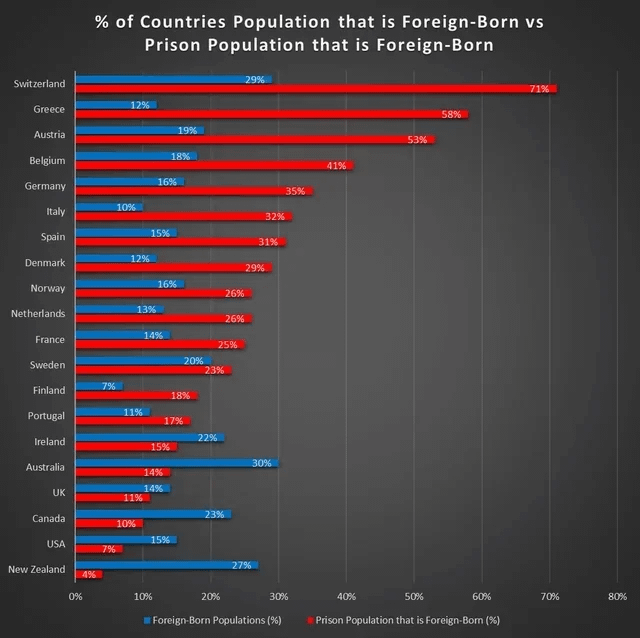
Incarceration Rates: Foreign-Born Nationals are Under-represented in the Anglosphere but are Over-represented in Europe [OC]
Posted by Fluid-Decision6262

Incarceration Rates: Foreign-Born Nationals are Under-represented in the Anglosphere but are Over-represented in Europe [OC]
Posted by Fluid-Decision6262
9 Comments
[Financial Times: The Anglosphere has an advantage on immigration](https://www.ft.com/content/c6bb7307-484c-4076-a0f3-fc2aeb0b6112)
One of the biggest discrepancies that this financial times article talks about is the immigrant trends in the English-speaking world vs in Europe, including the over-representation of foreign-born nationals in mainland European prisons vs under-representation of foreign-born nationals in Anglosphere prisons (US, UK, Canada, Australia, NZ, and Ireland).
In each core Anglosphere country, foreign-born nationals are under-represented relative to their total share of the populous among local prison populations. In addition to being in prison less than the national averages, immigrants in the UK, Ireland, Australia, and the US, on average, provide a net positive fiscal boost to each local economy as foreign-born nationals often contribute more money to the economy than the amount they received from each government.
The children of immigrants are also performing better in the Anglosphere. In the UK, Australia, Canada, and USA, children of immigrants from all ethnicities earn more than their immigrant parents’ generation did, and on average, by the time the second generation reach adulthood, they are more educated and earn more than your average Brit, American, Canadian, Aussie, and Kiwi.
However in Europe, the opposite is true. Foreign-born nationals are over-represented in each selected mainland European country relative to their total share of the populous among local prison populations. In addition to being in prison more often, immigrants in countries like France, Belgium, Sweden, and the Netherlands are, on average, net recipients of government spending meaning they receive more money from the government than the amount of money they put in.
The children of immigrants are also performing worse in Europe. In France and Germany, children of immigrants inexplicitly earn less than their immigrant parents’ generation did, and on average, by the time the second generation reach adulthood, they are even more economically disadvantaged compared to your average European than their parents’ generation were.
What exactly does the Anglophone world do that continental Europe has not when it comes to better integrating newcomers to their countries?
And that’s why the far-right is growing in Europe….
Where are most of the immigrants in Europe from???? The American immigrants are mostly from Mexico and southern America. There are two cultural differences
In the US is a known fact, backed up with research which shows that racial and ethnic disparities exist in sentencing, with minorities, particularly Black individuals, facing harsher penalties and longer sentences compared to white individuals for similar offenses.
Foreigners, especially the caribbean type, are over-represented in chilean jails too.
“are your immigrants primarily Latino and Asian, or Muslim?”
A significant part of this is different ways in which racism works in different parts of the world. The anglo-sphere puts strong police pressure on specific parts on their own population that leads to over incarceration of those people. In continental Europe we do that on immigrant population.
Over my 39 years of live I’ve been stopped 5-6 times by the police. It has always been traffic controls. My african, and african descendent, friends get stopped a weekly basis for very flimsy reasons.
A lot of my teenage friends shoplifted at least a few times when they were teenagers. A few of them sold small amounts of drugs. Some of them were caught more than once doing both things. For shoplifting, no store ever called the police. They would threaten with it, bu then just dealt with it privately with their security personnel. For drug dealing, the cops would just take the drugs and not press any charges. Make these same friends less white, and suddenly the same acts lead to a police record.
I’ve helped in some of the camps in which they put migrants in the Canary Islands, and a lot of the police serving around those were racist assholes. They would claim an agression and take someone in custody just for people responding when they were acting like trash.
So my personal experience with both migrants and cops makes me very skeptical that the fraction of the population incarcerated, or found guilty of crimes, can be used as an objective statistic. The system that creates those stats is anything but objective.
The difference between how well immigrants adjust in the US (and actually all of the Anglo-Sphere) and Europe is startling. While it can be argued that Western Hemisphere immigrants might be culturally closer to the US than African and Islamic immigrants to Europe,I doubt that explains everything. Islamic immigrants to the US, unlike Europe, do very well, assimilate and tend to be practically invisible.
Could language also play a part? A lot of countries teach English as a second language, but not many of the European languages. Which might result in immigrants having an easier time adjusting to an English speaking country because it’s easier for them to communicate there, and it’s easier to figure out what’s going on around them.
This is just speculation, I don’t have any research this is based on, just me thinking about things.