
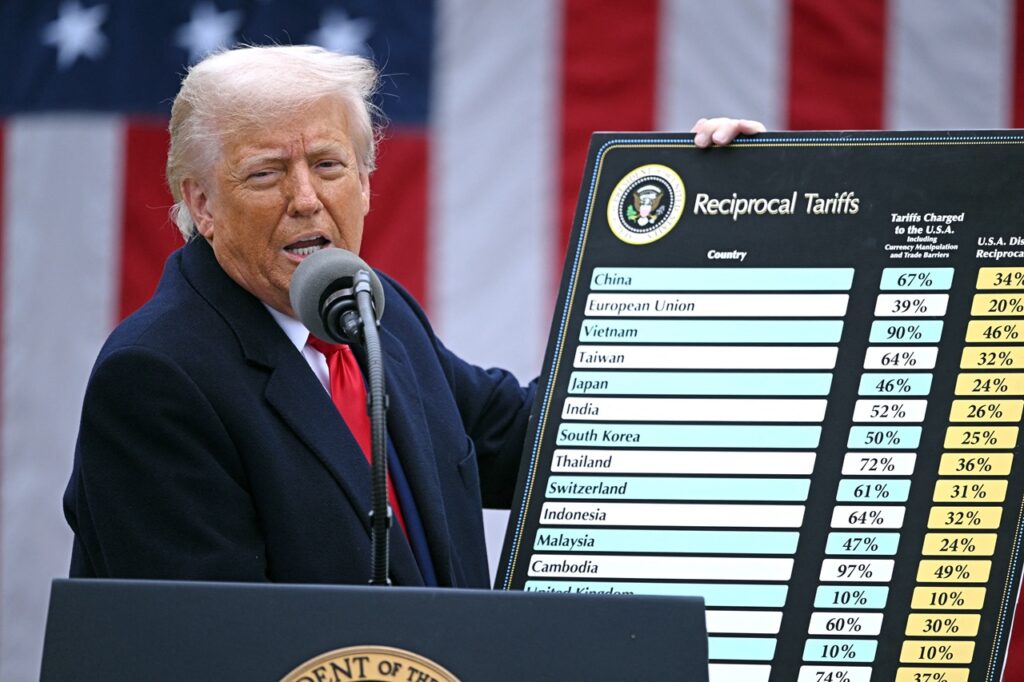
Since his reelection in 2024, President Donald Trump has accelerated a radical transformation of U.S. economic policy. The impact of his decisions—abrupt tariffs, a weakening dollar, pressure on the Federal Reserve—has been felt well beyond the country’s borders. According to economist Mohamed El-Erian, author of the Foreign Affairs piece, the world can no longer count on Washington as a source of stability. On the contrary, it must brace for a new era of volatility, fragmentation, and uncertainty.
Even before the elections, the world was already grappling with geopolitical tensions and technological disruptions. But now, the new factor is the unpredictability of U.S. policies. El-Erian describes this as a break from decades of continuity: the old “golden rules” that guided governments, companies, and investors no longer apply. Decisions have become erratic, tariff exemptions appear arbitrary, and trust in institutions is beginning to erode.
The effect has been immediate: consumer and business confidence has plummeted, financial markets are unstable, and economic forecasts swing between opposing scenarios. While some foresee a Reagan-Thatcher-style economic restructuring, others fear a return to stagflation and financial instability.
The U.S. as an Emerging Economy?
One of the most striking warnings in the article is that the U.S. economy is starting to resemble that of a developing country. The comparison is not exaggerated: a weak tax system, rising deficits, sudden trade policies, capital outflows, and concerns about central bank independence—all in the heart of the world’s most powerful economy.
This situation creates a double dilemma: on one hand, foreign investors—long accustomed to the reliability of U.S. markets—are growing increasingly cautious. On the other, allied countries are trying to shield themselves from Washington’s mood swings. Europe is seeking new agreements with Africa, Asia, and Latin America. China is positioning itself as a more dependable economic power. However, none of them is strong enough to replace U.S. leadership.
A World at a Crossroads
El-Erian outlines two possible scenarios. In the first, Trump succeeds in reforming the state apparatus, reducing debt, and laying the groundwork for a dynamic private sector that can harness innovation in artificial intelligence, robotics, and life sciences. Tariffs would remain, but a fairer trading system would emerge, with clearer rules and a more equitable distribution of global costs.
In the second, more pessimistic scenario, deficits spiral out of control, institutional trust deteriorates, and international tensions rise. In this context, other countries would be forced to prioritize self-sufficiency, and the world could slide into a 1970s-style recession, marked by high prices, low growth, and a general decline in well-being.
Both paths are plausible. In fact, at the beginning of 2025, markets estimated an 80% chance of a positive outcome. But that optimism dropped to 50% in April after Trump announced new tariffs. Even now, the future remains uncertain.
Adapt or Fall Behind
The only certainty, El-Erian warns, is that uncertainty is here to stay. And neither governments nor companies can afford paralysis. Instead, they must adopt a strategy of resilience: strengthen balance sheets, diversify risks, invest in human capital, and prepare for a variety of scenarios. It’s essential to break free from rigid mental frameworks and avoid what psychologists call “active inertia”—recognizing the need for change while continuing to operate in the same way.
The experience of IBM in the 1980s offers a useful example. Although the company understood it needed to shift from mainframes to personal computers, it failed to redirect its resources effectively and was overtaken by new competitors. Something similar could happen to countries and institutions that fail to adapt in time.
A World Without a Rudder?
What’s most troubling, El-Erian argues, is that no one seems to be steering the ship. The global economic architecture built after World War II is being dismantled, with no alternative model in sight. Multilateral coordination is weakening, supply chains remain unstable, and financial markets are under strain.
In this context, leaders have two options: remain passive and hope things return to normal, or seize the moment to reform institutions, diversify dependencies, and build autonomy. Neither path is risk-free—but what’s clear is that inaction is no longer an option.