
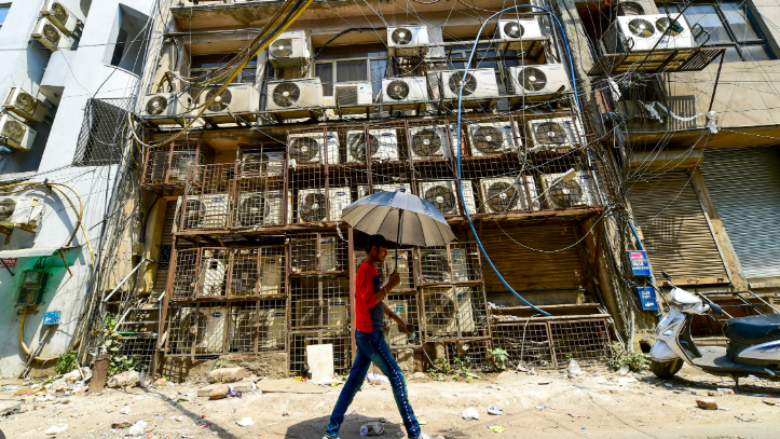
Air conditioners in Europe – Italy is the largest user, but where does Kosovo stand?

Express newspaper
18/07/2025 7:14
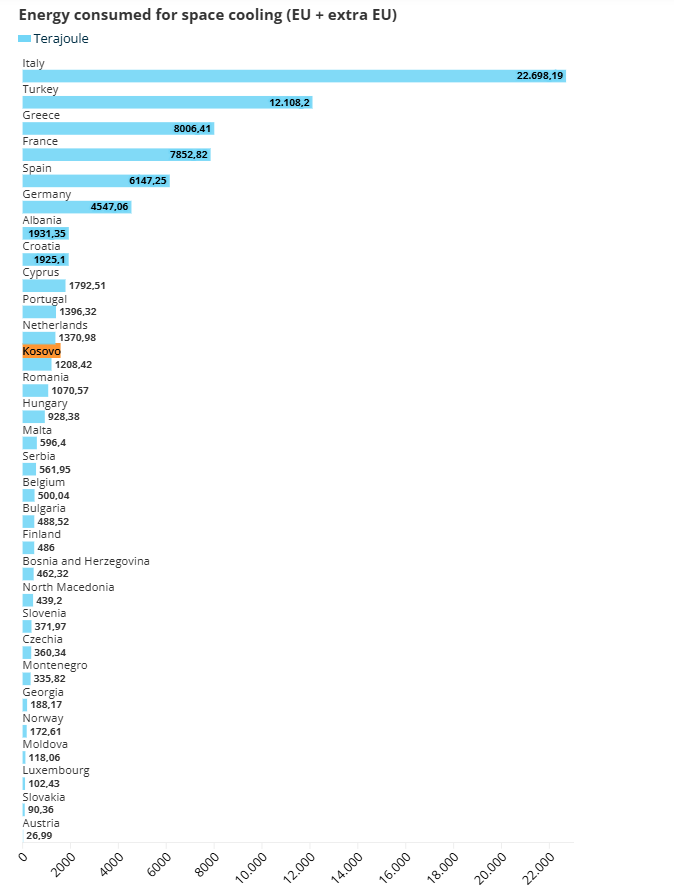
New data shows that Italy is the largest consumer of air conditioners in the European Union, followed by Greece, France and Spain.
As Europe faces another heatwave, air conditioners remain an indispensable companion in the most affected countries, with more and more people considering them a necessity rather than a luxury.
Italy, more than any other European country, cannot do without it, reports euronews.
This country alone uses over a third of all the electricity used for air conditioning in the 27 member states of the European Union, according to Eurostat, amounting to approximately 23 thousand terajoules out of a total of just over 60 thousand terajoules.
This is despite high electricity prices in Europe.
Meanwhile, Kosovo ranks 12th on the list of countries with the highest energy consumption for space cooling. According to the latest data, our country spends around 1208.42 terajoules of energy for this purpose, while Albania ranks seventh with 1931.35 terajoules.
Why are Italians so fond of air conditioners?
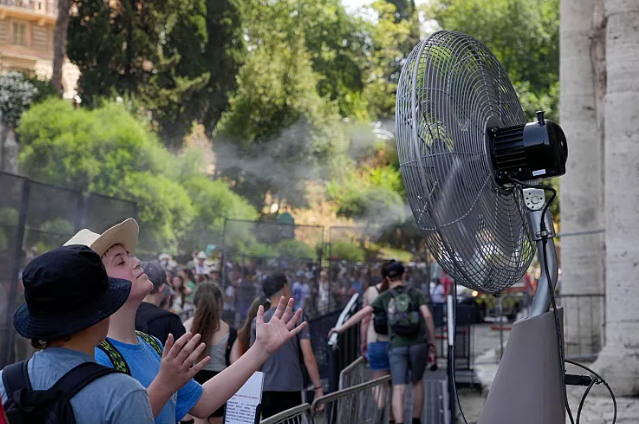
In recent years, the country has been hit by severe heat waves, with temperatures reaching up to 48 degrees Celsius in regions such as Sicily or Sardinia.
Furthermore, Italy has the oldest population in Europe, making residents very susceptible to extreme heat.
Greece tells a similar story. Despite its smaller size, it ranks second in the EU for air conditioning usage. It consumes just over 8000 terajoules for this purpose, followed by France, Spain and Germany.
However, air conditioning accounts for only a small part of household electricity consumption in the EU, accounting for just 0.6 percent.
The largest share (62.5 percent) is dedicated to heating rooms, followed by water heating at 15 percent and lighting at 14.5 percent.
Which European countries recorded the highest temperatures in 2025?
This summer, Europe and neighboring countries have already experienced high temperatures.
The Western Balkans are facing severe drought, while wildfires caused the evacuation of thousands of tourists in Greece and left at least two people dead in Turkey.
Faced with growing concerns about climate change, in early July, Ankara passed a historic climate law that aims for net-zero emissions by 2053.
Even Western Europe was not spared.
Portugal has reported the highest temperature on the continent so far: 46.6 degrees Celsius was measured in Mora, 100 km from Lisbon.
Neighboring Spain was hit by fires, which left two people dead and devastated the northeastern province of Tarragona, where around 18 residents were placed in isolation for safety reasons.
Spain reported the second highest temperature in Europe in the summer of 2025. The temperature of 46 degrees Celsius was recorded in El Granado, near the southern border with Portugal.
Mainland Greece ranked third with 43.2 degrees Celsius in Skala, a town in the southern Peloponnese region.
The recent heatwave is believed to have caused nearly 300 additional deaths.
Are Europeans becoming more energy-conscious?
The good news is that Europeans are using less energy at home.
After a record peak of 11 million terajoules in 2021, energy consumption has fallen to 9.6 million, according to the latest Eurostat data, with households accounting for 26.2 percent of final energy consumption.
Most of this energy is covered by natural gas (29.5 percent) and electricity (25.9 percent). /Telegraph