
US tariffs threaten Serbian arms exports

Express newspaper
18/07/2025 16:11
Weapons and ammunition for civilian use are among the products that Serbia exports most to the United States. But new 35% tariffs, which the US has warned will take effect on August 1, could hit this industry hard.
According to the Republican Statistical Office of Serbia, these products are among the ten most exported to the US in recent years.
Milojko Brzaković, former director of the Serbian arms company “Zastava Oružje” in Kragujevac, says the industry can survive this blow if all participants in the export chain share the burden.
“Everyone can give up a part of the profit. The factory can lower prices, and so can the traders, while buyers in the American market will have to bear part of the cost, as prices will increase,” he tells Radio Free Europe.
“Zastava Arms” and “Prvi Partizan” – the largest exporters
The largest arms exporters from Serbia to the US are “Zastava Oruzhe” from Kragujevac and “Prvi Partizan” from Užica – companies that are largely state-owned.
“Zastava” sells sporting and hunting weapons, intended for training and civilian use, to the American market, while the factory in Užice exports ammunition.
Both companies have representative offices in the USA: “Zastava arms USA” and “PPU USA ammunition”.
On July 7, United States President Donald Trump announced 35% tariffs on imports from Serbia, starting August 1.
They will be part of a new US customs policy for a number of countries.
Trump announced the new tariffs through letters to the countries’ leaders, indicating that they would not apply if those countries or their companies decided to manufacture within the US.
Serbian military analyst Aleksandar Radic estimates that higher tariffs would constitute a serious blow.
“Weapons from Serbia to the US have competitive prices. If they were to become more expensive, I believe that buyers would show interest in those that are cheaper, because everything is seen through the dollar. Indirectly, this is the goal of the new measures of the US administration – for America to return to domestic production,” Radić tells Radio Free Europe.
Kalashnikovs from Kragujevac in American stores
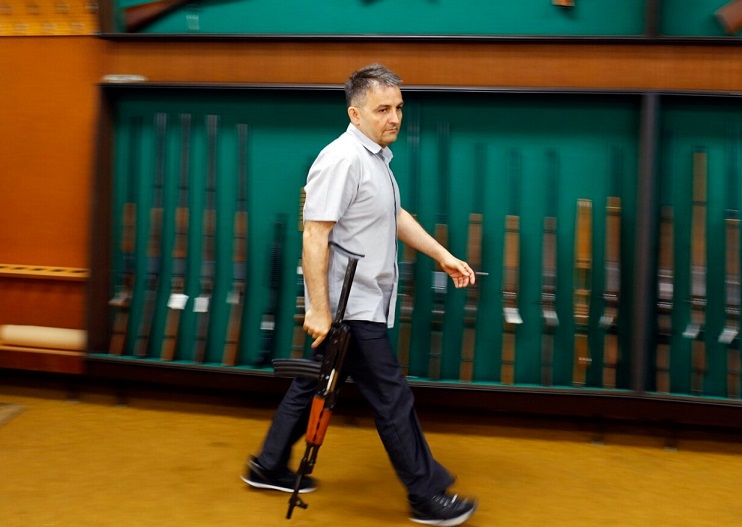
The website of “Zastava Arms USA” shows that the Kragujevac factory’s main product on the American market is the M70 rifle variant, based on the Soviet “Kalashnikov” system.
This weapon is sold in the US in the form of a semi-automatic sporting rifle.
The average price of a Kalashnikov from Kragujevac, according to information from the seller’s website, is around $1.500.
“In the US, ‘Zastava’ is a respected brand, because it has proven its quality over the past decades. From production in Kragujevac, a semi-automatic rifle goes to the US, made from an automatic version of the Kalashnikov. The law allows them to possess semi-automatic weapons,” says Brzaković.
In addition to these rifles, originally known as the AK-47, “Zastava” also exports ammunition for this 7.62×39 mm caliber weapon, spare parts, sniper rifles, carbines, pistols, hunting rifles, and knives to the US.
The Kragujevac factory has a multi-year contract to supply the US with sporting and hunting weapons, worth $234 million.
In December 2021, the then director of the Zastava Oruzhe factory, Milan Petkovic, said that “this ensures full capacity utilization for the next five years.”
High demand for ammunition
Radiq says that we must wait for the new tariffs to see what mechanism will be implemented.
“Until then, ammunition is exported to America at the request of the American market, which consumes large quantities of various calibers. Serbia produces non-standard ammunition, such as those for the Kalashnikov, and sells them to ‘Zastava,'” says Radic.
The Serbian government, the country’s Ministry of Defense, Zastava Arms, Zastava Arms USA, and the Serbian Chamber of Commerce did not respond to Radio Free Europe’s questions about the expected increase in US tariffs.
The American Chamber of Commerce in Serbia told Radio Free Europe that it will continue to support the best possible economic relations between the two countries.
“We hope that a way can be found so that continued trade between the US and Serbia is not burdened by additional tariffs,” she said.
“The military program is another story”
Data on the export of arms and military equipment, including those to the US, has not been publicly available in Serbia in recent years.
According to Serbia’s annual report, published by the Geneva-based Arms Trade Treaty (ATT), Serbia exported 2024 large-caliber artillery systems to the US in 1.757, while a year earlier it had exported 208 pieces.
Brzaković says the military program is “a different story” compared to the civilian one.
“America is not a big importer for its armed forces from manufacturers in Serbia, so I don’t think there will be any problems in that area,” he says.
Radić points out that, in previous years, automatic rifles, machine guns and mortars have been exported from Serbia to the US.
“The US was planning them for third countries, which are its allies. In recent years, there is reason to assume that it is mainly about exporting ammunition for the needs of the Ukrainian armed forces,” says Radiq.
Serbia suspended exports
In late June, the Foreign Intelligence Service of the Russian Federation announced that ammunition produced in Serbia was being sent to NATO member countries, which were then delivering it to Ukraine.
Belgrade has repeatedly denied that Serbia exports weapons to Ukraine or Russia, emphasizing that it has no control over the final destination of the weapons after they are sold to third countries.
Serbia’s President, Aleksandar Vučić, told The Jerusalem Post in early June that he is “the only one in Europe currently trading military ammunition with Israel.”
Following the escalation of the conflict between Israel and Iran a week later and questions about whether Serbia had chosen sides in that conflict, Vučić announced on June 23 that the Serbian state had suspended the export of ammunition.