
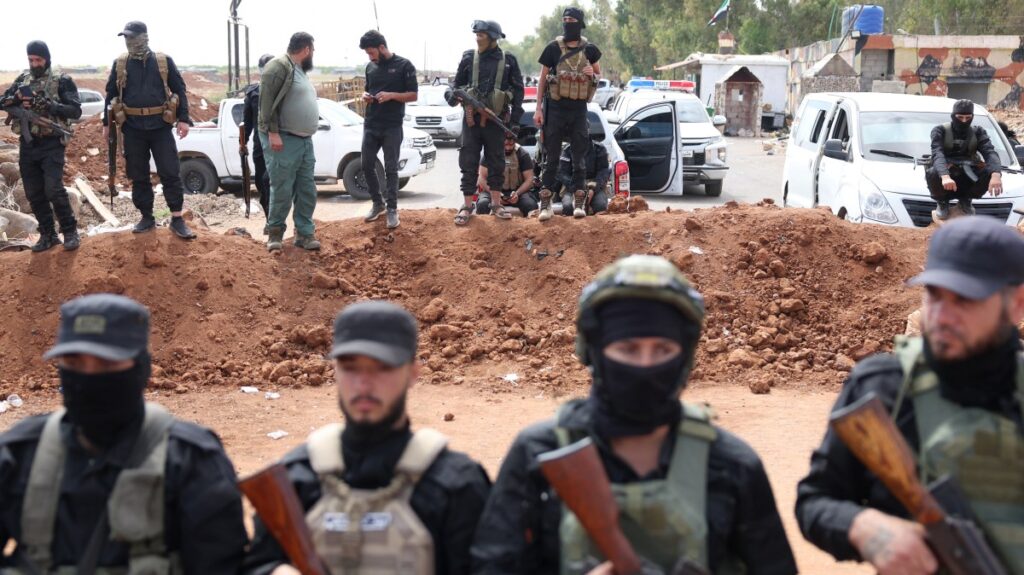

Syrian government security forces set up a checkpoint in the town of Busra al-Hariri to prevent armed tribal fighters from advancing towards the city
OMAR HAJ KADOUR/AFP/GETTY IMAGES
The overthrow of Bashar al-Assad offered Syria’s people the chance of superseding a recent history of brutal despotism and a 13-year repression of a popular uprising. Yet, seven months since his enforced departure, the country remains scarred by violence and at risk of renewed civil war. In the past week, hundreds have been killed in clashes between Druze and Bedouin militias in the southern Syrian province of Sweida. Western governments must impress upon Damascus that flows of aid and diplomatic support will depend on crushing sectarian forces and cracking down on terrorism rather than giving them free rein.
Ahmed al-Sharaa, the Syrian president, has given rhetorical expression to the principle of defending the country’s religious and ethnic minorities, but this is scarcely reassuring on its own. There are reliable allegations that government forces took part in massacres of Druze civilians. Marco Rubio, the US secretary of state, has demanded the end of “the rape and slaughter of innocent people”. He added that Damascus “must hold accountable and bring to justice anyone guilty of atrocities including those in their own ranks”. Mr Rubio’s comments implicitly challenge the strategy so far adopted under the Trump administration. President Trump has thus far treated Mr Sharaa as, in effect, a man he can do business with. The White House has given every indication that it wishes for a strong and centralised government in Damascus to hold Syria together. Thomas Barrack, Mr Trump’s special envoy to Syria, said a fortnight ago after meeting Mr Sharaa: “What we’ve learnt is federalism doesn’t work.”
Syria might benefit from a viable central government. A fissiparous state is one that is vulnerable to tribalism and sectarianism. But if the Trump administration’s diagnosis of what Syria needs is correct, it crucially depends on rule from Damascus that has legitimacy. And not all US allies have confidence in this outcome. Israel plainly does not, which explains its intervention with airstrikes last week to try to protect the Druze and establish a buffer zone in the south of the country.
Israeli attempts to keep neighbouring states from accumulating centralised power have an admittedly poor record, with heavy humanitarian costs, going back at least to the invasion of Lebanon in 1982. But it is not baseless to worry about the emergence of another putative autocrat in Damascus, with jihadist links.
Mr Trump hailed Mr Sharaa as an “attractive, tough guy” after meeting him in Saudi Arabia in May. There is every reason to wish for a stable Syria with a viable central government in succession to the nightmare that was the Assad regime, whose murderous campaign of repression created a huge outward flow of some 14 million refugees. The Sunni majority in Syria would undoubtedly wish for this, as would neighbouring states that have borne the brunt of the refugee crisis, notably Turkey and Saudi Arabia.
But the occurrence of three outbursts of lethal communal violence since the fall of Assad give scant grounds for optimism. If the Syrian state becomes a vehicle for repression against minorities, western diplomacy will be making a familiar mistake in embracing it for fear of something worse. The United States above all must make clear that support will depend on Damascus cracking down on thuggish elements of the armed forces, rather than creating another republic of fear.