
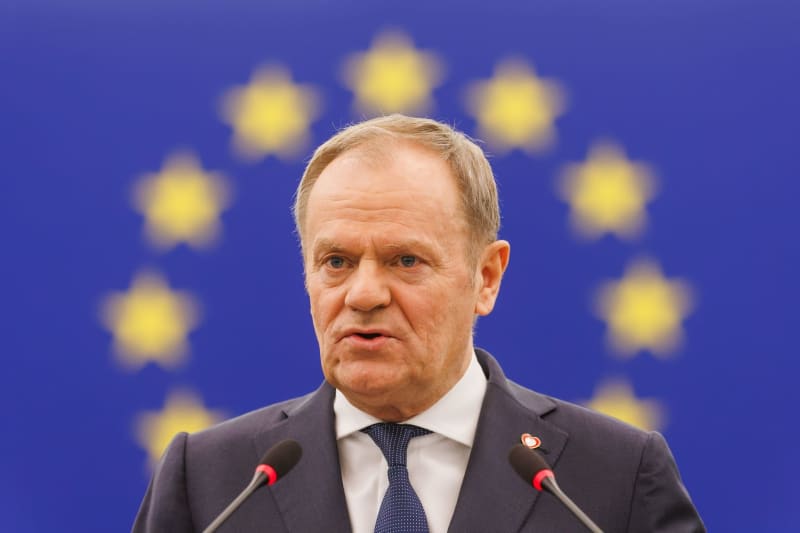
Polish Prime Minister Donald Tusk unveiled a new Cabinet line-up on Wednesday, aiming to breathe new life into his centrist government before right-wing populist Karol Nawrocki takes office as president.
Tusk said he was rebooting his government in order to safeguard national order, external security and Poland’s future.
Foreign Minister Radosław Sikorski, one of the country’s most popular politicians according to polls, was also given the role of deputy prime minister.
Tusk appears to be positioning Sikorski as a potential successor, the daily Rzeczpospolita said.
At the Interior Ministry, Marcin Kierwiński will replace Tomasz Siemoniak, who remains in the Cabinet as the coordinator of special services.
Tusk also announced the creation of two super ministries as part of a broader government reorganization.
A new Ministry of Energy will be formed from parts of the existing climate, environment and industry portfolios, to be led by Miłosz Motyka.
The Finance and Economy ministries will merge under the leadership of Andrzej Domański.
The reshuffle will reduce the number of ministries from 26 to 21, Tusk said.
Tusk is trying to regain political footing as President-elect Nawrocki, a staunch EU sceptic, is set to take office on August 6.
Polish presidents hold the power to veto legislation, and Nawrocki is expected to wield that authority even more aggressively than his predecessor, Andrzej Duda — another conservative who clashed with Tusk’s pro-European coalition.
Nawrocki’s presidency could mark a significant shift in both domestic and foreign policy for the EU and NATO member state.
Coalition strains mount
Tusk is also grappling with mounting tensions within his unwieldy coalition, which spans three electoral alliances.
The bloc has struggled to deliver on many of its 2023 campaign pledges, including liberalizing abortion laws and reforming the judiciary to strengthen the rule of law.
“The dispute must end,” Tusk warned on Wednesday. “All coalition partners must understand that unity is expected.”
The conservative opposition, led by the former ruling Law and Justice (PiS) party and its right-wing allies, has rebounded in the polls.