
Since taking office six months ago, Ghana’s President John Mahama has placed a firm focus on reviving the country’s economy — a key promise of his campaign.
The new leader is seeking to shift the West African nation away from relying solely on its traditional sectors to establishing a more diversified economy. To this end, Mahama has launched a so-called 24-hour economy designed not only to create job opportunities around the clock but also to transform Ghana from an imports-based economy to self-sufficiency.
“This policy is made for Ghana and the future,” Mahama said. “The 24-Hour Plus Programme will be the catalyst for Ghana’s economic growth, and we are sure it will make Ghana prosper.”
Under the plan, various industries will operate in three eight-hour shifts daily, with public and private sectors working together to keep the economy running around the clock. The initiative chiefly targets existing key sectors in the country such as agriculture, manufacturing, and essential services but could be expanded to other areas in the long-term.
As promising as it may appear, questions remain about the feasibility of Mahama’s pet project.
A country that never sleeps?
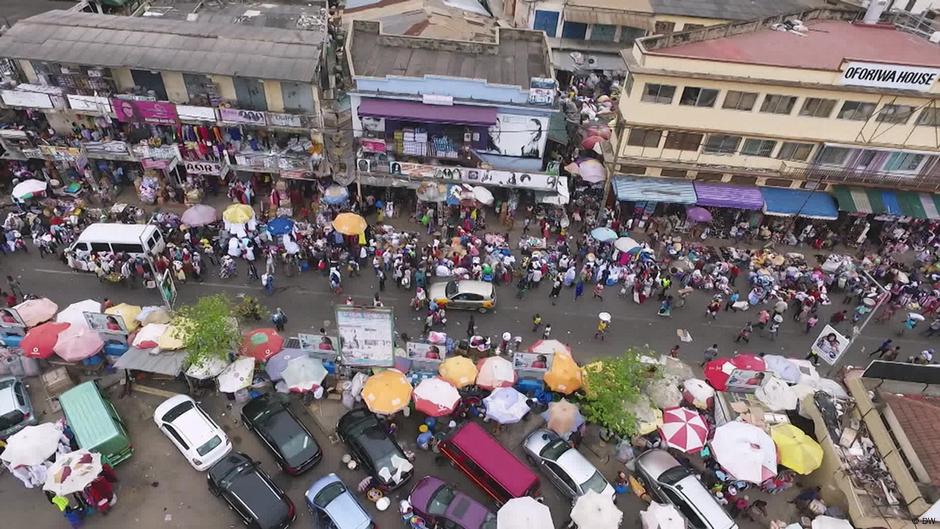
Ghana’s capital Accra can’t be compared to New York, Dubai or Tokyo when it comes to 24-hour amenities. In the African context, few cities run around-the-clock services although Accra and cities in Nigeria, Democratic Republic of Congo, South Africa and Kenya boast vibrant informal night-time economies.
Mahama’s plan is about far more than creating cities where shops, restaurants and bars can operate day and night: His vision is to boost Ghana’s economic output by tripling the hours that vital industries and sectors operate — from an average of eight hours per day to 24 hours.
By the end of the decade, this ambitious policy could create 1.7 million new jobs across the nation, which would mean a 5% drop in unemployment.
Economist Daniel Anim Amarteye believes that bridging the gap from the theoretical idea behind the new policy to its actual application is where things could potentially go awry.
“About $4 billion to drive this 24-hour policy is needed,” Amarteye told DW. The expense has to be seen in the context of Ghana already owing $3 billion to the International Monetary Fund (IMF) after defaulting repeatedly on some of its existing debt in recent years.
President John Mahama wants to make good on his pledge to revive Ghana’s economyImage: Seth/Xinhua/IMAGO
Implementing an ambitious vision
Ghana’s approach as a government-backed policy is unique on the African continent but faces multiple hurdles in its implementation.
“On paper, the program sounds or appears innovative and progressive, with a propensity of transforming Ghana’s economy. So it makes theoretical sense … [because] it’s a program that seeks to create jobs, bring about productivity, lift up from poverty,” says Amarteye.
“As it stands now, we have so many graduates who are unemployed. And so, a program that would ensure that people are employed and jobs are created, will also increase our GDP.”
But in practical terms, he told DW, funding will be a limiting factor: “Who exactly is the private sector, who you are expecting [to fund the programme]? The internal private sectors does not have the financial muscle … to drive such an innovative program.”
According to Amarteye, even if Ghana’s private sector were able to fund a major transformation of the economy, it would still take time for private enterprises to fully buy into Mahama’s ambitious idea.
“[Each enterprise] would have to do a cost-benefit analysis first, and that takes time.”
Amarteye suggests that the onus should be on the government to cough up the funds first and thus “dictate the pace” before private enterprises across Ghana can actually join Mahama’s 24-hour economy revolution.
Can an economy run around the clock?
DW’s correspondent in Accra, Isaac Kaledzi, agrees that the execution of the 24-Hour Plus agenda could run into trouble — not only on account of the remaining questions on funding but also due to a lack of certain infrastructure elements to implement the plan countrywide.
“The country is suffering with power [supply] currently. We are struggling … to keep the lights on [in Ghana]. We have to make sure that infrastructure is there first,” Kaledzi says. He also stresses that smaller enterprises especially might be hesitant to be part of the plan: existing companies could suffer financial losses by creating more supply than there is demand by producing around the clock.
However, he believes young people in particular need such a decisive impetus from the government to find new ways to secure their financial future:
“[The 24-hour policy] is not taking a job away from someone but is making room for someone else also to join,” Kaledzi says.
A 24-hour economy could create new businesses such as restaurants catering to shift workersImage: DW
A public-private collaboration
Mahama’s plan stands out for not being exclusively a top-down approach. While championed and led by his government, the 24-Hour Plus plan it will rely on a collaborative approach involving labor unions, the private sector and international development partners.
This might become its Achilles’ heel, according to Amarteye. He believes that in practice, the balance between various stakeholderswill not be as balanced as the government might make it sound at this point. “The government is going to be a facilitator to help the private sector to drive this agenda. This reliance on private sector can be problematic.” That could result in private companies — especially the bigger ones — ending up with too much leverage in the scheme.
“A 24-hour economy is therefore only one of the ways of ensuring that we improve our economy… and to continue [building on] the gains of the previous administration. We should not see the 24-hour economy as a sole game changer,” says Amarteye.
He suggests that the so-called One District One Factory (1D1F) initiative of Ghana’s previous administration, which focuses on job creation, should also be continued and expanded. It is paused currently.
An overdue shift in mindset
In Ghana, Africa’s 10th strongest economy, unemployment, poverty and food insecurity have been long-standing policy issues.
According to Amarteye, what has stood in the way of affecting change has been the nation’s mindset. In order for an innovative approach like shifting the economy to a 24-hour cycle, Ghanaians would need to alter the way they view their government. “So many people work for the government but not many trust the government.”
Are Ghanaians ready to change the way they run their economy?Image: Christian Thompson/Anadolu Agency/picture alliance
Amarteye believes that Mahama wants to help restore public trust by creating transparent and accountable government departments to administer the funds involved in running the 24-hour economy. He also underscores the point that Ghana’s workers would have to alter the way they think about the nature of work itself in order to build a 24-hour economy.
“We have been trained to go look for white-collar jobs, administrative jobs, office jobs. We are not focused on vocational and technical training, and that is where the gap is… We are still following the colonial legacy left behind of training administrators. The number of people doing vocational courses … is limited. And that has to change.”
Edited by: Benita van Eyssen