
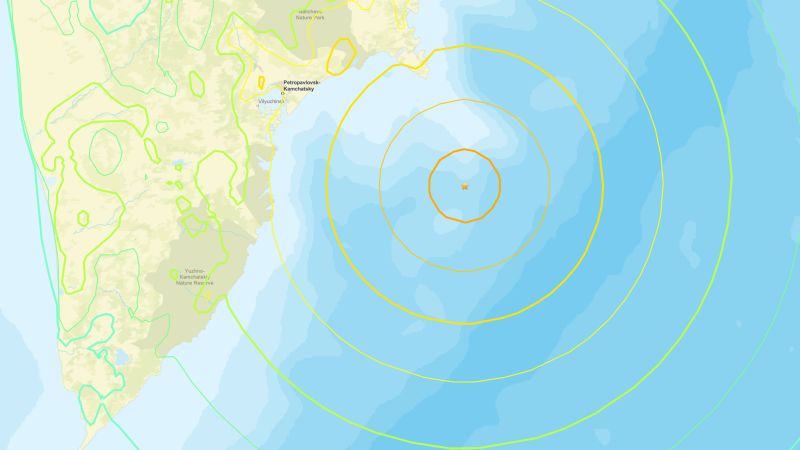
A massive 8.8 magnitude earthquake struck off Russia’s remote east coast, triggering tsunami alerts in several Pacific nations as well as Hawaii, Alaska, the US and Canadian coasts, and parts of South America.
The quake is tied for the sixth strongest ever recorded, and the strongest since 2011, when a 9.0 magnitude earthquake hit northeast Japan, triggering a devastating tsunami.
It’s too early to say how damaging any tsunami waves may be, or how many countries might be affected. The first places to be hit have started to report waves that appear less severe than initially forecast.
But experts across the Pacific warn the scale of waves can vary greatly in different locations and are urging the public to remain away from coastlines. Tsunami waves can also continue to impact coastlines hours after they first hit.

Some of the biggest waves are expected to hit Hawaii shortly with the governor warning the impact could wrap around the islands.
Here’s what we know.
The earthquake’s epicenter is about 74 miles (119 kilometers) southeast of Petropavlovsk-Kamchatsky, on the Kamchatka Peninsula in far east Russia, at a depth of 20.7 kilometers, according to the US Geological Survey (USGS).
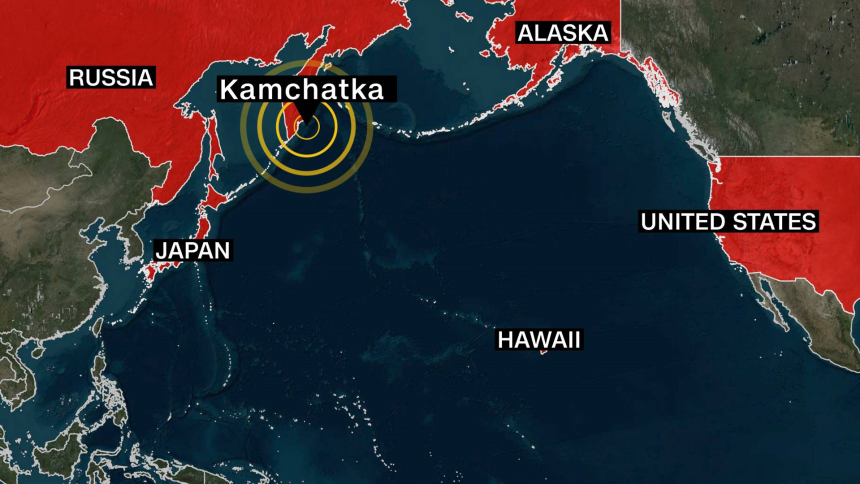
Kamchatka, which is sparsely populated, is part of the Pacific Ring of Fire, an area of intense seismic and volcanic activity on both sides of the Pacific Ocean.
Two powerful aftershocks of 6.3 and 6.9 magnitudes struck off Russia in the hour after the initial quake. Dozens more aftershocks above a 5 magnitude also struck Russia in the immediate hours after.
The earthquake triggered tsunami warnings and advisories for several Pacific nations, including Russia’s Far East, Japan, the Philippines and Indonesia, as well as the state of Hawaii, parts of Alaska’s Aleutian Islands, and the rest of the US and Canadian West Coast, down to South America. The governments of Chile, Peru and Ecuador also issued tsunami alerts.
Advisories are also in place for several Pacific US territories, including Guam, the Northern Mariana Islands and American Samoa.
The biggest waves, reaching above 3 meters (almost 10 feet), are possible in Ecuador, the northwestern Hawaiian islands, and Russia, according to the National Weather Service. Surges higher than normal are also possible along other coastal areas of South America, the Pacific islands and Asia.
Hawaii is currently under a tsunami warning – the most severe form of tsunami alert, issued when hazardous weather is already happening is likely to start, and when the weather threatens life or property.
The first tsunami waves are expected to reach Hawaii around 7:10 p.m. local time (1:10 a.m. ET).
Gov. Josh Green urged residents to evacuate coastal zones “right” away in a news conference.
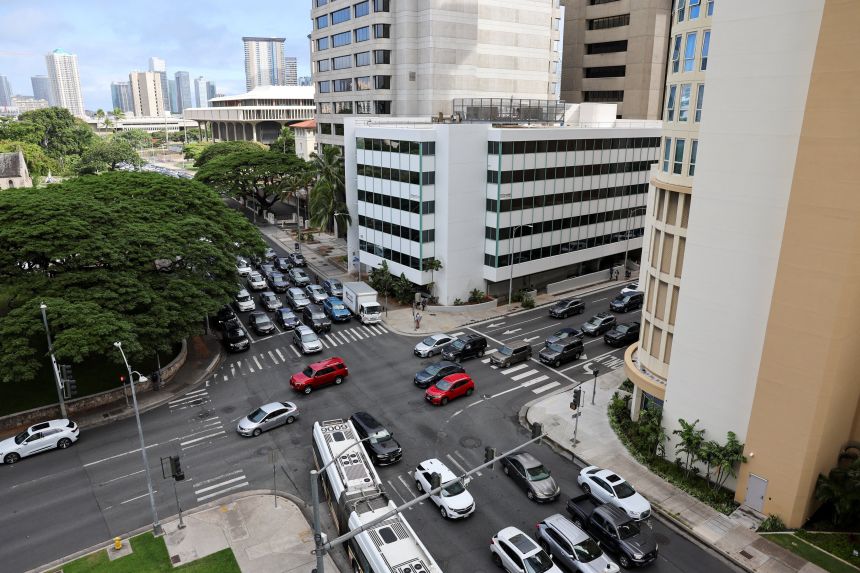
“You need to expect that there will be flooding on the islands and it will be imminent after the wave hits,” he said.
“It will not hit one beach, it will wrap around the islands,” Green said, adding, “If we’re calm, we’re going to be fine.”
Hotels along the west coast of Hawaii’s Big Island are currently evacuating guests.
The first tsunami waves have hit the coasts of Russia, Japan and Alaska, but minimal damage has been reported so far.
Japan’s northernmost island Hokkaido was one of the first places to report tsunami waves, along with parts of Russia. So far, the waves in Hokkaido have measured about 30 to 40 centimeters (1 to 1.3 feet) – less than the initial forecast of up to 3 meters (9.8 feet).
A tsunami threat was declared in Russia’s Kamchatka’s Peninsula, according to local governor Vladimir Solodov who urged residents to stay clear of coastlines. A tsunami wave of 3-4 meters high has been recorded in the Yelizovo District of Kamchatka, according to authorities.
Drone footage shows dramatic scenes of flooding in Russia’s Kuril Islands, but minimal damage had been reported so far.
A tidal rise of 1 foot was observed by the volcanic island of Amchitka, Alaska, at around 5:14 p.m. Pacific Time — the only tsunami observation in the US so far.
This is a developing story and will be updated.