
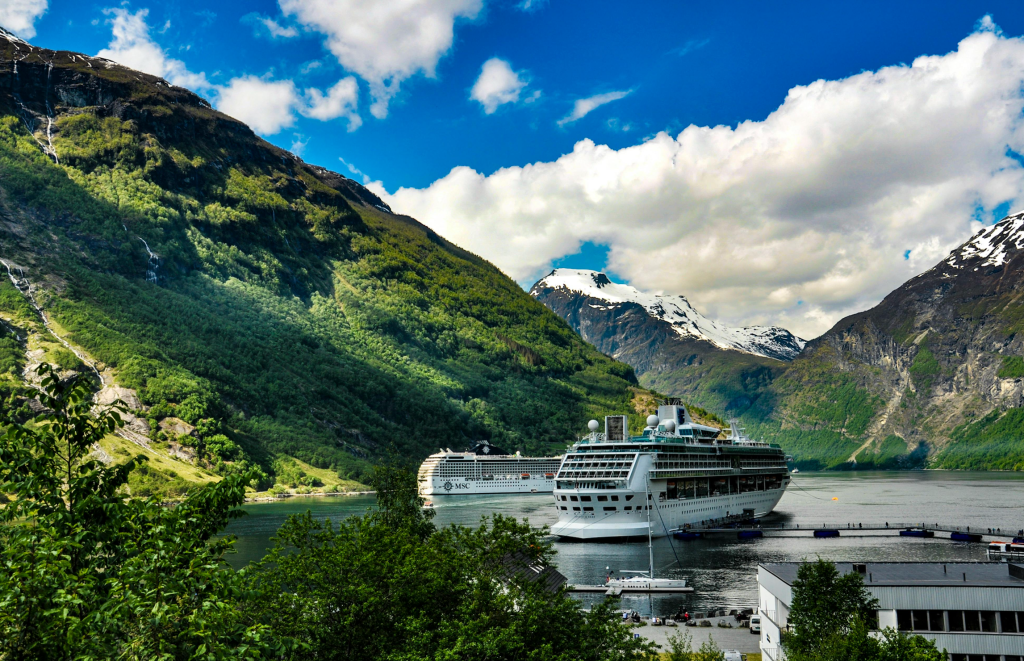
Norway’s new emissions rules for cruise ships have received a mixed reaction from operators already sailing with cleaner technology: They say the government may be letting bigger polluters off the hook.
The country’s long planned zero-emissions mandate for ships entering its iconic fjords begins in 2026. But it now only applies to vessels under 10,000 tons. Larger ships won’t have to comply until 2032.
“This postponement from the government is a scandal. The authorities gave us industry players many years to develop solutions, and we delivered,” said Lasse Vangstein, chief communications and sustainability officer at Havila Voyages.
“We do not agree that this is as difficult as many players in the industry make it out to be. We understand that it may be challenging for the very large cruise ships, but there are alternative solutions that don’t have to come at the expense of tourist inflow or value creation in the World Heritage areas,” Vangstein added.
Skift contacted the operators of ships that are over 10,000 tons that run cruises in Norway. None responded but the international cruise industry as a whole, under the Cruise Lines International Association (CLIA), has pledged to reduce emissions to almost zero by 2050.
Loophole Fears
Others warn the 2032 delay creates a loophole: Large ships can anchor outside the protected fjords and ferry passengers in by land or smaller boat, potentially undermining the policy’s climate goals.
“As the current regulation only applies to ships entering the heritage fjords directly, there is growing concern around vessels anchoring outside the protected zone and transporting guests overland without being subject to the same emission standards,” trade group Cruise Norway told Skift.
The new law will apply to five fjords: Nærøyfjord, Aurlandsfjord, Geirangerfjord, Sunnylvsfjord, and Tafjord, all designated UNESCO World Heritage sites.
Ships must also use shore power where available, rather than running fossil-fueled engines while docked.
Norwegian officials say it’s about protecting the iconic, fragile fjord landscape, and making cruise tourism more sustainable in the long term.
“This is an important breakthrough for our World Heritage fjords,” said Minister of Climate and Environment Andreas Bjelland Eriksen. “The zero-emission requirement will contribute to technological development and lower emissions, while also ensuring that the spectacular World Heritage fjords remain attractive tourist destinations.”
Cruise Lines Invest in Greener Fleets
 Cruise operator Hurtigruten says it is developing what it says will be the world’s first zero-emissions ship, powered by large sails with solar panels. Credit: Hurtigruten.
Some cruise companies already sailing in Norway say they’ve made early moves to upgrade their fleets.
Hurtigruten, a local cruise operator, told Skift that the 2026 rules won’t apply to it immediately because their ships exceed the 10,000-tonne threshold. But it has still invested heavily in battery-hybrid technology.
“Of our fleet, four ships have been upgraded to battery-hybrid-powered ships: MS Richard With, MS Kong Harald, MS Nordlys, and MS Finnmarken. This is part of Hurtigruten’s €100 million fleet upgrade investment announced in 2021,” a spokesperson said.
Those hybrid ships reduce emissions by up to 25%, but the company acknowledges this won’t be enough for the 2032 target. Hurtigruten says it is now working on what it calls “the world’s first zero-emission ship,” which it expects to launch by 2030.
“We are committed to delivering a ship that surpasses all others, in terms of energy efficiency and sustainability, within just a few years,” said CEO Hedda Felin in a previous statement.
The vessel will be powered by a combination of wind, battery, and solar, with aerodynamic sails covered in solar panels, and capable of using power from the midnight sun during Norway’s 24-hour daylight summers.
Havila Voyages has invested in plug-in hybrid vessels powered by 86-ton battery packs, enabling up to four hours of silent, zero-emission sailing. It plans to transition to biogas by 2028 and hydrogen propulsion by around 2030.
The Stakes for Norwegian Tourism
The fjords where the new rules apply generate roughly $22 million annually for the local economy, according to Business Norway. Geirangerfjord, for example, sees around 800,000 visitors per year, half of them arriving by cruise ship.
In 2023, Norway had around 54.9 million cruise passengers in total, with demand particularly strong from U.S. travelers. The rules could reshape that traffic over time, especially if larger cruise ships choose to bypass fjord zones or reduce the number of calls.
The Norwegian government told Skift that the rules for large vessels were delayed because the technology for lower-emission solutions for smaller vessels is more advanced.
“The technology for zero-emission solutions is more commercially mature for smaller vessels, and it has been necessary to implement different phase-in timelines,” state secretary Astrid Hoem said.
“It is positive that some operators have already made efforts to decarbonize, and we expect that more will prepare to comply with the regulation coming into force.”
Infrastructure Gaps Pose a Challenge
Implementing the new requirements means building out charging and shore-power infrastructure in remote coastal areas, something the government is working on.
Cruise Norway said there are also problems with access to on shore power.
“Flåm has received NOK 100 million in government funding for shore power infrastructure, while Geiranger – where the main challenge is access to grid capacity – has not yet received comparable support. This highlights the need for tailored solutions and increased national facilitation, particularly for destinations with complex infrastructure constraints,” the Cruise Norway spokesperson said.
But others in the maritime sector say clarity in the regulations and rules, which have been in talks since 2018, is what was needed.
“The process of developing zero-emission requirements has been long and demanding,” said Alf Tore Sørheim, Director General at the Norwegian Maritime Authority, in a statement. “Now that new provisions have been adopted, it is important to highlight that they provide the clarity the industry has long awaited.”
Skift’s in-depth reporting on climate issues is made possible through the financial support of Intrepid Travel. This backing allows Skift to bring you high-quality journalism on one of the most important topics facing our planet today. Intrepid is not involved in any decisions made by Skift’s editorial team.

September 16-18, 2025 – NEW YORK CITY