
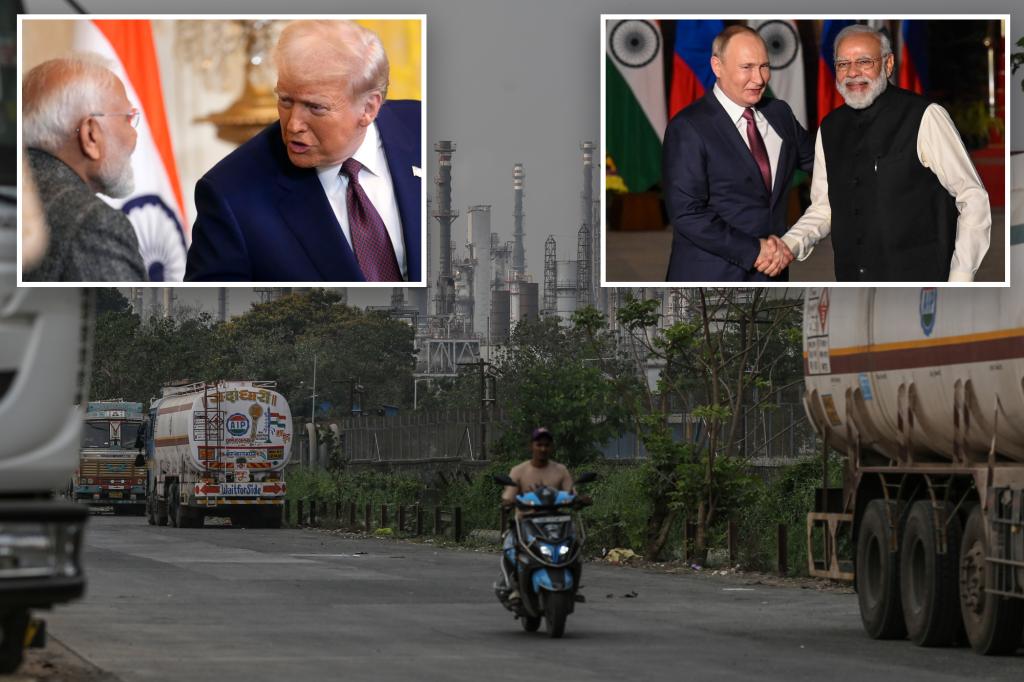
WASHINGTON — President Trump said Wednesday he would impose a 25% tariff on India starting Friday — along with an additional penalty for buying Russian energy and weapons.
The announcement was the first in a flurry of economic pronouncements from the White House, including an additional 40% tariff on Brazilian goods and an agreement on energy development with Pakistan.
While describing India as a “friend,” the president raged against New Delhi’s high tariffs on US products, including its “obnoxious” non-monetary trade barriers.
“Also, they have always bought a vast majority of their military equipment from Russia, and are Russia’s largest buyer of ENERGY, along with China, at a time when everyone wants Russia to STOP THE KILLING IN UKRAINE — ALL THINGS NOT GOOD! INDIA WILL THEREFORE BE PAYING A TARIFF OF 25%, PLUS A PENALTY FOR THE ABOVE, STARTING ON AUGUST FIRST,” Trump wrote on Truth Social.
President Trump raged against India’s high tariffs on the US, including its “obnoxious” non-monetary trade barriers.. AP
India would be the first country known to be sanctioned for continuing to trade with Russia amid its ongoing invasion of Ukraine.
On Tuesday, Trump told reporters he would give Russia 10 days to end the 41-month-old war on Kyiv before slapping secondary tariffs and sanctions on Moscow’s economic partners.
The White House is racing to complete negotiations ahead of Trump’s Aug. 1 deadline to impose reciprocal tariffs on dozens of nations.
Trump initially announced April 2 he would levy 26% tariffs on Indian imports, but dropped rates to 10% while talks continued.
The US has since reached framework agreements with the European Union, the United Kingdom, Japan and Indonesia.
India applied an average tariff rate of 5.2% on US goods as of 2022 and imports a wide range of American products, including oils and machinery.
India’s Prime Minister Narendra Modi (right) greets Russian President Vladimir Putin before a meeting at Hyderabad House in New Delhi on December 6, 2021. AFP via Getty Images
The US, meanwhile, tariffed India at an average rate of 2.4% in previous years.
The high rate on India may also be a ploy to get Apple to produce its iPhones in the US, as CEO Tim Cook has eyed manufacturing up to 25% of the product there with the aim of moving away from China.
Every morning, the NY POSTcast offers a deep dive into the headlines with the Post’s signature mix of politics, business, pop culture, true crime and everything in between. Subscribe here!
Trump said in March he told Cook to produce the phones in the US instead, expressing frustration over the tech company’s potential move to India.
“I said to Tim, I said, ‘Tim, look, we treated you really good, we put up with all the plants that you build in China for years, now you got [to] build [with] us. We’re not interested in you building in India, India can take care of themselves … we want you to build here,’” Trump said at the time.
An oil refinery operated by Bharat Petroleum Corp. Ltd., in Mumbai, India, on Friday, April 4, 2025. Bloomberg via Getty Images
Trump also told reporters Wednesday that the India rate is partly due to the country being a part of the BRICS trading alliance with Brazil, Russia, China and South Africa, a coalition the president described as “anti-America.”
“We’ll see what happens,” he said of the likelihood of coming to a deal before Friday. “We’re talking to India now.”
The high proposed rates for India still come as a surprise given Trump’s close relationship with Indian Prime Minister Narenda Modi in his first term and Vice President JD Vance’s moves to strike a deal back in April.
Vance said April 21 that he and Modi had come to a “road map” on trade, and that a firm agreement would be coming soon.
Trump, citing a “national emergency,” also implemented an additional 40% duty on Brazil via executive order Wednesday, bringing the total tariff rate on South America’s largest economic power to 50%.
“Members of the Government of Brazil have taken actions that interfere with the economy of the United States, infringe the free expression rights of United States persons, violate human rights, and undermine the interest the United States has in protecting its citizens and companies,” Trump wrote in the order, further arguing that the “political persecution” of former Brazilian President Jair Bolsonaro has contributed to “the deliberate breakdown in the rule of law in Brazil.”
“In my judgment, this action is necessary and appropriate to deal with the national emergency declared in this order,” the president said.
Bolsonaro is on trial in Brazil for his alleged role in a plot to overturn the results of his country’s 2022 election. Trump slammed the case against the former president as a “witch hunt” earlier this month when he first threatened the 50% tariff rate.
The president also announced a deal struck with Pakistan “whereby Pakistan and the United States will work together on developing their massive Oil Reserves.”
“We are in the process of choosing the Oil Company that will lead this Partnership,” Trump wrote on Truth Social. “Who knows, maybe they’ll be selling Oil to India some day!”
In another executive order, Trump announced that starting Aug. 29, a trade loophole exempting cheap goods from tariffs would be closed globally.
Trump previously suspended the so-called “de minimis” exemption – applied to goods valued at or under $800 – for Chinese imports, due to concerns over illicit fentanyl shipments.
The new duty, ranging from $80-$200 per item, will be applied to de minimis products shipped through means other than the international postal network.
“We are very busy in the White House today working on Trade Deals,” Trump said in a Truth Social post, announcing that he planned to meet representatives from South Korea in the afternoon.
“South Korea is right now at a 25% Tariff, but they have an offer to buy down those Tariffs,” the president revealed. “I will be interested in hearing what that offer is.”