
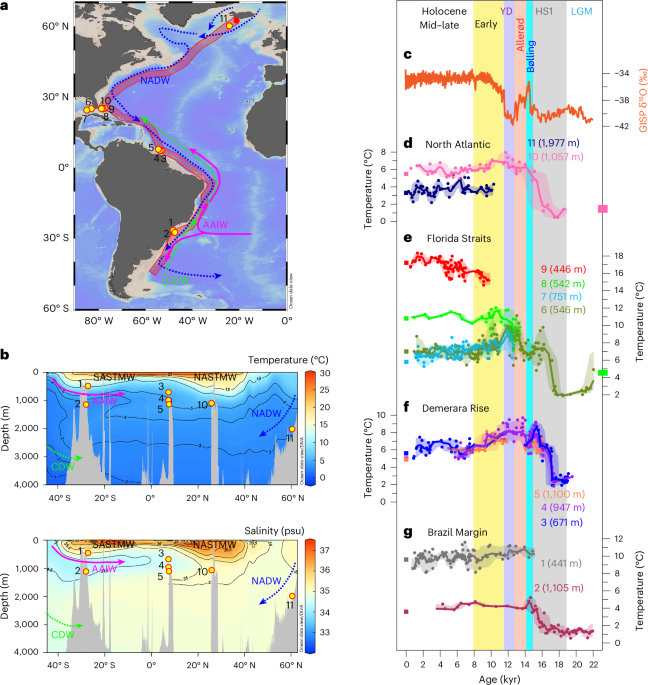
Buckley, M. W. & Marshall, J. Observations, inferences, and mechanisms of the Atlantic Meridional Overturning Circulation: a review. Rev. Geophys. 54, 5–63 (2016).
Lynch-Stieglitz, J. et al. A diminished North Atlantic nutrient stream during Younger Dryas climate reversal. Science 384, 693–696 (2024).
Caesar, L., Rahmstorf, S., Robinson, A., Feulner, G. & Saba, V. Observed fingerprint of a weakening Atlantic Ocean overturning circulation. Nature 556, 191–196 (2018).
Thornalley, D. J. R. et al. Anomalously weak Labrador Sea convection and Atlantic overturning during the past 150 years. Nature 556, 227–230 (2018).
Zhu, C., Liu, Z., Zhang, S. & Wu, L. Likely accelerated weakening of Atlantic overturning circulation emerges in optimal salinity fingerprint. Nat. Commun. 14, 1245 (2023).
van Westen, R. M., Kliphuis, M. & Dijkstra, H. A. Physics-based early warning signal shows that AMOC is on tipping course. Sci. Adv. 10, eadk1189 (2024).
Kilbourne, K. H. et al. Atlantic circulation change still uncertain. Nat. Geosci. 15, 165–167 (2022).
Weijer, W., Cheng, W., Garuba, O. A., Hu, A. & Nadiga, B. T. CMIP6 models predict significant 21st century decline of the Atlantic Meridional Overturning Circulation. Geophys. Res. Lett. 47, e2019GL086075 (2020).
Clark, P. U., McCabe, A. M., Mix, A. C. & Weaver, A. J. Rapid rise of sea level 19,000 years ago and its global implications. Science 304, 1141–1144 (2004).
Carlson, A. E. et al. Rapid early Holocene deglaciation of the Laurentide ice sheet. Nat. Geosci. 1, 620–624 (2008).
Lippold, J. et al. Constraining the variability of the Atlantic Meridional Overturning Circulation during the Holocene. Geophys. Res. Lett. 46, 11338–11346 (2019).
McManus, J. F., Francois, R., Gherardi, J. M., Keigwin, L. & Drown-Leger, S. Collapse and rapid resumption of Atlantic meridional circulation linked to deglacial climate changes. Nature 428, 834–837 (2004).
Ng, H. C. et al. Coherent deglacial changes in western Atlantic Ocean circulation. Nat. Commun. 9, 2947 (2018).
Huang, K.-F., Oppo, D. W. & Curry, W. B. Decreased influence of Antarctic Intermediate Water in the tropical Atlantic during North Atlantic cold events. Earth Planet. Sci. Lett. 389, 200–208 (2014).
Valley, S., Lynch-Stieglitz, J. & Marchitto, T. M. Timing of deglacial AMOC variability from a high-resolution seawater cadmium reconstruction. Paleoceanography 32, 1195–1203 (2017).
Oppo, D. W. et al. Deglacial temperature and carbonate saturation state variability in the tropical Atlantic at Antarctic Intermediate Water depths. Paleoceanogr. Paleoclimatol. 38, e2023PA004674 (2023).
Ayache, M., Swingedouw, D., Mary, Y., Eynaud, F. & Colin, C. Multi-centennial variability of the AMOC over the Holocene: a new reconstruction based on multiple proxy-derived SST records. Glob. Planet. Change 170, 172–189 (2018).
Valley, S. G., Lynch-Stieglitz, J., Marchitto, T. M. & Oppo, D. W. Seawater cadmium in the Florida Straits over the Holocene and implications for upper AMOC variability. Paleoceanogr. Paleoclimatol. 37, e2021PA004379 (2022).
Came, R. E., Oppo, D. W. & Curry, W. B. Atlantic Ocean circulation during the Younger Dryas: insights from a new Cd/Ca record from the western subtropical South Atlantic. Paleoceanography 18, 1086 (2003).
He, F. & Clark, P. U. Freshwater forcing of the Atlantic Meridional Overturning Circulation revisited. Nat. Clim. Change 12, 449–454 (2022).
Chen, T. et al. Radiocarbon evidence for the stability of polar ocean overturning during the Holocene. Nat. Geosci. 16, 631–636 (2023).
Lynch-Stieglitz, J., Curry, W. B. & Lund, D. C. Florida Straits density structure and transport over the last 8000 years. Paleoceanography 24, PA3209 (2009).
He, C. et al. North Atlantic subsurface temperature response controlled by effective freshwater input in ‘Heinrich’ events. Earth Planet. Sci. Lett. 539, 116247 (2020).
Liu, Z. et al. Transient simulation of last deglaciation with a new mechanism for Bølling–Allerød warming. Science 325, 310–314 (2009).
Pedro, J. B. et al. Beyond the bipolar seesaw: toward a process understanding of interhemispheric coupling. Quat. Sci. Rev. 192, 27–46 (2018).
Schmidt, M. W. et al. Impact of abrupt deglacial climate change on tropical Atlantic subsurface temperatures. Proc. Natl Acad. Sci. USA 109, 14348–14352 (2012).
Schmidt, M. W., Chang, P., Parker, A. O., Ji, L. & He, F. Deglacial tropical Atlantic subsurface warming links ocean circulation variability to the west African monsoon. Sci. Rep. 7, 15390 (2017).
Umling, N. E. et al. Atlantic circulation and ice sheet influences on upper South Atlantic temperatures during the last deglaciation. Paleoceanogr. Paleoclimatol. 34, 990–1005 (2019).
Rühlemann, C. et al. Intermediate depth warming in the tropical Atlantic related to weakened thermohaline circulation: combining paleoclimate data and modeling results for the last deglaciation. Paleoceanography 19, PA1025 (2004).
Lynch-Stieglitz, J. et al. Muted change in Atlantic overturning circulation over some glacial-aged Heinrich events. Nat. Geosci. 7, 144–150 (2014).
Zhu, C. et al. Antarctic warming during Heinrich Stadial 1 in a transient isotope-enabled deglacial simulation. J. Clim. 35, 7353–7365 (2022).
Valley, S. G., Lynch-Stieglitz, J. & Marchitto, T. M. Intermediate water circulation changes in the Florida Straits from a 35 ka record of Mg/Li-derived temperature and Cd/Ca-derived seawater cadmium. Earth Planet. Sci. Lett. 523, 115692 (2019).
Stewart, J. A. et al. Arctic and Antarctic forcing of ocean interior warming during the last deglaciation. Sci. Rep. 13, 22410 (2023).
Gu, S. et al. Coherent response of Antarctic Intermediate Water and Atlantic Meridional Overturning Circulation during the last deglaciation: reconciling contrasting neodymium isotope reconstructions from the tropical Atlantic. Paleoceanography 32, 1036–1053 (2017).
Zhu, C. et al. Enhanced ocean heat storage efficiency during the last deglaciation. Sci. Adv. 10, eadp5156 (2024).
Osman, M. B. et al. Globally resolved surface temperatures since the Last Glacial Maximum. Nature 599, 239–244 (2021).
Bereiter, B., Shackleton, S., Baggenstos, D., Kawamura, K. & Severinghaus, J. Mean global ocean temperatures during the last glacial transition. Nature 553, 39–44 (2018).
Baggenstos, D. et al. Earth’s radiative imbalance from the Last Glacial Maximum to the present. Proc. Natl Acad. Sci. USA 116, 14881–14886 (2019).
Shackleton, S., Seltzer, A., Baggenstos, D. & Lisiecki, L. E. Benthic δ18O records Earth’s energy imbalance. Nat. Geosci. 16, 797–802 (2023).
Lippold, J. et al. Contrasting paired benthic and planktonic foraminifera radiocarbon ages from Bermuda Rise ODP Site 1063 during Heinrich Stadials 1 and 2. Radiocarbon 66, 816–823 (2024).
Martin, K. C. et al. Greenland ice cores reveal a south-to-north difference in Holocene thermal maximum timings. Geophys. Res. Lett. 51, e2024GL111405 (2024).
Lynch-Stieglitz, J., Schmidt, M. W. & Curry, W. B. Evidence from the Florida Straits for Younger Dryas ocean circulation changes. Paleoceanography 26, PA1205 (2011).
Gu, S. et al. Assessing the ability of zonal δ18O contrast in benthic foraminifera to reconstruct deglacial evolution of Atlantic Meridional Overturning Circulation. Paleoceanogr. Paleoclimatol. 34, 800–812 (2019).
Pöppelmeier, F., Jeltsch-Thömmes, A., Lippold, J., Joos, F. & Stocker, T. F. Multi-proxy constraints on Atlantic circulation dynamics since the last ice age. Nat. Geosci. 16, 349–356 (2023).
Seierstad, I. K. et al. Consistently dated records from the Greenland GRIP, GISP2 and NGRIP ice cores for the past 104 ka reveal regional millennial-scale δ18O gradients with possible Heinrich event imprint. Quat. Sci. Rev. 106, 29–46 (2014).
Gu, S., Liu, Z. & Wu, L. Time scale dependence of the meridional coherence of the Atlantic Meridional Overturning Circulation. J. Geophys. Res. Oceans 125, e2019JC015838 (2020).
Jiang, Z. et al. No consistent simulated trends in the Atlantic Meridional Overturning Circulation for the past 6,000 years. Geophys. Res. Lett. 50, e2023GL103078 (2023).
He, C. et al. Hydroclimate footprint of pan-Asian monsoon water isotope during the last deglaciation. Sci. Adv. 7, eabe2611 (2021).
Liu, Z. et al. Tropical mountain ice core δ18O: a Goldilocks indicator for global temperature change. Sci. Adv. 9, eadi6725 (2023).
Back, L. et al. Global hydrological cycle response to rapid and slow global warming. J. Clim. 26, 8781–8786 (2013).
Liu, Z. Evolution of Atlantic Meridional Overturning Circulation since the last glaciation: model simulations and relevance to present and future. Phil. Trans. R. Soc. A 381, 20220190 (2023).
Lehman, S. J. & Keigwin, L. D. Sudden changes in North Atlantic circulation during the last deglaciation. Nature 356, 757–762 (1992).
Boyer, T. P. et al. World Ocean Atlas 2018 (NOAA National Centers for Environmental Information, accessed May 2022); https://www.ncei.noaa.gov/products/world-ocean-atlas
McKay, N. P., Emile-Geay, J. & Khider, D. geoChronR – an R package to model, analyze, and visualize age-uncertain data. Geochronology 3, 149–169 (2021).
Schlitzer, R. Ocean Data View https://odv.awi.de/ (2021).
Bryan, S. P. & Marchitto, T. M. Mg/Ca-temperature proxy in benthic foraminifera: new calibrations from the Florida Straits and a hypothesis regarding Mg/Li. Paleoceanography 23, PA2220 (2008).
Oppo, D. W. et al. Data constraints on glacial Atlantic water mass geometry and properties. Paleoceanogr. Paleoclimatol. 33, 1013–1034 (2018).
Rosenthal, Y., Lear, C. H., Oppo, D. W. & Linsley, B. K. Temperature and carbonate ion effects on Mg/Ca and Sr/Ca ratios in benthic foraminifera: aragonitic species Hoeglundina elegans. Paleoceanography 21, PA1007 (2006).
Lauvset, S. K. et al. GLODAPv2.2022: the latest version of the global interior ocean biogeochemical data product. Earth Syst. Sci. Data 14, 5543–5572 (2022).
Yu, J. & Elderfield, H. Mg/Ca in the benthic foraminifera Cibicidoides wuellerstorfi and Cibicidoides mundulus: temperature versus carbonate ion saturation. Earth Planet. Sci. Lett. 276, 129–139 (2008).
Marchitto, T. M., Bryan, S. P., Doss, W., McCulloch, M. T. & Montagna, P. A simple biomineralization model to explain Li, Mg, and Sr incorporation into aragonitic foraminifera and corals. Earth Planet. Sci. Lett. 481, 20–29 (2018).
Boyle, E. A. & Keigwin, L. D. Comparison of Atlantic and Pacific paleochemical records for the last 215,000 years: changes in deep ocean circulation and chemical inventories. Earth Planet. Sci. Lett. 76, 135–150 (1985).
Boyle, E. & Rosenthal, Y. in The South Atlantic: Present and Past Circulation (eds Wefer, G. et al.) 423–443 (Springer, 1996).
Lu, W., Guo, W. & Oppo, D. W. Assessing the precision and accuracy of foraminifera elemental analysis at low ratios. Geochem. Geophys. Geosyst. 25, e2024GC011560 (2024).
Greaves, M. et al. Interlaboratory comparison study of calibration standards for foraminiferal Mg/Ca thermometry. Geochem. Geophys. Geosyst. 9, Q08010 (2008).
Stewart, J. A. et al. NIST RM 8301 boron isotopes in marine carbonate (simulated coral and foraminifera solutions): inter-laboratory δ11B and trace element ratio value assignment. Geostand. Geoanal. Res. 45, 77–96 (2021).
Came, R. E. et al. in Ocean Circulation: Mechanisms and Impacts Geophysical Monograph Series Vol. 173 (eds Schmittner, A. et al.) 247–264 (American Geophysical Union, 2007).
Blaauw, M. & Christen, J. A. Flexible paleoclimate age–depth models using an autoregressive gamma process. Bayesian Anal. 6, 457–474 (2011).
Heaton, T. J. et al. Marine20 – the marine radiocarbon age calibration curve (0–55,000 cal bp). Radiocarbon 62, 779–820 (2020).
Lund, D. C., Tessin, A. C., Hoffman, J. L. & Schmittner, A. Southwest Atlantic water mass evolution during the last deglaciation. Paleoceanography 30, 477–494 (2015).
Came, R. E., Oppo, D. W., Curry, W. B. & Lynch-Stieglitz, J. Deglacial variability in the surface return flow of the Atlantic Meridional Overturning Circulation. Paleoceanography 23, PA1217 (2008).
Thornalley, D. J. R. et al. Long-term variations in Iceland–Scotland overflow strength during the Holocene. Clim. Past 9, 2073–2084 (2013).
Snoll, B. et al. A multi-model assessment of the early last deglaciation (PMIP4 LDv1): a meltwater perspective. Clim. Past 20, 789–815 (2024).
Deschamps, P. et al. Ice-sheet collapse and sea-level rise at the Bølling warming 14,600 years ago. Nature 483, 559–564 (2012).
Lu, W. Dataset for “Warmer shallow Atlantic during deglaciation and early Holocene due to weaker overturning circulation”. Zenodo https://doi.org/10.5281/zenodo.15192546 (2025).