
‘LEFT BEHIND’:
Unlike high-tech industries, it would be hard for traditional industries to expand to the US, as they need high margins and advanced automation, an expert said
The US’ tariff polices are expected to hurt Taiwan’s old-economy industries more than their tech counterparts, as it is harder for the traditional industrial sector to relocate production to the US to avoid tariffs, economics experts said.
The White House on Friday announced a 20 percent blanket tariff on Taiwan, down from the 32 percent it unveiled on April 2.
The government said the 20 percent is provisional and that it is seeking a lower levy through further negotiations.
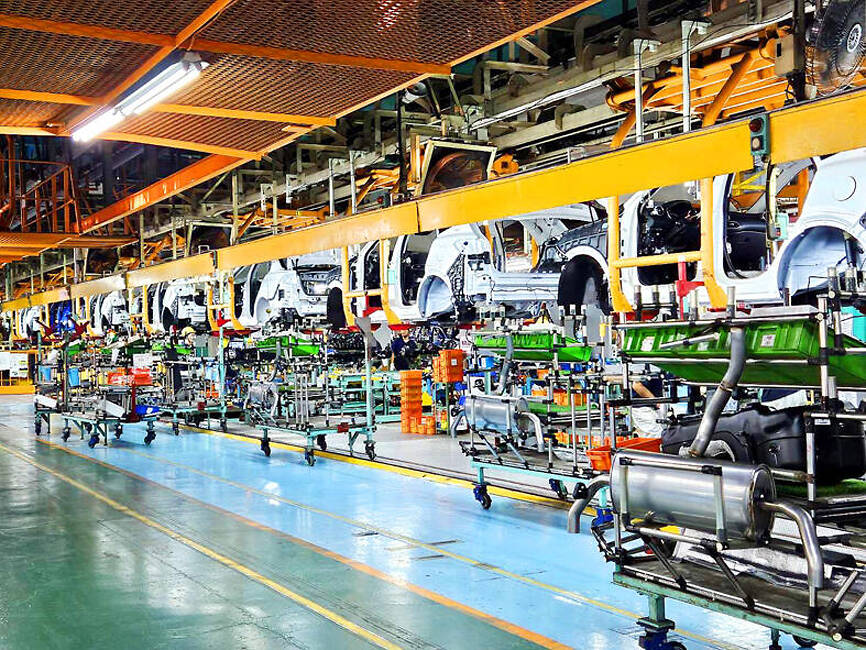
Photo courtesy of the Taiwan Transportation Vehicle Manufacturers Association
Chung-Hua Institution for Economic Research (CIER) vice president Wang Jiann-chyuan (王健全) on Friday said that US President Donald Trump’s tariff policies seek to encourage manufacturers to invest in the US and make“made in the US” products.
“However, not all local industries can afford to move to the US,” he said. “Old-economy industries would not be able to avoid the high tariffs imposed by the Trump administration and would bear the brunt of the levy, as they do not have sufficient US investments.”
An industry that wants to expand to the US needs a high gross margin to cushion high product costs abroad and must have advanced automation to deal with the labor shortage there, Wang said.
That industry also needs to build a cluster and forge a comprehensive supply chain in the US market, and its investments must meet demand, he added.
High-tech industries such as chip makers, integrated circuit packaging and testing providers, and artificial intelligence suppliers have the capability to expand to the US, but many old-economy firms would be left behind, Wang said.
Unlike contract chipmaker Taiwan Semiconductor Manufacturing Co, which is investing US$65 billion in Arizona and has pledged to invest an additional US$100 billion in the state, with a gross margin of 50 percent, many old-economy companies only have a gross margin of less than 10 percent or even 3 to 4 percent, he said.
“It is hard for old-economy manufacturers to follow tech giants and move production to the US,” Wang said.
Since 2022, many old-economy industries had invested large amounts in Southeast Asian countries, as many of their customers asked them to go there under the “Taiwan plus one” initiative, he said.
“Now several Southeast Asian countries also face US tariffs, and their rates are at about the same level as Taiwan’s, so it would not be cost-efficient for Taiwanese old-economy firms to go there,” Wang said, referring to a 20 percent levy for Vietnam, and 19 percent for Thailand and Cambodia.
In addition to the US tariffs, Taiwanese traditional manufacturers have to deal with things such as the need to build an industrial cluster, and deal with labor and electricity issues in Southeast Asia, he said.
The old-economy sector would also be affected by the appreciation of the New Taiwan dollar, which has soared 9.18 percent against the greenback since the beginning of the year, Wang said.
Supply Management Institute head Pai Tsung-cheng (白宗城) said that many old-economy industries, which are already in trouble, are expected to go from bad to worse due to the tariffs and foreign exchange losses.
Some manufacturers have given up due to small profit margins, but their products are fundamental to many industries, Pai said, referring to producers of fasteners such as screws and bolts.
“The government should not ignore traditional industries, as many, including hand machines, machine tools and metal parts makers, are likely to be hit hard by the tariff,” Pai said. “These old-economy firms could go under without assistance, which would dent the supply chain.”