
Body Text:
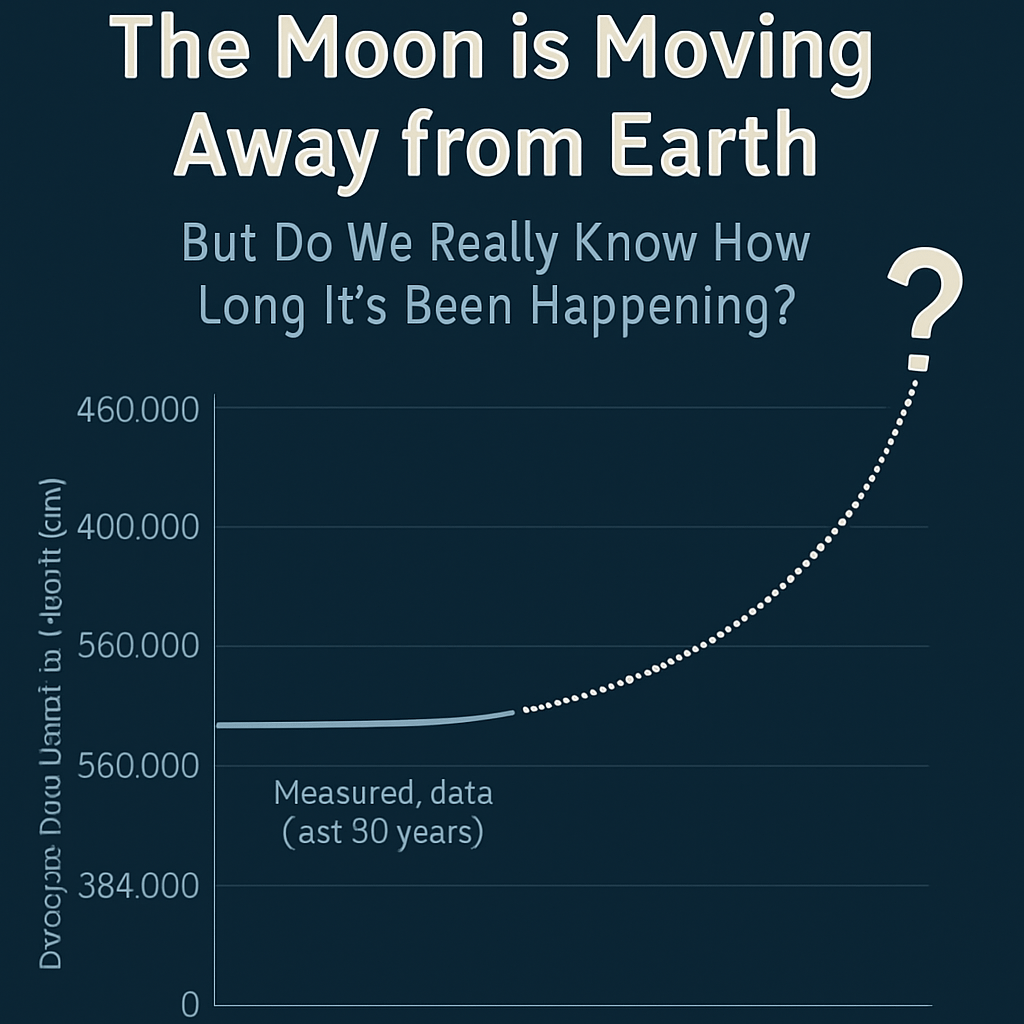
We know the Moon is drifting away from Earth at a rate of 3.8 cm per year, confirmed by precise laser reflectors left during the Apollo missions.
But here’s the problem — we’ve only been measuring this for a few decades.
Textbooks tell us this retreat has been happening for millions or even billions of years, but those projections are based on extrapolations, not direct data.
If we simply extend today’s retreat rate backwards, it would imply the Moon was touching Earth 1.5 billion years ago. That conflicts with geological records, tidal patterns, and even Earth’s life timeline.
Could the retreat rate have fluctuated over time? Are we making linear assumptions about a process that might be dynamic and variable?
This graph shows the measured retreat (solid line) vs the assumed ancient projection (dotted line), highlighting the question mark on how accurate our long-term assumptions are.
*This visualization is OC (Original Content). I created it to illustrate the difference between the measured lunar retreat data (solid line from Apollo-era laser reflectors) and the assumed long-term projections (dotted line) we often see in scientific models.
The big “?” represents the uncertainty in projecting billions of years into the past when we’ve only been measuring for a few decades.*
Posted by Less-Average-9720