
The Mediterranean is “boiling” due to climate change, with its waters warming faster than the global ocean average. What does this mean for marine ecosystems – and ultimately, for humans? Kathimerini explores emerging trends with insights from scientists working on the front lines of marine and climate research.
The data
“The Mediterranean is particularly vulnerable to climate change due to its unique geography, and its rate of warming already exceeds the global average. Specifically, the surface of the Mediterranean Sea has been warming by 0.041°C per year over the past four decades (1982-2023),” says Dr Sofia Darmaraki, a physical oceanographer and climate extremes researcher at the Foundation for Research and Technology – Hellas (FORTH).
“In Greece, recent data show that warming affects the entire water column. According to [the Greek weather and climate information network] Climatebook’s climate assessment, during the period 1991-2020, surface temperatures rose by about 1.5°C, increased by approximately 1.2°C in the upper 200 meters, by 0.9°C between 200 and 800 meters, and even at depths reaching 4,000 meters, temperatures rose by roughly 0.2°C,” she explains.
“These figures are based on climate models and confirm recent observations showing that heat accumulation in the Mediterranean is more pronounced moving from west to east. As a result, we are seeing more frequent and intense marine heatwaves – prolonged periods when sea temperatures rise well above seasonal norms,” adds Darmaraki.
“The rising trend in average sea temperatures, coupled with the increasing frequency of extreme events such as marine heatwaves, is pushing marine ecosystems to their limits – threatening both biodiversity and the ecological resilience of the Mediterranean,” she concludes.
In a recent study titled “Marine Heatwaves in the Mediterranean Sea: A Literature Review,” a team of researchers from FORTH, the Hellenic Center for Marine Research (HCMR), the University of Athens, and several international institutions conducted a systematic review of existing scientific literature to document, compare and evaluate the known impacts of marine warming in the Mediterranean in recent years.
Below are some key findings from their review, complemented by insights from other experts in the field.
• Disruption at the base of the food chain
First, rising temperatures in the Mediterranean are altering both the function and composition of phytoplankton – the microscopic plant organisms that form the foundation of the marine food chain. Warmer waters are driving a shift toward smaller phytoplankton species, reducing chlorophyll concentrations (a key indicator of ocean productivity), and disrupting zooplankton biomass, particularly among copepods – tiny organisms that serve as a critical food source for many fish species. These changes decrease the availability of food throughout the marine food chain, with cascading effects on ecosystem stability.
• Declining fish stocks
Second, fish populations are showing clear signs of stress. Shifts in species distribution, reduced egg production, and evidence of thermal stress have all been observed. Overall, fishery yields are declining: In Greece, for example, the total catch dropped by 16% in 2022 compared to 2020 – although the Covid-19 pandemic may have also contributed to the downturn.
Climate models presented by HCMR scientists Konstantinos Tsagarakis and Dimitris Damalas project a decline in potential fishery production of 2.8-5.3% by 2050 under the greenhouse gas mitigation scenario (RCP2.6), and a more substantial decrease of 7-12.1% under the high-emissions scenario (RCP8.5). The review also notes a rise in mortality incidents among commercially valuable fish species.
• Invasive species
Third, rising sea temperatures are facilitating the spread of invasive, thermophilic species – many of which are aggressive colonizers. These species, such as the silver-cheeked toadfish and the lionfish, often outcompete or displace native marine life and cause significant damage to marine vegetation, disrupting food chains and impacting fisheries.
• Marine mammals and turtles
Fourth, marine species such as dolphins, sea turtles, and the Mediterranean monk seal are responding to warming seas with noticeable shifts in their distribution and breeding cycles, as well as increased susceptibility to disease.
• Jellyfish blooms
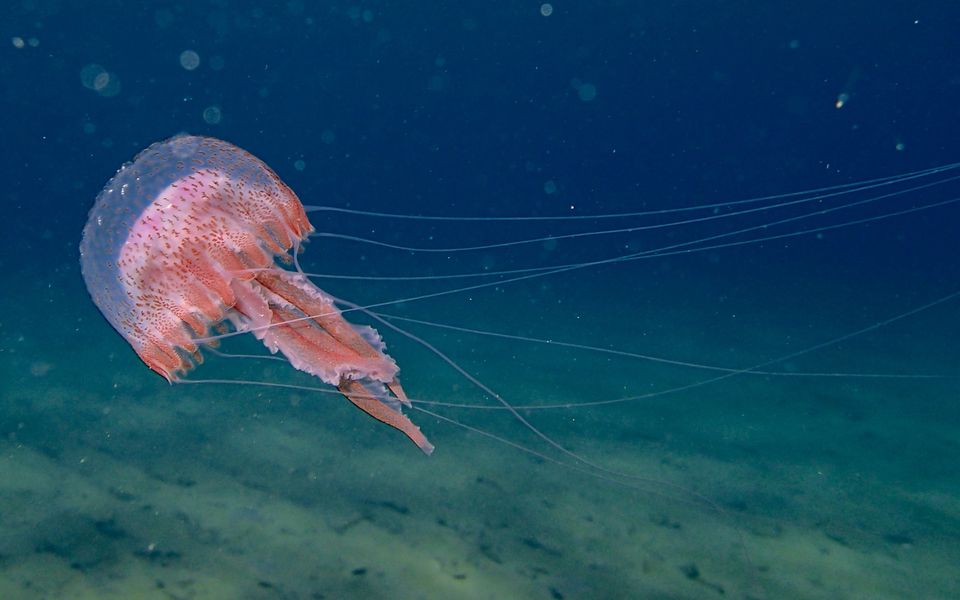
Fifth, jellyfish sightings are on the rise in several regions. “Climate change and overfishing are two key factors contributing to the increased frequency of jellyfish blooms. Warmer waters accelerate jellyfish metabolism and reproduction, while overfishing reduces populations of natural predators such as sunfish, swordfish, tuna and bogue. At the same time, a decline in fish larvae leaves more food available for jellyfish to thrive,” explains Epaminondas Christou, research director at the Institute of Oceanography, HCMR.
• ‘Fish nurseries’
Sixth, Posidonia oceanica seagrass meadows – often referred to as the “fish nurseries” – are suffering from biomass loss, widespread mortality, and limited reproductive recovery following marine heatwaves. These underwater meadows are vital breeding and nursery habitats for many marine species. Their decline has wide-ranging consequences, including reduced carbon storage and diminished oxygen production.
Sessile invertebrates such as corals and sponges have also experienced mass die-offs, particularly during heatwave events in 2003 and 2022. Degradation has been observed in entire ecosystems, including iconic Mediterranean coral species such as the red gorgonian (Paramuricea clavata).
• Aquaculture under threat
Seventh, aquaculture – including the farming of fish and mussels – is also facing significant losses. As the review notes, aquaculture systems are especially vulnerable because farmed species cannot move to escape extreme temperatures. These conditions cause severe physiological stress, respiratory difficulty due to reduced oxygen availability, and ultimately, mass mortality. Hypoxia (low oxygen levels) is a leading cause of fish deaths in Mediterranean aquaculture operations, with the impact intensified in heavily used coastal areas.
Rising surface temperatures also disrupt the natural mixing of ocean waters. “Normally, in winter, surface waters become denser as they lose heat to the atmosphere and sink. This mixing process transports well-oxygenated water to deeper layers. Vertical oxygen transfer is essential for sustaining life at greater depths,” explains Dimitris Velaoras, senior researcher at HCMR.
Major losses in fisheries
“Changes in marine ecosystems have significant socioeconomic impacts, particularly in the fishing and aquaculture sectors, which employ around 600,000 people across the Mediterranean region. These changes have led to economic losses in fisheries and placed heavy burdens on coastal communities that depend on them. The eastern and southeastern Mediterranean are especially vulnerable, with the most severe effects seen in the composition and abundance of catches. Notably, the decline of Posidonia seagrass meadows is estimated to have caused losses exceeding 750 million euros between 1990 and 2014, while the spread of species like the blue crab has damaged equipment and reduced fishermen’s incomes, as observed in Tunisia,” explains Darmaraki.
Regarding aquaculture, “future projections indicate that under extreme scenarios, profitability losses due to marine heatwaves could reach as high as 80%. The mussel farming sector has been particularly hard hit in recent years, with notable examples including the loss of 900 tons of mussels in the Evros Delta in 2013 – amounting to 9 million euros – and a 50% mortality rate in the Thermaic Gulf in 2021. Moreover, elevated temperatures encourage the spread of pathogenic organisms, rendering farmed fish unmarketable,” adds the researcher.