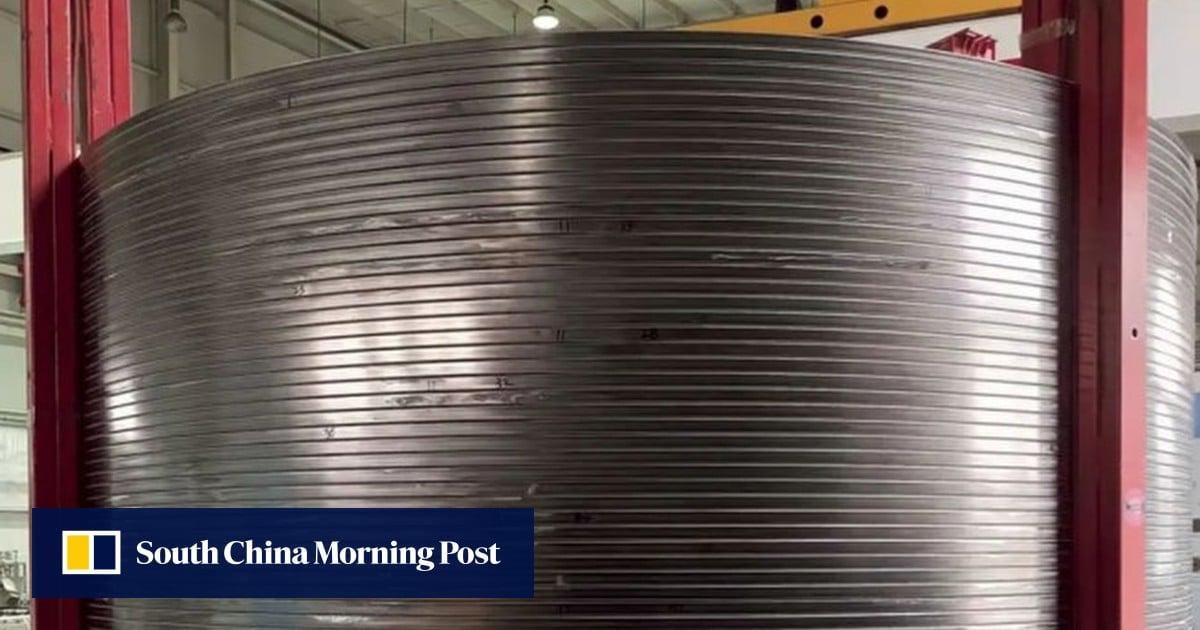
China creates new “super steel” alloy for their nuclear fusion BEST Tokamak reactor
https://www.scmp.com/news/china/science/article/3320595/absolutely-impossible-how-china-created-super-steel-nuclear-fusion

China creates new “super steel” alloy for their nuclear fusion BEST Tokamak reactor
https://www.scmp.com/news/china/science/article/3320595/absolutely-impossible-how-china-created-super-steel-nuclear-fusion
3 Comments
> In the quest to harness the power of the stars, one of the greatest challenges lies not in mastering fusion, but in **finding materials strong enough to contain it**.
> Chinese scientists have detailed how they created **CHSN01 (China high-strength low-temperature steel No 1)**, deployed it this year in the construction of world’s first fusion nuclear power generation reactor and put China in a leading position in materials science.
> ITER, the world’s largest fusion experiment, was launched in 2006 from a collaboration between seven members, **including China.** The material used for ITER’s cryogenic steel must withstand both liquid helium’s 269 degrees Celsius (516 Fahrenheit) cryogenic environment and the massive Lorentz forces generated by intense magnetic fields. In 2011, China’s team **developed the first viable solution** but Li Laifeng, a researcher at the Chinese Academy of Sciences’ (CAS) Technical Institute of Physics and Chemistry in Beijing, still had qualms. Li wrote: “While ITER’s maximum 11.8 Tesla field design is enough for itself, future higher-field magnets **will require advanced materials**”. He added that ITER could not generate electricity, but China’s own reactor would.
> In 2017, Li went to the United States to take part in the International Cryogenic Materials Conference, where he introduced his new material. However, **foreign experts were skeptical**, believing the existing technological route was “**absolutely impossible**” to produce better cryogenic steel.
> By late 2021, the High-Strength Steel Research Alliance was formed, **uniting four institutes, 13 enterprises** and four welding specialists under Li Laifeng’s leadership, sharing its technological advances with the industry and carrying a goal of developing a new type of domestic cryogenic steel. Their biweekly technical forums and a **“racehorse” development model** – in which blind samples underwent independent evaluation at the Institute of Physics and Chemistry – accelerated progress.
> In August 2023, experts confirmed that the new CHSN01 steel had met the engineering benchmarks that had been set. The material could **withstand 20 Tesla magnetic fields and 1,300MPa stresses while showing superior fatigue resistance compared to traditional alloys.** Now they’re looking to capitalize on the cryogenic steel development beyond the reactor. “In addition to its applications in superconductivity, this steel can also be used in other related areas,” Zhao said.
> It has since been deployed in a Chinese fusion reactor project, and the authors wrote about the **12-year process** to develop the material in a paper published in Applied Sciences in May.
This paper referenced talks about the new steel alloy being used for [cable-in-conduit conductors (CICC) jackets for the central solenoid of the fusion reactor.](https://www.mdpi.com/2076-3417/15/9/5201)
[More details on the BEST Tokamak reactor](https://www.xdgro.com/article/detail.html?id=1056&language=en)
[This paper](https://www.mdpi.com/2076-3417/15/9/5201) lists out the exact chemical composition ratio for CHSN01 if you click Table 2: 55.1Fe, 22.1Cr, 14.6Ni, 5.22Mn, 2.1Mo, 0.31N, 0.3Si, 0.19V, 0.09Nb, 0.008C, 0.005P, 0.002S
Got really excited initially and thought this was related to the reactor wall material (where we desperately need a breakthrough), but this is awesome too!