
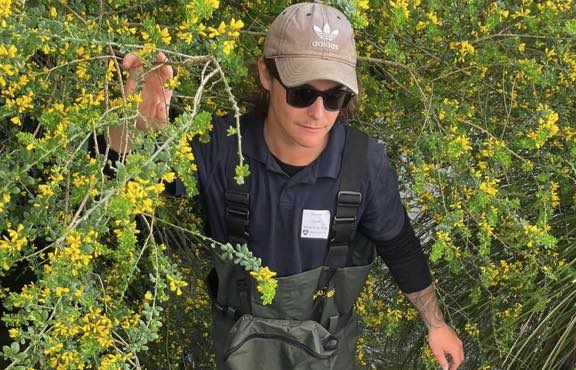
Environmental scientist Taylor Thomson stands knee-deep in an estuary, testing water quality as part of his work to prevent coastal ecosystems from collapsing. His research focuses on a critical question: How can communities know when their waterways are approaching an irreversible ecological breakdown?
Thomson, who works as an Environment Specialist at BHP and contributes to Field-Based STEM education programs, has developed ecological models that help regional councils identify when estuaries might tip from healthy, clear-water environments into degraded, muddy systems that struggle to support marine life.
“A tipping point is like a ball being pushed up a hill,” Thomson explained during a recent Field-Based STEM videocast. “It takes a lot of work to push that ball up to the top. Once it gets to the top, it flies down to the bottom, and that’s the other stable state, which is that muddy environment that we don’t want.”
Taylor Thomson’s Predictive Models Transform Council Decision-Making
Thomson’s ecological models use keystone species and environmental factors like nutrients and sediments to predict how many years might pass before an estuary reaches its tipping point. The work aims to help councils become proactive rather than reactive in their environmental management.
Currently completing his master’s degree in environmental science at Waikato University, Thomson focuses on estuaries around New Zealand that can exist in two distinct states: a healthy sandy shore environment with clear water and lower nutrients, or a degraded muddy bottom system with turbid water and high nutrient levels.
The transition between these states often proves difficult to reverse. Once an estuary shifts to the degraded state, Thomson notes, “it takes all that work and more to push it back up and get back into the right state.”
His models examine specific indicator species, including mamoni, a type of clam that plays a crucial role in nutrient cycling. These organisms pump water from sediments back to the surface, helping to process nutrients in healthy estuaries. When nutrient levels become too high, however, these key species cannot survive, leading to algal blooms and further ecosystem degradation.
From Research to Real-World Application
Thomson’s path to environmental science began with an early fascination with sharks and human interactions with aquatic ecosystems. After completing his undergraduate degree in environmental science and psychology at Waikato University, he worked as an environmental monitoring officer with the Waikato Regional Council, spending four days a week collecting samples across a wide range of environments.
This hands-on experience informed his current modeling work, which addresses a common challenge in environmental management: the significant time lag between when pollution enters waterways and when its effects become visible. Through groundwater transport, nutrients can take anywhere from hours to decades to reach receiving waters, making it difficult for communities to understand the connection between their actions and environmental outcomes.
“Even when you explain it to them, a lot of people thought we were testing for COVID in the waterways,” Thomson said about public interactions during his monitoring work. This disconnect between scientific work and public understanding drives his involvement in Field-Based STEM, where he works directly with teachers and students to improve environmental education.
Thomson has recently worked with schools across Auckland, conducting water quality analysis and helping students develop monitoring programs for local streams and reserves. His educational approach emphasizes practical, hands-on learning that connects students with real environmental challenges in their communities.
The scientist advocates for early environmental education that helps students understand how to preserve ecosystems before restoration becomes necessary. “It’s really nice to be able to take that to the students and get them to learn from a really young age and get them thinking about how they can preserve these environments for themselves,” he said.
Thomson’s combination of rigorous scientific modeling and community education reflects a growing recognition that effective environmental management requires both technical expertise and public engagement. His work demonstrates how predictive ecological models can serve as early warning systems, giving communities the information they need to protect their coastal environments before irreversible damage occurs.
The research comes at a critical time for New Zealand’s estuaries, many of which face increasing pressure from agricultural runoff, urban development, and climate change. Thomson’s models offer councils and communities a tool to anticipate and prevent ecological collapse, rather than simply responding after damage has already occurred.