
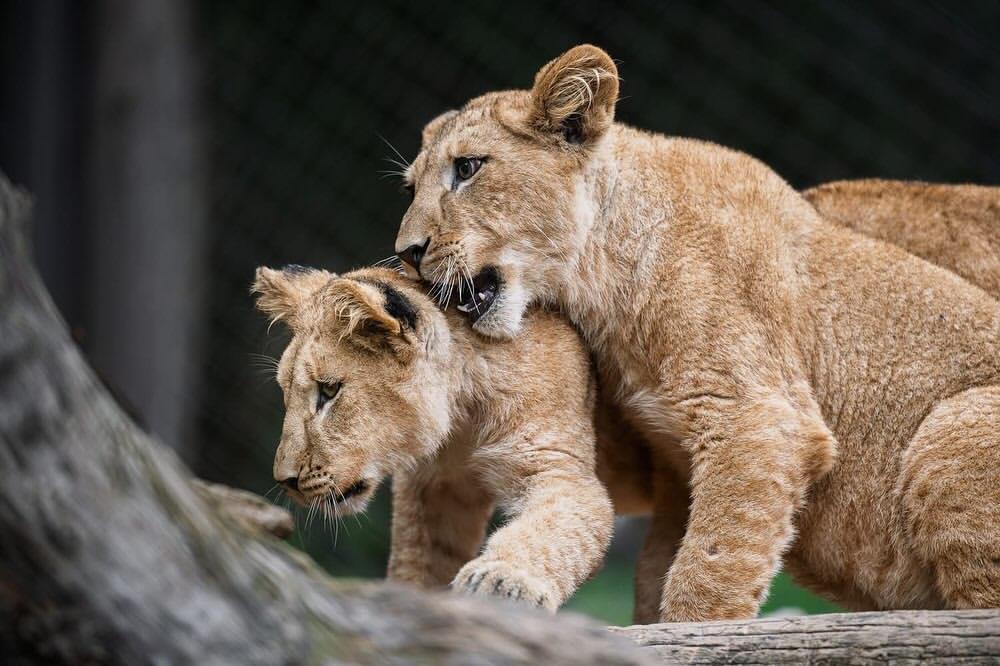
Marrakech – Four Barbary lion cubs were recently born at Dvůr Králové Safari Park in the Czech Republic. The three females and one male cub were seen playing in their outdoor enclosure on Wednesday under the watchful eyes of their parents, Khalila and Bart, according to the Associated Press (AP).
The cubs represent a vital contribution to the small surviving population of this rare lion subspecies. As part of an international endangered species program, they will soon be sent to other participating parks, including the Beersheba zoo in Israel.
Dvůr Králové Deputy Director Jaroslav Hyjánek told the AP that preliminary steps have been taken for a possible reintroduction of the Barbary lion into its natural habitat. Initial talks with Moroccan authorities have not rejected the idea of reintroduction in one of the Atlas Mountains national parks.
“It’s important to have such a vision for any animal,” Hyjánek said to the AP. “Without it, the existence of zoos wouldn’t make sense.”
A conference of experts is planned in Morocco for late 2025 or early 2026 to evaluate the feasibility of such a plan. Any reintroduction would face numerous obstacles since the lion has been absent from the environment for decades.
Morocco currently hosts the world’s largest collection of Barbary lions, with populations varying between 30 and 40 individuals. The Rabat National Zoological Garden announced last October that a Barbary lion cub born in August 2024 would be presented to visitors.
Named Azaghar, the male cub was born on July 26, 2024, to 13-year-old mother Massa and 8-year-old father Layt. The birth was the result of a breeding program that began in 2022.
Read also: Culture Minister: History Supports Atlas Lions’ Centuries-Old Presence in Morocco
“Right after the birth of the Atlas lion cub, there are a number of measures that we undertake immediately,” explained Saad Azizi, head of the veterinary and zoological service at Rabat National Zoo at the time. These include housing arrangements, veterinary examinations, and eventual reintroduction to the group.
The cub was initially dependent on his mother’s milk but has since been weaned and is eating meat. Since its opening in 2012, the Rabat Zoo has recorded about 18 lion births.
The Barbary lion, a majestic member of the Northern lion subspecies, once roamed freely across northern Africa, including the Atlas Mountains. They were almost completely wiped out due to human activities, including being killed by gladiators in Roman times, overhunting, and habitat loss.
The last known photo of a wild Barbary lion was taken in 1925, with the last individual killed in 1942. It’s believed the last small populations went extinct in the wild by the mid-1960s.
Fewer than 200 Barbary lions are currently estimated to live in captivity worldwide. Through its conservation program, the Rabat Zoo aims to maintain a founding population by promoting controlled reproduction and ensuring balanced management.
According to the IUCN, Barbary lions are now classified as part of the Panthera leo leo subspecies, which includes lions from West Africa across to northeast Africa and India.
While the Barbary lion subpopulation has not been officially assessed as Extinct in the Wild, lions are extinct across their entire North African range.