
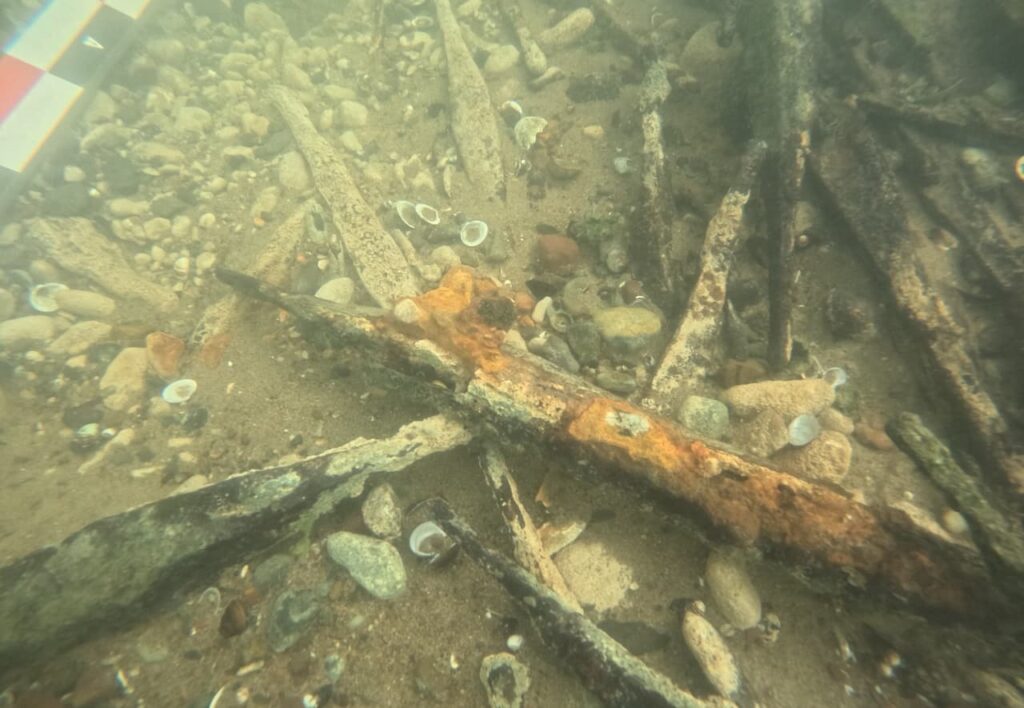
Archaeologists conducting excavations on the banks of the Sava River in Tolisa, Bosnia, have discovered an unprecedented number of bipyramidal ingots—rare metal bars that, according to experts, may date back more than two thousand years.
An ingot is a piece of relatively pure metal cast into bars, plates, or blocks, used for transportation and later transformation into tools, weapons, utensils, and other objects.
Their shape varies depending on the historical period in which they were produced, and those found in Tolisa show characteristics typical of the transition between the Late Iron Age (La Tène period) and the Roman era, placing them between the 1st and 2nd centuries BCE.
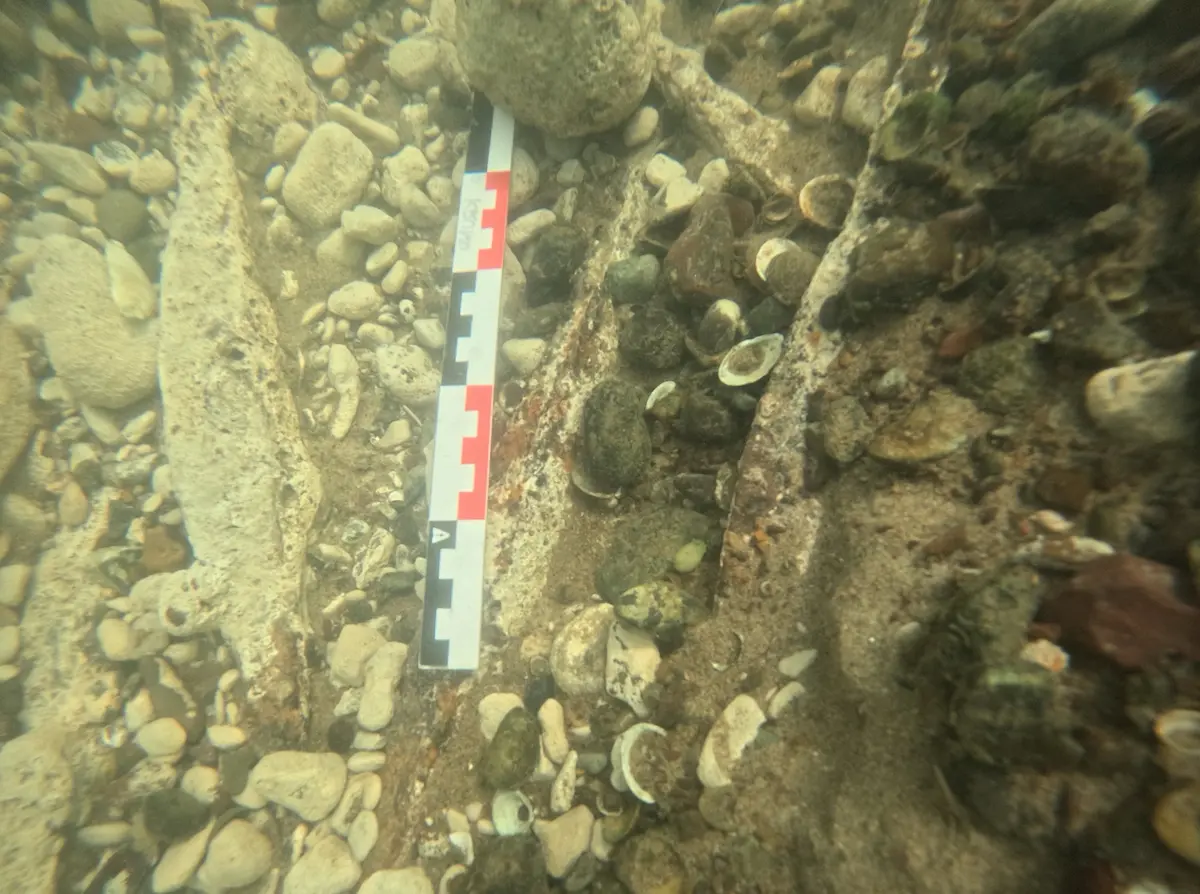 Another view of the set of ingots found in Bosnia. Credit: Muzej Franjevačkog samostana Tolisa Vrata Bosne
The scale of the discovery becomes evident when compared with existing records: until now, throughout Bosnia and Herzegovina, the National Museum in Sarajevo held a single ingot of this type. In Croatia, only one other specimen is preserved, and in Slovenia, barely two or three.
The greatest discoveries of these objects have been made in France, Germany, Hungary, and Romania. However, thanks to this new find, the region of Bosanska Posavina could now surpass, at a single site, the total number of known ingots across all of Europe.
It all began with Pero Matkić, a history enthusiast from Posavina, who last year, by chance, spotted something unusual in the murky waters of the Sava. He took several photographs that were sent to Hrvoje Vulić, director of the Vinkovci City Museum, who immediately recognized the importance of the material. His involvement led to the participation of the Croatian Conservation Institute and underwater archaeologist Krunoslav Zubčić.
After waiting for the river level to drop, an excavation was organized with the participation of Nikica Spudić—specialist from the Karlovac Mountain Rescue Service—, Pero Matkić himself, his son Mihovila, and Joza Jezerčić, the museum director. The work concluded with a meticulous documentation process: reference points were fixed, the area was photogrammetrically recorded to generate a 3D model of the site, and finally, each piece was numbered and extracted.
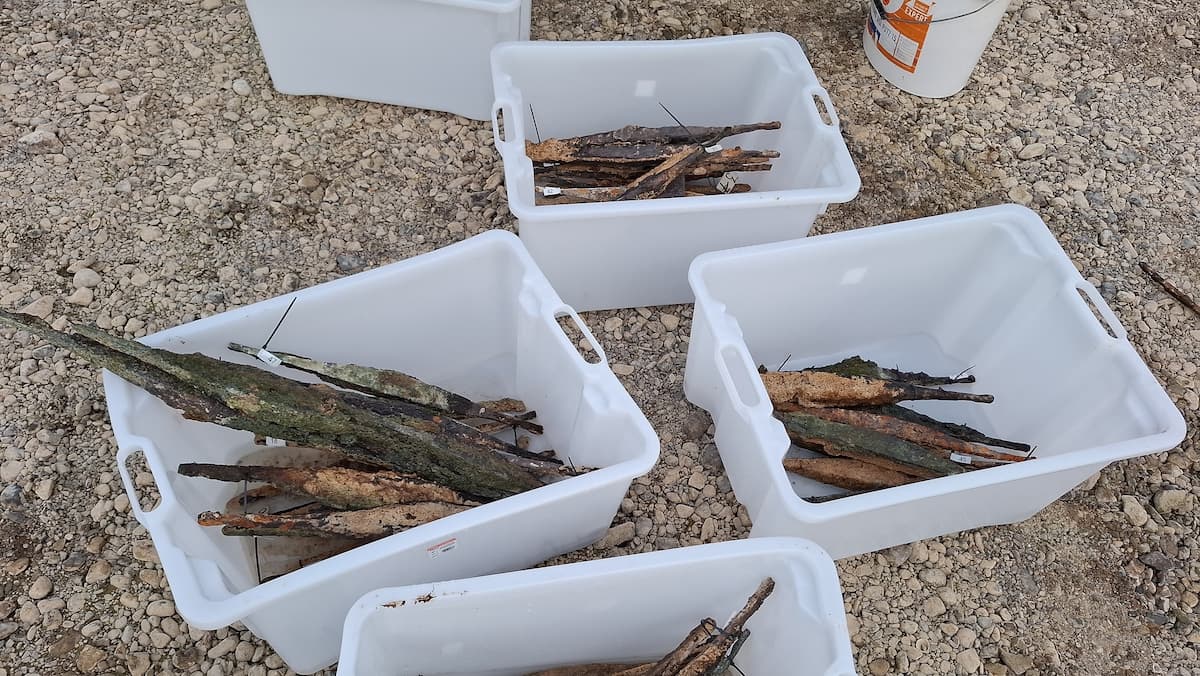 The ingots already extracted from the riverbed. Credit: Muzej Franjevačkog samostana Tolisa Vrata Bosne
The ingots were submerged in tubs of distilled water where they will remain until they are conserved and further analyzed. Upcoming chemical studies could reveal crucial information such as the origin of the metal or confirmation of trade routes that connected Bosanska Posavina with Central Europe in pre-Roman times.
According to experts, this discovery could forever change the perception of the role this region played in ancient trade and economy, showing that Bosanska Posavina was a much more significant center of activity than previously believed.
The museum has expressed its gratitude to the Croatian Conservation Institute, especially to Zubčić and Spudić, but has emphasized the tireless work of Pero Matkić, who for more than forty years has explored the region in search of historical traces to preserve in Vrata Bosne.
The story of these mysterious ingots is just beginning, and their impact goes beyond Bosnia’s borders. Given the complexity and cost of chemical analyses—a long and meticulous process—the project will require international collaboration, extending to Slovenia, Germany, France, and Austria.
Discover more from LBV Magazine English Edition
Subscribe to get the latest posts sent to your email.
A recent study published in the journal Saguntum by researchers Macarena Bustamante Álvarez and Andrea Menéndez Menéndez, from the University of Granada, reveals that a series of small bronze objects,…
The latest excavation campaign at Uşaklı Höyük, a mound rising on the arid central Anatolian plateau, has unearthed a discovery that could rewrite forgotten aspects of Hittite society: the remains…
Sometimes, nature shapes and creates forms so perfect they can fool even the most trained eyes. This is the case with phenomena known as geofacts—a term that combines geology and…

For decades, biology textbooks have taught us that primates — the group that includes monkeys, apes, and humans — originated in warm tropical rainforests. But a study published in the…
An international team of scientists has reconstructed the genetic history of horses in the Iberian Peninsula over the past 26,000 years, revealing a past that includes extinct lineages, ancestral breeding…

An international team of scientists has found what may be the first geochemical evidence from ocean sediments in the depths of Baffin Bay, near Greenland, supporting the controversial Younger Dryas…
For decades, one of the most widely accepted theories in archaeology and the social sciences held that the introduction of agriculture in Europe, around 8,000 years ago, marked the inevitable…
In 2013, in the municipality of Arcos de Valdevez, located in the northern Portuguese region of Alto Minho, the União das Freguesias de Grade e Carralcova was created—a merger of…
In the reddish lands of Hualongdong in China’s Anhui province, the discovery of a set of fossilized teeth estimated to be 300,000 years old challenges established narratives about human evolution…
In the summer of 2024, during rescue excavations linked to the installation of an electric cable in the municipality of Kapitan Petko Voyvoda, in southern Bulgaria and just a few…
Load more articles
Something went wrong. Please refresh the page and/or try again.