
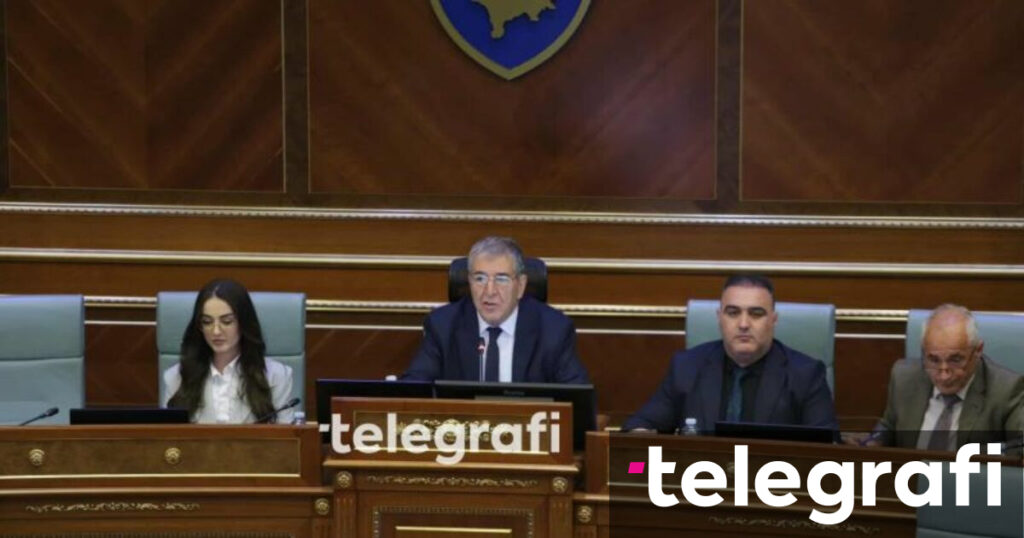
The Constitutional Court has again ordered the deputies of the Assembly of Kosovo to constitute the new parliamentary composition – resulting from the February 9 elections – but this time with clearer instructions.
They are ordered to constitute the Assembly within a 30-day period and elect the Speaker of Parliament through open voting, putting the same candidate on the ballot no more than three times.
But when can a constitutive session be called?
It is not known exactly. It could be this week, or next week at the latest, depending on when the full verdict is published by the Constitutional Court.
The constitutive session cannot be held until the Constitutional Court publishes the full verdict.
According to Eugen Cakolli from the Democratic Institute of Kosovo, based on previous practices, the Constitutional Court needs one to two weeks at most to publish the full verdict.
“Let’s say if the verdict is published on Wednesday, then the hearing could be called immediately on Thursday and then the 48-hour cycle could continue,” Cakolli said on KTV on August 8.
The constitutive session of the Assembly was first called on April 15 by the country’s president, Vjosa Osmani. Since then, MPs have held 54 continuations of this session, which have been led by Speaker Avni Dehari, as the oldest MP of the new legislature.
The Constitutional Court said that Presiding Judge Dehari did not act on the basis of this court’s previous verdict of June 26, adding that all sessions held from June 27 to July 26 “are declared invalid.”
According to the Rules of Procedure of the Assembly, the chairman of the constitutive session is responsible for the smooth running of the session, and Dehari is expected to convene the session as soon as the Constitutional Court publishes the full verdict in the Official Gazette.
How was the decision received?
The decision was welcomed by parties that were in opposition last term, but was criticized by the election-winning party, the Vetevendosje Movement (LVV).
The LVV called the decision arbitrary, the Democratic Party of Kosovo (PDK) and the Democratic League of Kosovo (LDK) called it a constitutional and democratic victory, while the Alliance for the Future of Kosovo (AAK) spoke of the overthrow of the dictatorship.
According to the LVV, the Constitutional Court’s announcement “constitutes a dangerous deviation from its constitutional role” and is “contrary to the fundamental principles of the rule of law and the separation of powers.”
LVV MP and acting Minister of Justice, Albulena Haxhiu, told a press conference on August 10 that “the Constitutional Court’s announcement constitutes a serious concern, because it is a flagrant excess of the powers that the Constitutional Court has.”
Asked if her party will respect the decision, Haxhiu said: “What our action will be after this announcement, after the ruling, you will understand when the time comes.”
PDK leader Memli Krasniqi said that this Constitutional Court decision confirmed his party’s position that the LVV “has held the Assembly of the Republic of Kosovo hostage, deliberately and in a planned manner blocking its functioning for narrow government interests, with actions completely outside the Constitution.”
The leader of the LDK, Lumir Abdixhiku, welcomed the Constitutional Court’s decision, calling it a “great victory for democracy.”
Ardian Gjini from AAK said that with the Constitutional Court’s decision, “democracy won, dictatorship was overthrown.”
What is expected from the full verdict?
The full verdict of the Constitutional Court, in addition to paving the way for the constitutive session to be held the following day, is expected to clarify more things.
She is also likely to respond to a now-withdrawn request by Kosovo President Vjosa Osmani, regarding what would happen if the Kosovo Assembly was not constituted by July 26 – the deadline previously set by the court through a ruling.
In her previous ruling, which the deputies ignored, the Constitutional Court had not indicated the legal consequences of such disregard.
The Constitutional Court can now indicate what the consequences will be if MPs again ignore the 30-day order to form a new Parliament.
“Although the president has withdrawn the request, the Constitutional Court has the legal right to review it, because it must be clear that this is an issue of public and constitutional interest,” said Cakolli.
Cakolli said that such deadlines will be destined not to be respected by political actors, as they “lack the political will to find solutions, not because they do not know the procedures.”
“Parties will continue to violate deadlines as long as the court does not clearly spell out what the consequences will be for MPs and the Assembly in the event of further failures,” he said.
Who has how many votes?
This entire crisis of several months comes as a result of the lack of a political agreement between parliamentary parties, as no party won the majority to govern alone.
The LVV of the incumbent Prime Minister, Albin Kurti, won 48 seats and the other parliamentary parties have refused to vote for its candidate for Speaker of the Assembly, for whose appointment at least 61 votes are needed.
While LVV insists that Albulena Haxhiu is a worthy candidate, some of the largest parliamentary parties, such as PDK, LDK, and AAK, exclude her as “divisive.”
PDK came second with 24 seats, LDK third with 20, followed by Serbian List – the largest Serb party in Kosovo with 9, and the coalition between AAK and the Social Democratic Initiative, with 8.
Another 11 seats belong to minorities. /REL/