
German Embassy: Politicians must act urgently now to end the six-month crisis

Express newspaper
12/08/2025 10:31
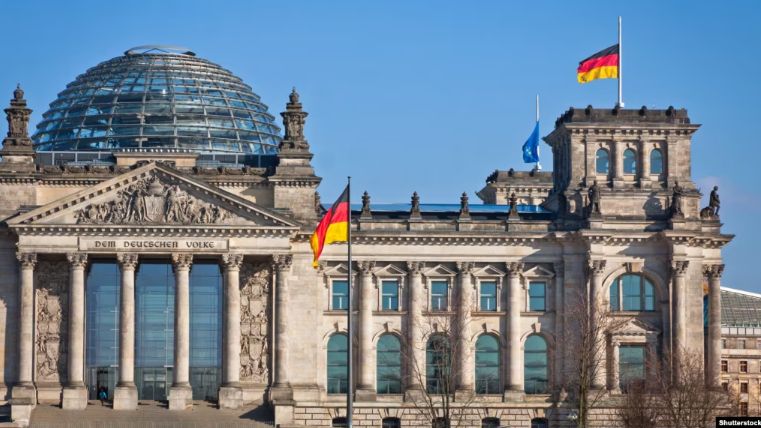
The German Embassy in Kosovo told Radio Free Europe that it expects all political powers in Kosovo to “fully respect and implement” the decision of the Constitutional Court of Kosovo on the constitution of the new parliamentary composition resulting from the February elections.
Berlin warned that there would be consequences if this decision was not implemented.
“Politicians must now act urgently to end this nearly six-month crisis. We expect a swift resolution, within the [Constitutional] deadline, and call on all political stakeholders to work towards a compromise. Failure to respect the decision poses a threat to the well-being of citizens and the path to EU integration,” the German Embassy in Pristina said in a response to Radio Free Europe.
The Constitutional Court of Kosovo on August 8 published its ruling on the political impasse, stating that MPs must constitute the Assembly within 30 days and that the new Speaker of the Assembly must be elected through open voting.
The 30-day deadline begins when the full Constitutional Court judgment is published in the Official Gazette, which has not yet happened.
The call from the German Embassy comes at a time when the German director for the Western Balkans, Michael Reiffenstuel, held meetings with party and state leaders in Kosovo.
According to the Embassy, in these meetings, he conveyed the message that the Constitutional Court’s decision must be respected.
During his stay in Kosovo on August 10 and 11, Reiffenstuel held separate meetings with the President of Kosovo, Vjosa Osmani, the acting Prime Minister and leader of the Vetëvendosje Movement, Albin Kurti, the leader of the Democratic Party of Kosovo, Memli Krasniqi, and the leader of the Democratic League of Kosovo, Lumir Abdixhiku. The German envoy also met with representatives of Kosovo Serb parties and civil society.
The European Union, as well as the embassies of the United States and Italy, have called on political parties to implement the Constitutional Court’s decision.
The parties that were in opposition last term, PDK, LDK, and the Alliance for the Future of Kosovo, welcomed the Constitutional Court’s decision, while it was criticized by the election winner, the Vetëvendosje Movement.
The LVV has described the Constitutional Court’s decision as arbitrary, adding that it “constitutes a dangerous deviation from the constitutional role” and that it is “contrary to the fundamental principles of the rule of law and the separation of powers.”
The full verdict of the Constitutional Court, in addition to paving the way for the constitutive session to be held the following day, is expected to clarify more things.
She is also likely to respond to a now-withdrawn request by Kosovo President Vjosa Osmani, regarding what would happen if the Kosovo Assembly was not constituted by July 26 – the deadline previously set by the court through a ruling.
In her previous ruling, which the deputies ignored, the Constitutional Court had not indicated the legal consequences of such disregard.
The Constitutional Court can now indicate what the consequences will be if MPs again ignore the 30-day order to form a new Parliament.
The political crisis was caused after no party won the majority to govern alone in the February elections.
The LVV won 48 seats and the other parliamentary parties have refused to vote for its candidate for Speaker of the Assembly, for whose appointment at least 61 votes are needed. According to the new Constitutional Court decision, the LVV can only put a candidate for Speaker of the Parliament on the ballot three times.
In the February 9 elections, PDK came second with 24 seats, LDK third with 20, followed by the Serbian List – the largest Serb party in Kosovo with 9, and the coalition between AAK and the Social Democratic Initiative, with 8.
Another 11 seats belong to minorities. /REL/