
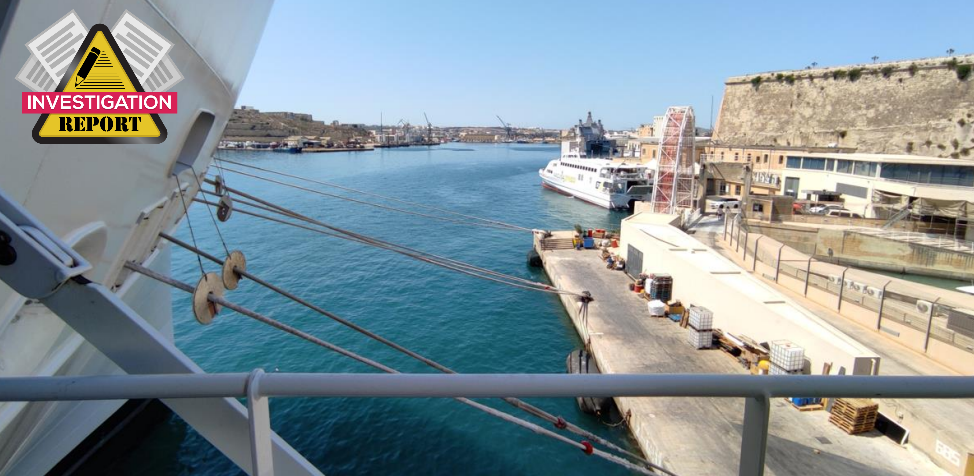
Transport Malta has issued an investigation into an incident where an able bodied seafarer (AB) on the passenger ship MSC World Europa suffered serious facial injuries at the port of Valletta, Malta, due to a mooring rope parting during the berthing operation.
The incident
MSC World Europa sailed from Messina, Sicily on 06 August 2024, enroute to Valletta Cruise Port (VCP), Malta. Pre-arrival manoeuvres and mooring arrangements were planned, and associated risks mitigated. The following morning at 0600, the master held a meeting to discuss the vessel’s intended mooring plan, which was discussed and agreed. The first officer was designated as the Officer in charge (OIC) at the forward mooring station. At 0700, MSC World Europa arrived at the entrance to the port of Valletta. When a local pilot arrived on board, the master was on the manoeuvring controls. The vessel’s drafts were 9.24 m forward and 9.04 m aft.
The mooring crew members donned their PPE and assembled at their respective mooring stations. The OIC discussed the forward station’s intended mooring plan and briefed the crew on safety and Mooring Checklist C09, contained in the Company’s Standard Mooring Procedures Manual. Communications between the bridge and OIC were conducted by VHF radio.
 Credit: Transport Malta
At about 0730, MSC World Europa approached the assigned berth at Pinto Wharf 1 & 2. The crew took their positions, with the OIC stationed on the starboard side observation platform, monitoring overside operations, while the bosun standing inside, in line of sight with the OIC, verbally communicated or signalled actions to the mooring crew. Shortly after 0735, a spring line from W2 windlass was run ashore to bollard 6.
At 0739:33 s, the bridge communicated that the vessel was in position. The spring line was held tight and secured. A breast line from the aft split-drum of winch M4 was passed through the universal roller fairlead, located forward of the observation platform, and secured to bollard 3. The crew members then shifted to M3 from where an intermediate breast line was run ashore to bollard 2. At 0742:50 s, the master instructed the OIC to haul-in the breast line with minimum tension. At 0744, the OIC reported 2 and 1 (intermediate breast, spring and breast line) lines to the bridge.
Shortly after, the bridge instructed the forward station ‘not to touch the breast line’ and to proceed with the rest of the mooring. The OIC acknowledged the order, and the breast line was set on the winch brake and gears disengaged. The crew started to run a second breast line from the forward split-drum of M4, passing it through the adjoining roller fairlead.
While moorings at the forward station progressed unimpeded, the aft station reported that its heaving line had repeatedly fallen in the water and no ropes could be sent ashore. During the ensuing five minutes or so, the bridge manoeuvred the stern closer to the quay, using the ship’s stern thrusters. A back spring was thus secured aft at 0744. Less than a minute later, at 0745:35 s, the forward breast line parted, just outside of the roller fairlead. The line recoiled around the fairlead, striking the AB. The force of the impact knocked him unconscious. The line travelled further in before falling on the deck, near winch M4. The OIC immediately notified the bridge and Mike Echo (medical signal) was declared.
The ship’s paramedic soon arrived and provided first aid. The injured crew member regained consciousness and was transferred to the ship’s Medical Centre for treatment.
Conclusions
#1 Immediate safety factors
- The breast line parted due to tensile overload during the berthing operation.
- Part of the failed mooring rope whipped past one of the crew members on the mooring platform, inflicting facial injuries.
#2 Conditions and other safety factors
- The failure of the mooring rope under investigation was primarily attributed to progressive mechanical degradation and thermo-oxidative ageing of the rope’s internal fibres.
- The hard locking of the winch brake prevented the rope to render under strain.
- Laboratory inspections and visual and microscopic examination revealed extensive hardening, and embrittlement of core strands, consistent with environmental exposure and internal frictional heating.
- The mooring rope had a significantly diminished load-carrying performance relative to the certified minimum breaking load.
- The engagement of thrusters to get the stern closer to the quay and ease the transfer of heaving line to the mooring personnel ashore, seemed to have generated a turning moment about the aft sited fender/s, acting as a pivot point. The resultant moment would have pulled the stern closer along the quay and bow away, thereby straining the relatively short breast line.
- The energy stored in the Bexcoflex tail stiffened under the strain and had likely contributed to the parted line to recoil violently.
- Without any load or tension cues, the crew was unlikely to know or warn others if the line was under strain, predict failure or probable direction of whiplash.
- Degradation from environmental exposure and internal frictional heating of core strands during previous mooring events had led to the weakening of tensile force were not readily detectable by the onboard visual or tactile examination.
- The vessel’s overhang had resulted in the aft mooring station distant from the adjoining quay.
#3 Other findings
- No mooring boat or boathook was available to transfer / pick up heaving line from the sea.
- HMPE ropes have low elongation properties and as such audible signs are often missing.
- Given the complexities in evaluating factual condition of jacketed HMPE ropes, it remained doubtful whether ships’ crews have the necessary skill or experience to accurately establish whether ropes in use were suitable for further service.
Actions taken
Safety actions taken during the course of the safety investigation
The Company took the following actions:
- implemented Gleistein Tracking software programme for the management of mooring equipment, digitally assisted inspections, and real-time safety status of all mooring equipment and ropes;
- distributed a mooring rope maintenance training video on board its fleet;
- directed mooring crew compliance to Company procedure R14-Mooring Anchoring Operations and Mooring Checklist C09;
- agreed with VCP to use the storm bollard for head and breast lines;
- agreed with the Malta Maritime Pilots to engage their pilot boat to transfer mooring ropes ashore.
The Company is recommended to:
Transport Malta’s Ports & Yachting Directorate is recommended to: