
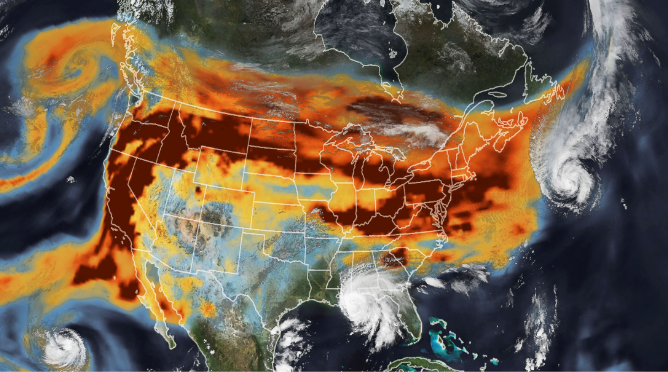
Climate-induced weather disasters include record wildfires in the West, record-setting heat waves and droughts, and aggressive hurricanes. Here, smoke plumes and hurricane clouds are visible at once (photo courtesy of NASA Earth Observatory).
The U.S. Environmental Protection Agency under President Donald Trump is seeking to rescind the EPA’s longstanding finding from 2009 that greenhouse gas emissions endanger public health and welfare.
The EPA is making a truly radical move here.
The endangerment finding has been a linchpin to the agency’s regulatory actions over the years to deal with climate change. In announcing the move to rescind the finding, EPA Administrator Lee Zeldin boasted: “Today is the greatest day of deregulation our nation has seen.” Zeldin is effectively waging war against what he disparagingly calls “the climate change religion.”
This latest EPA move on the endangerment finding must be placed in context.
The U.S. Supreme Court ordered the EPA to regulate carbon dioxide and other greenhouse gas emissions under the Clean Air Act back in 2007. The court left it to the agency to make the required endangerment finding. And Congress recently reaffirmed the EPA’s endangerment finding when it passed the Inflation Reduction Act in 2022.
So, this action would be a dramatic change in EPA policy in defiance of Supreme Court precedent and an act of Congress. And the action prioritizes deregulation over the EPA core mission of protecting health and the environment.
All this is taking place in the wake of what I have called a “grand upheaval” in federal administrative law.
In recent years, the U.S. Supreme Court adopted a new set of administrative rules aimed largely at restricting the Biden Administration from implementing its regulatory policies.
The court took a three-pronged approach: (1) to interpret regulatory statutes narrowly against agency authority; (2) to bar regulations on what the Court deemed “major questions”; and (3) to overrule the Chevron deference formerly given to agencies when interpreting ambiguous statutes. The Court often targeted the EPA under this new approach.
In my opinion, the Supreme Court’s new restrictive view of agency authority could backfire on Zeldin as he wages his war on “the climate change religion.” The EPA will be hard-pressed to find substantial scientific evidence to support its political conclusion that the finding of endangerment no longer applies. The provocative notion about greenhouse gas emissions posing no serious adverse health risks is rooted in politics and not science.
I do not believe the EPA can justify such an erroneous finding under either the Administrative Procedure Act or the Clean Air Act.
For the EPA now to rescind its endangerment finding from 2009 is a “major question“ that Congress has not specifically delegated to the EPA as required by current Supreme Court precedent. Indeed, Zeldin shows this is a “major question” with his own hyperbolic boast about the effect of the decision. And finally, the EPA will get no Chevron deference for its proposed decision to deregulate greenhouse gas emissions under the Clean Air Act.
We’ll likely find out soon if the Supreme Court will consistently stand by its new rules of federal administrative law. If not, you can draw your own conclusions about why.