
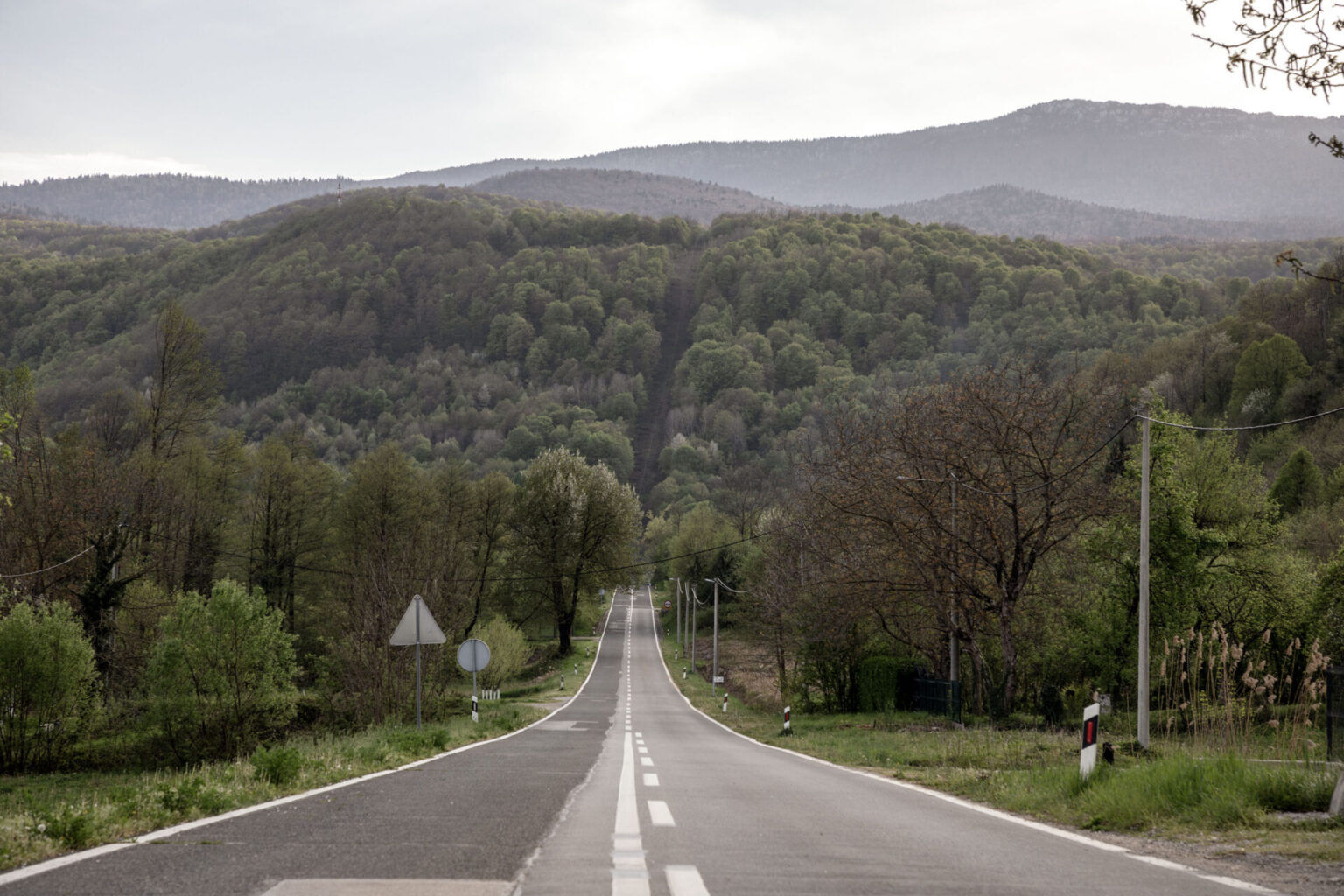
Believing Serbia’s favorable policy toward Cubans was ending, the Rodriguez family joined a group of their compatriots and headed for the border, where they paid a local fisherman to carry them across the Drina River in a wooden boat and into Bosnia. They headed up to the northwestern frontier town of Bihać with a new destination — Spain. This would necessitate a series of attempts to clandestinely cross the 570-mile Croatian border, a practice now universally referred to by migrants as “the game.” But in the early stages of the game, they had not yet been told about the minefields littering their path.
Aladin Bajraktarević from the Bosnia and Herzegovina Mine Action Center (BHMAC) strides into the hotel breakfast room in Bihać and starts laying out A4 printouts of maps, announcing: “You are six kilometers [3.7 miles] from the nearest mine!”
It’s April 2025, and Bajraktarević points to aerial shots of villages ringed by red blotches signifying minefields. His next photo features a prominent red blotch — blood seeping out from a flock of sheep that had wandered over a mine. “When I show the maps during presentations on landmine awareness, sometimes people don’t listen.” The next photo he places on the table shows a mangled human corpse. “When I show them these, they pay attention. I tell them, ‘Your kids can end up like this.’”
According to BHMAC, the last recorded landmine-related fatality in the Una Sana canton was in 2009, and the victim was a deminer. Since the end of the war in 1995, at least 615 people have been killed by landmines. BHMAC suspects there are at least 20,000 mines in Una Sana, a region stretching across the northwestern frontier with Croatia. Bakrajtarević has a team of 20 deminers, but recruiting new members is a struggle. The low monthly salary of around 700 euros ($790) for a scout, Bajraktarević says, is less than the waitresses serving breakfast earn.
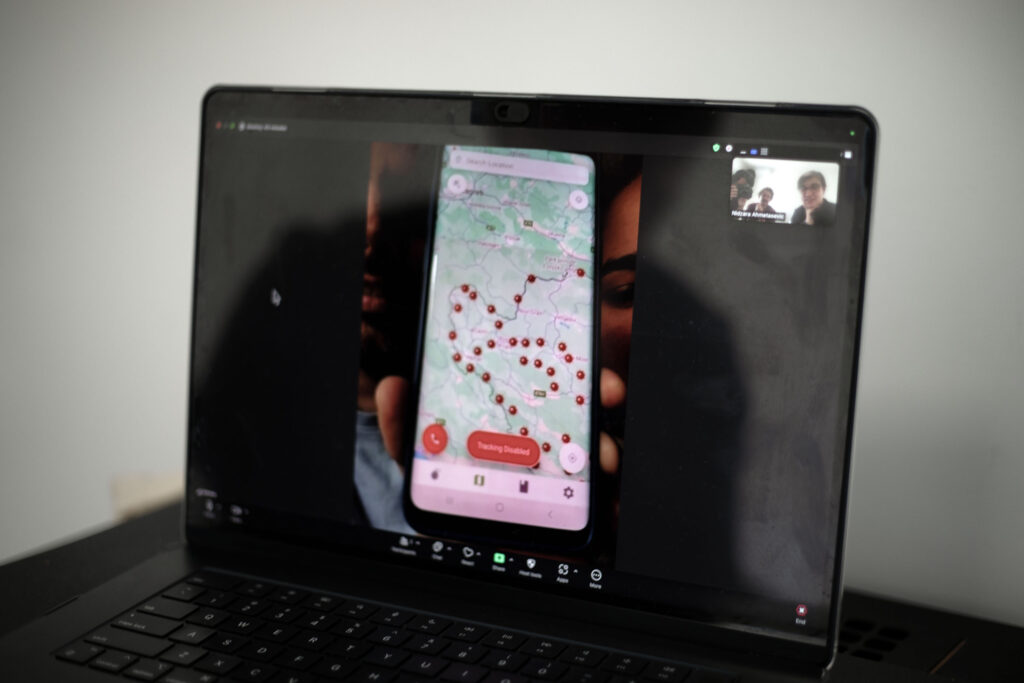 By video call, the Rodriguez family shows a screenshot of the route they took out of Bosnia, with the red dots marking mines (Maryam Ashrafi)
In the 1990s, this region was the scene of fierce battles between multiple armies, and years of shifting frontlines have bequeathed the landscape with a deadly legacy: the country’s highest concentration of landmines near residential areas. But it is in the deep forests and high mountain passes spanning the Bosnian-Croatian border that conceal many more. After the war, this landscape was an underutilized migration route, but in 2016, EU leaders sought to prevent hundreds of thousands of people from crossing from Greece to Western and Northern Europe. Militarized borders and violent pushbacks along the EU border slowly shifted the migration flow westward, and irregular arrivals into Bosnia jumped from around 755 in 2017 to more than 24,000 in 2018.
Towns around Bosnia’s northern border with Croatia became epicenters for migrants, media, and humanitarian organizations. Maps were distributed, warning those crossing the border about the risk of landmines. In the spring of 2021, a Pakistani man was killed and several members of his group injured after walking into a minefield in Saborsko, a small town in Croatia several miles from the Bosnian border. No migrants have been reported killed by landmines in Bosnia, but Bajraktarević and his team regularly find scattered clothes and other detritus strewn around the minefields. Anecdotally, hunters tell him they see migrants entering forests, followed by sounds of muffled explosions. “Dead or Missing in the Balkans,” a Facebook group run by locals and volunteers, contains countless pleas from people whose loved ones were last seen leaving Bosnia, “going for a game.”
The Rodriguezes were advised to follow a route into Croatia that ended near a church, some ruined buildings, and a bus stop. The progress was relatively easy until the first landmine sign plunged the group into dread. Still, they pressed on, walking all night until finally crossing the border where they were promptly captured by Croatian police. “They arrested us and made us sit in a completely sealed van for hours in the sun. They wouldn’t let us feed the children or let them go to the bathroom,” Adriana recalls.
She also explains that the Croatian police searched their belongings and confiscated their telephones. “I confronted them and asked for it back, I was crying because we were going to get lost. Then a female officer put her face right next to mine and told me to leave or she’d hit me. I was holding my one-year-old baby in my arms.”
Without any means of navigation, the Cubans were left stranded on the mountainside. “They just stood there yelling at us: ‘Go to Bosnia, go to Bosnia.’ I was afraid we would never find our way back.”
Again, they walked through the woods under the signs warning of mines. “We saw many blankets, towels, empty water bottles, and clothes,” Adriana remembers. “I can’t say exactly where the minefield began or ended because we only saw signs on the trees, and they didn’t indicate the limits, like ‘it starts here’ or ‘it ends here.’ I’ve never felt so scared.”
Fortunately, they encountered Nedžad, a local businessman, who was hunting in the forest. “They were exhausted, lost, with small kids in their arms,” he told us when we met up on the hilltops outside Bihać. Nedžad, who preferred not to give his surname, hosted the family for a few days while they regained their strength. A former soldier who spent the war fighting on various frontlines in the immediate area, he thought the family was lucky. “They had walked straight through the minefield.”
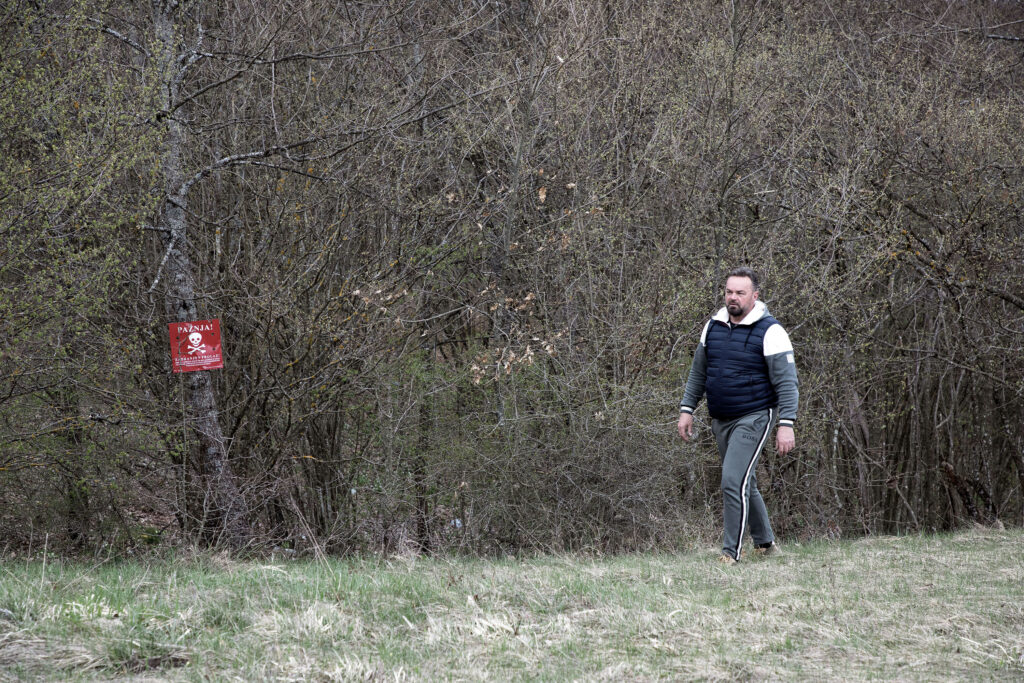 Nedzad, a local businessman and veteran from the 1990s war in Bosnia, walks along the edge of a mine-suspected area near Lipa migrant camp (Maryam Ashrafi)
A Moroccan asylum seeker now living in Italy sends us a video of his passage out of Bosnia a few years prior. Sunlight filters through the trees on which hang bright red signs with skulls and crossbones. Between heavy breathing, the man narrates in the Darija dialect of Arabic: “We arrived in Croatia, walking through paths of death,” he says. “May God protect and make it easy for each person walking these paths. I do not know if the Croats will take this video away or it will remain. Please God make it easy on us, please we are in the middle of the Croatian forest. We are in the middle of mines. Please God make it easy on us.”
At a Bihać restaurant adorned with hunting paraphernalia, Ermin Lipović scrolls through photos of the bruised and battered migrants who emerge from confrontations with the Croatian border guards. Some cradle broken arms in slings, others lie motionless on stretchers with head stabilizers. Often, migrants pushed back from Croatia become stranded in the mine-riddled forests and may alert the police, who in turn will call Lipović to guide them to safety. In his fifties, wiry and alert, Lipović leads the local branch of the Mountain Rescue Service and braves harsh terrain and extreme weather to attend to lost hikers, farmers trapped under tractors and paragliders caught in tree branches. Since 2018, migrants are increasingly among the lost.
“Sometimes you see mothers and fathers with little children,” Lipović shakes his head. “They have milk in their backpack and it’s frozen solid. No thermal clothing, nothing. Every time you go up the mountain, you don’t know who you will meet. I go quietly. Sometimes the smuggler says, ‘Don’t come here.’ I say, ‘OK, you’re going to Croatia, but please go that way instead!’
Lipović thinks it probable that some have died from triggering landmines deep in the forest. “You have people here buried without a name,” he says, gesturing to the other side of Bihać. There the town’s main cemetery features a section for migrants with a dozen simple gravestones inscribed with the letters NN (from the Latin nomen nescio, or “I do not know the name”).
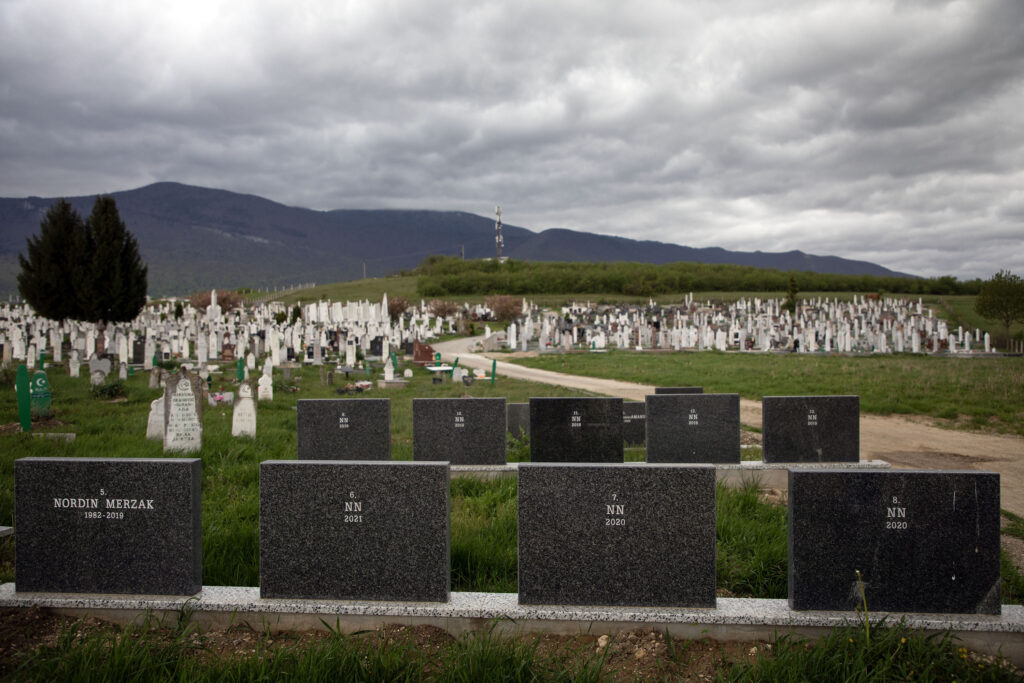 In a corner of the Bihać cemetery, several tombstones for migrants and people found dead near the border are marked with the letters “NN” (Maryam Ashrafi)
We drive southeast out of Bihać toward the largely uninhabited hamlet of Lipa. It was here in December 2020 that people were seen running from clouds of black smoke after the tented settlement hastily established to house migrants was incinerated in an unexplained fire. Months before, Europe’s biggest refugee camp on the Greek island of Lesbos had also gone up in flames. Its replacement — an isolated, heavily surveilled Closed Controlled Access Centre — would herald the EU’s new model of quasi-detention facilities for asylum seekers. In November 2021, local and EU officials opened Lipa amid great fanfare, with the regional head of the International Organization for Migration (IOM), Laura Lungarotti, announcing: “Today we are turning a tragedy into an opportunity.”
Lipa lies at the end of a two-mile-long dirt track, with rows of metal warehouses and shipping containers dotted along a windswept hilltop surrounded by barbed wire fencing. The European Commission financed the construction of the camp with an initial €1.7 million ($1.9 million) with member states also contributing an additional €500,000 ($570,000) for a small detention facility inside. Sixteen miles away from the nearest town, Lipa is in the middle of nowhere or, to use a Bosnian term, a vukojebina — “a place where the wolves fuck.”
We saw no wolves, though bears and lynx are known to roam nearby. A note written in Arabic and Farsi stuck on a portacabin at the camp’s entrance warns migrants of the hunting season in the surrounding hills. More arresting are the other signs a few hundred yards away behind the camp. Poking out of the trees, bright red and square, with a prominent skull and crossbones and white capital letters screaming “MINES!”
The signs were placed there by Bajraktarević’s colleagues from the national demining agency. He says that BHMAC deem it a “mine suspected area,” meaning that there is a possibility that mines or unexploded ordnance may be present. Despite this, Bajraktarević says they have not been contacted by any authority or international organization since to completely clear the area.
We were allowed into Lipa by the state Ministry of Security under the strict instructions that we did not take any photos or speak to any of the migrants inside. After a terse exchange in Bosnian with the camp manager, our friendly but nervous minder announced: “What I have to tell you is that I am not allowed to tell you all the information.”
During our brief tour around the facilities, we learned that Lipa has the capacity for 1,500 single male asylum seekers but was currently 10% full. The nationalities included Moroccans, Algerians, Afghans, Palestinians, Egyptians, Syrians, Libyans, and Pakistanis. On average, people stay for 10 days with access to basic services: food, showers, hygiene items, and a visiting doctor. Curiously for such an isolated facility, there is no public transport connection and migrants are obliged to use private taxis, the same ones that also drive migrants to the Croatian border for grossly inflated fees. It is also common for those without funds to walk to the camp, crossing over terrain that the state demining agency believes may contain mines.
“It’s a business, not just for smugglers but for taxi drivers,” says a humanitarian worker in Bihać, whose organization opposed the location of the camp from the beginning. “They pay 50 euros [$58.26] each for a taxi to Lipa from the border, they fit as many as they can. Everyone is using the opportunity to get money from them.”
Landmine awareness sessions are conducted “from time to time,” according to our minder as “this area is potentially infested with mines.” “They could be there, but it is not 100%,” he continued, adding: “But it never happened over here that somebody stepped on a mine and activated it. We all know where those landmines, maybe, are. We know where the biggest fights happened during the war, so we’re not going there.”
 A migrant wounded after attempting to cross the Croatian border negotiates with a taxi driver for a ride back to Lipa (Maryam Ashrafi)
In a statement to Inkstick, the spokesperson for the EU delegation in Sarajevo, Ferdinand Koenig, said that the territory of the Lipa camp was confirmed as mine-free prior to its establishment and that this one was of the essential conditions demanded by the EU before committing to financing.: “In the vicinity of Lipa, there are zones which are classified as ‘suspected but not confirmed dangerous areas’ for mines,” Koenig added “The ongoing presence of marked warning signs several hundred meters from the camp serves as a precautionary measure to protect migrants and local communities, and this marking is regularly maintained and verified, including through periodic checks, by BHMAC.”
Though Lipa is managed by Bosnian authorities, the IOM was the primary implementing agency involved in its establishment. In a statement to Inkstick, IOM spokesman Francois Lhoumeau said: “To ensure accuracy, IOM cross-checked the BHMAC digital platform, which provides real-time updates on mine-suspected zones in the country. The platform confirms that there are no mine-contaminated areas in the immediate surroundings of TRC Lipa.”
When we stood behind the camp, the Suspected Mines app told us we were less than two miles from a mine. Lhoumeau also said: “Prior to the opening of TRC Lipa, BHMAC informed IOM that a limited number of signs would be installed as a precautionary measure. It is important to note that the actual mined area is located significantly farther north and does not pose a direct threat to either the residents or staff operating within the TRC Lipa perimeter.”
“Gaza, Ukraine — I don’t watch the news anymore. The world comes past my door.” – Ibrahim Džanić
Given their similarity, it is difficult to know the difference between signs that have been laid “as a precautionary measure” and those that warn of known minefields. But contradiction was a common theme throughout our inquiries. Many times, we were told with extreme confidence in one breath that an area had no mines, only to be told seconds later that if there are mines then there are not many, or if there are then they are probably inactive.
Šuhret Fazlić, the former mayor of Bihać, whose tenure coincided with the establishment of Lipa, flatly denies the area is — or ever was — mined. “I am not aware of the signs,” he says, “but if they are there then it is because of the possibility that some unexploded ammunition could be there. Or there is a theoretical possibility that there are mines in some areas, so they [BHMAC] put up the signs to release themselves of the responsibility.”