
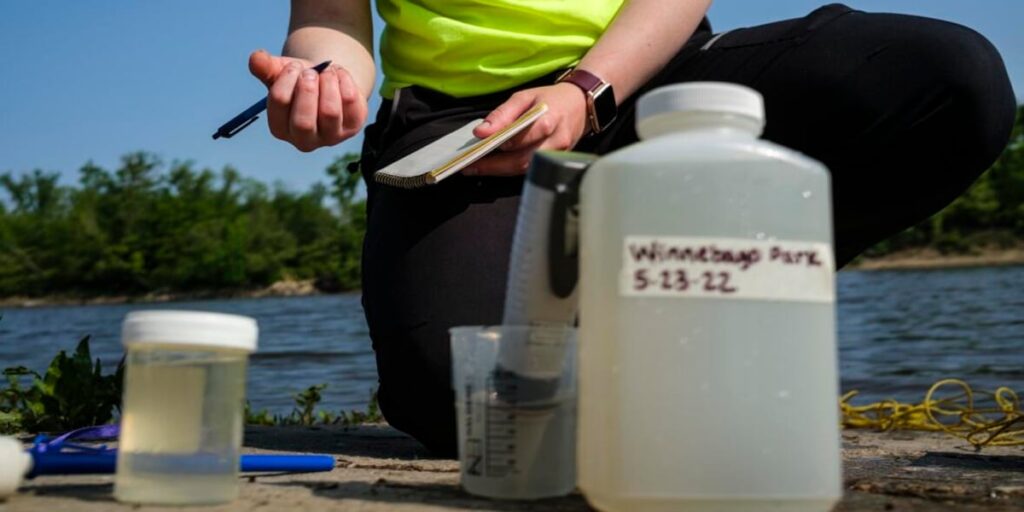
Iowa has some of the most severe nitrate pollution in its drinking water supply in the nation.
The executive director of the Science and Environmental Health Network, an environmental and public health advocacy group, says Iowa must work to end the “preventable suffering” of its residents due to this pollution.
Carolyn Raffensperger — who is also an environmental lawyer — said that “preventable suffering” includes cancer diagnoses and birth defects that could be linked to water contamination across the state.
Raffensperger’s comments during a recent talk with the environmental nonprofit Food & Water Watch came as Iowa was experiencing a spike in nitrate levels in water supplies across the state. Contamination in the state’s water supply comes primarily from agricultural runoff.
Nitrate is a compound that occurs naturally as well as in animal waste and is needed for plants to grow. Too much nitrate, though, is harmful to people and ecosystems.
Jennifer Breon, Food & Water Watch’s Iowa organizer, said that according to her organization’s analysis Iowa has more factory farms than any other state and that those farms produce more than 100 billion pounds of manure every year. Factory farms involve raising livestock in densely populated environments, which are often called concentrated animal feeding operations, or CAFOs.
“That’s 25 times as much as Iowa’s human population [produces], and that waste is largely unregulated and untreated,” she said.
According to an analysis by Investigate Midwest, over the last ten years, the Iowa Department of Natural Resources reported 694 impaired water segments, meaning they do not meet at least one of the water quality standards set by the Iowa Department of Natural Resources or the federal government. That can include pollutants like nitrates as well as others.
Rivers make up 80% of polluted water, followed by lake segments at 18%. Wetlands and reservoirs account for less than 2%, according to Investigate Midwest.
Raffensperger said during her talk that “we are now in hospice ecologically in Iowa.”
Widespread contamination
On July 2, the Raccoon River — which runs through Des Moines — reached a nitrate level of 16.04 mg/L. In late June, the Des Moines River was reported to have nitrate levels of 14.57 mg/L. The rivers feed into the region’s water plants to be treated and distributed to homes for drinking water.
The Environmental Protection Agency’s legal threshold for drinking water is 10 mg/L. The water utility said “all water produced by Central Iowa Water Works continue[d] to meet all safe drinking water standards” during the spikes, but water requires particular treatment to remove nitrates when the source is contaminated.
It’s not the first time nitrate levels have spiked in Iowa.
Investigate Midwest’s analysis of reports from the Iowa DNR found that nearly eight out of 10 river segments have been continuously impaired due to nitrate and other contaminants for at least a decade. During the same period, 43% of lake segments experienced a similar condition.
Some river (15%) and lake (11%) segments have fallen short of key water quality standards for at least 20 years.
The vast majority of nitrate contamination in central Iowa – nearly 80% – comes from agricultural land, according to Polk County’s water quality assessment report, which was released on Monday, Aug. 4.
Jerald Schnoor, an environmental engineer and University of Iowa professor emeritus, served as one of the project’s science advisors. He said that about 40% of contamination comes from fertilizer that is applied to the land and runs off into the water. Another portion – about 20% – comes from crops, like soybeans, fixing nitrogen from the atmosphere into the soil and making it available for runoff. The last 20% comes from manure that is applied to the land.
Besides agriculture, about 20% of nitrate in Iowa’s waterways comes from “atmospheric deposition,” like rain and snow. Schnoor said that wastewater from developed land contributes less than two percent of nitrate in the waterways.
Elevated levels of nitrate in drinking water are an issue beyond Iowa, as well. Most U.S. states have reported nitrate levels above the Environmental Protection Agency’s maximum allowable level of 10 mg/L in drinking water. However, some regions, including much of central and southern Wisconsin, northeastern Iowa, and central Minnesota have higher rates of violations.
High nitrate levels also show up in groundwater, which can be particularly harmful for people who use private wells for drinking water. In some parts of southern and central Minnesota over 10% of sampled private wells had nitrate levels above the legal limit.
Nitrate flows downriver, as well, affecting communities along the way and ultimately contributing to a so-called “dead zone” in the Gulf of Mexico, an area of reduced oxygen where little marine life can survive.
Elevated nitrate levels in drinking water can cause cancers and be particularly harmful to babies and pregnant people. The contaminant has been linked to “blue baby syndrome,” a life-threatening condition that can reduce an infant’s ability to carry oxygen through the bloodstream.
“We are charged with preventing the preventable suffering of the cancer and birth defects associated with our wayward industrial agriculture,” Raffensperger said. “We are charged with getting Iowa out of hospice ecology.”
In February, it was announced by the Iowa Cancer Registry, that the number of cancer survivors is growing in the state but Iowa continues to have the second highest cancer rate in the nation, only behind Kentucky.
“This is a real public health concern,” Breon said in the forum. But “there are a lot of solutions out there.”
Tackling the problem
The Central Iowa Water Works placed a ban on residential watering for the first time ever on June 12 to combat the recent spike in nitrate levels in the region’s water supply.
But as of July 30, commercial and residential lawn watering has started phasing back in. Recent rainfall in central Iowa has diluted the nitrate concentration in the rivers.
In Cedar Rapids, city officials said that the city water was safe for consumption, despite the spikes that were seen across the state. As of Monday, Aug. 4, Cedar Rapids’ two water treatment plants were at about 5.8 mg/L and 5.5 mg/L of nitrate after treatment. The Cedar River, which flows through Cedar Rapids, was reported to be at 8.98 mg/L before being treated at the two city plants.
Iowa water systems have invested millions into nitrate removal. But nitrate contamination starts upriver and in fields so mitigation must, too.
On Tuesday, Aug. 5, Iowa state officials announced more than $450,000 in financial assistance to support landowners in adopting conservation practices aimed at improving water quality for eight public lakes in Iowa.
Around the state, there have been multiple “batch and build” projects started, where several farms at once receive end-of-field mitigation infrastructure to stop nitrate from entering the water.
However, some water quality programs in Iowa that have historically targeted nitrate have been recently defunded.
University of Iowa Assistant Research Scientist Elliot Anderson said that about 80 sensors have been placed in Iowa rivers to measure and report nitrate levels. The measurements have helped researchers understand which areas are most at risk, where conservation practices are working and to learn how nitrate moves through water for the last 10 years.
Anderson said that in July, the Iowa state government cut funding to the program, bringing the amount of sensors in Iowa rivers down from 80 to 20.
Not just a statistic
With the level of contamination in Iowa’s waterways and the health risks they pose, Raffensperger said “every single person, every single number … is a measure of suffering. We (need to) take precautionary action to prevent that harm, to prevent suffering.”
Raffensperger also said that it is imperative for Iowans to remember that each person whose health is affected by water contamination is more than just a data point.
“My own husband is in hospice right now, dying of cancer, probably caused by agricultural chemicals, and he’s not just a statistic,” Raffensperger said.
Scientist and environmental activist Sandra Steingraber also spoke at the forum, and highlighted her firsthand experience of cancer.
Steingraber was diagnosed with cancer on two separate occasions, once with bladder cancer when she was 20 years old and again in her 30s with colon cancer.
Steingraber was adopted as a child. Despite that, Steingraber, who is now 66, said multiple people in her family were also diagnosed with the same cancers.
“I realized that even though I’m an adopted person, that’s the reason that my adoptive aunt died of the same kind of bladder cancer I had,” she said. “My cousin, who’s exactly my age, had a much more aggressive form of colon cancer as a young woman than I did. These things are not explainable by a hereditary link. I come from a cancer family, but I’m not related to my family by chromosome, so I needed to look elsewhere for that explanation.”
This led Steingraber to take a genetic test to see if she had an inherited mutation that would predispose her to cancer. But just last month, she found out that she does not have the mutation, saying that the explanation for her health story lies “almost certainly” in the environment.
“I join with you in preventing suffering in Iowa, knowing that you have a terrible problem: some of the worst nitrogen pollution and water that we’ve ever seen, the highest cancer rates and highest new rates of cancer,” she said. “And so those two terrible truths together, I hope, will lead to change.”
This story is a product of the Mississippi River Basin Ag & Water Desk, an independent reporting network based at the University of Missouri in partnership with Report for America, with major funding from the Walton Family Foundation.
Copyright 2025 KWQC. All rights reserved.