
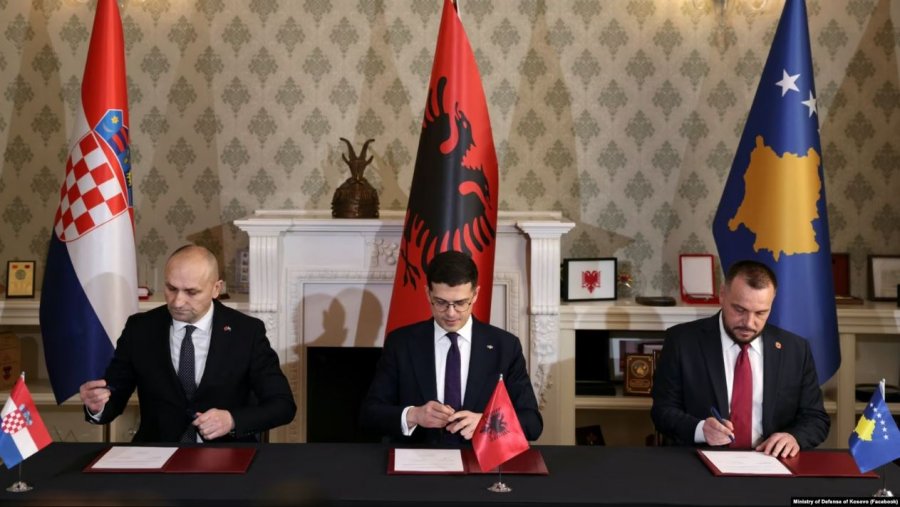
The plan for the Kosovo-Albania-Croatia military alliance will be finalized in September.

Express newspaper
15/08/2025 7:34
The concretization of military cooperation between Kosovo, Albania and Croatia is expected to take place in September, when the implementation plan for the declaration signed earlier by the defense ministers of the three countries is expected to be finalized.
The plan, among other things, also includes arms contracting, where the three countries aim to place a single order.
Security expert Nuredin Ibishi says that this form of contracting makes it easier and more affordable to purchase weapons.
“Even these aspects of the armament equipment are from a state or our main strategic partner, namely the United States of America, and the common goal of the three states, that after approval, so, as I said, from July 18 when it entered the operational phase by the working group, which will determine which will be those types of armament that will have a common order from these three states. Even the interaction itself, even in terms of joint exercises, in increasing capacities, in education and up to the military academies of these states, to also do the typification, namely the standardization of the armament. So, every time from the main NATO state, namely the United States of America”, said Ibishi. “When there is more demand for armament, then the price is also more favorable, but there are procedures that must be followed and an approval process in the Administration of the United States of America”.
Implementation group meeting
Kosovo’s acting Minister of Defense, Ejup Maqedonci, announced a few days ago to Radio Free Europe/Radio Liberty that an implementation group meeting was held in Tirana on July 18 to detail the plan for implementing the declaration. The final guidelines will be presented to the three ministries for approval in September.
The acquisition of defense capabilities is the first commitment in the declaration to which the Defense Ministers pledged.
According to Makedonci, the aim is to place one purchase order instead of three separate orders from each country.
“For example, a [weapons] system that all three countries are interested in purchasing from the US, we should place the order as a single purchase, using the legislation of each country, but the quantity and delivery time should be determined jointly, because when you buy more from the US, they cost less and arrive faster,” said the Macedonian.
These purchases are expected to be made with national funds of each country.
Kosovo, Albania and Croatia signed a declaration in Tirana on March 18, through which the countries commit to strengthening cooperation in the field of defense and security. The three countries have pledged to increase interoperability between their militaries through education, training and joint exercises, to engage in combating hybrid threats, and to coordinate policies for Euro-Atlantic integration.
The agreement, a guarantee for stability in the region
This agreement had prompted a reaction from Serbia, but the signatories emphasized that cooperation does not threaten anyone, but is a guarantee for stability and peace in the region.
The declaration represents an important development in the security architecture of the Western Balkans.
Former Deputy Minister of Defense, Bejtush Gashi, has said that the March 18 Agreement serves as a synchronized response to the profound transformations of the European geostrategic environment following the Russian aggression in Ukraine and the increase in Serbia’s military capacities.
In the context of the Western Balkans, according to Gashi, the agreement offers a functional cooperation model for non-NATO countries, contributing to the stabilization of the region and reducing the space for tensions sponsored by external actors.
“For Kosovo, which is not yet a NATO member, this initiative creates a functional mechanism of informal collective defense. Although it does not replace Article 5 of the North Atlantic Charter, it is in line with Article 4, which provides for immediate consultations between allies in the event of a threat to security, territorial integrity or political independence. Given that two of the three countries (Albania and Croatia) are NATO members, this alliance places Kosovo under a reinforced security umbrella, with direct implications for the southern wing of the Alliance,” said Gashi.
According to him, the Agreement addresses three main strategic objectives: increasing the interoperability of armed forces through the standardization of procedures and joint training in accordance with NATO doctrine; creating a regional capacity to respond to crises and hybrid threats; and reducing the armament gap towards states with accelerated investments in defense, guaranteeing strategic balance in the Balkans.
“The joint declaration foresees the exchange of professional expertise, the development of individual and collective training, as well as the building of reserve capacities, including the improvement of logistics, operations management and military-technical support systems. The harmonization of command procedures, combined with ‘joint-combined’ type exercises, increases the ability for coordinated response in crisis scenarios, including peacekeeping operations, emergency management and collective defense missions”, said Gashi, adding that this process brings Kosovo closer to the international standards of NATO and the EU not only at the tactical-operational level, but also in the framework of strategic planning, doctrine and civil-military interaction.
“Similar practices adopted by NATO aspirant countries have shown that integrated exercises and harmonization of command procedures increase the capacity of units to act under joint command, improve information exchange and reduce reaction time to hybrid threats. For Kosovo, this cooperation represents a concrete step towards building a collective defense capacity, strengthening the country’s credibility as a security partner in the region and contributing to the stability of the Western Balkans,” he said.
Serbia is the one threatening peace
Nureedin Ibishi also sees such alliances as necessary in the current geopolitical context.
“However, I think that these are not a danger, I am talking about states that have peaceful aspects, as we are now talking about three states, starting with Albania, Kosovo and Croatia, they have no territorial claims, not even in the past, recent history, they have no aggression against any state. They always have the goal and purpose of defense, especially Kosovo, every time it has the defensive or protective aspect. The very concept of doctrine and strategy is defined and determined in defense”, Ibishi emphasized.
Speaking about the reactions in Serbia after the signing of the Declaration, Ibishi says that it is precisely what has initiated alliances in the past that pose a danger and have broken peace agreements.
“Yes, Serbia was the first to break the Dayton agreement, when they did not set quotas regarding the number of soldiers, human capacities, armaments, that is, after the agreement or the end of the war in Bosnia-Herzegovina in 1995. It exceeded them by referring to issues that it calls for neutrality, while it armed itself everywhere. While now it is accusing this alliance which, as is known, has defensive purposes and the three states have no territorial claims to any state. Also, in 2023 Serbia reached a joint agreement in the field of defense with the Republic of Hungary,” he said.
Albania and Croatia are members of NATO, an organization that Kosovo aims to join. However, currently, within this organization, there are four countries that do not recognize Kosovo’s statehood.
The declaration signed in Tirana leaves the possibility for other countries to join, as it has been announced that Bulgaria has received an invitation.