
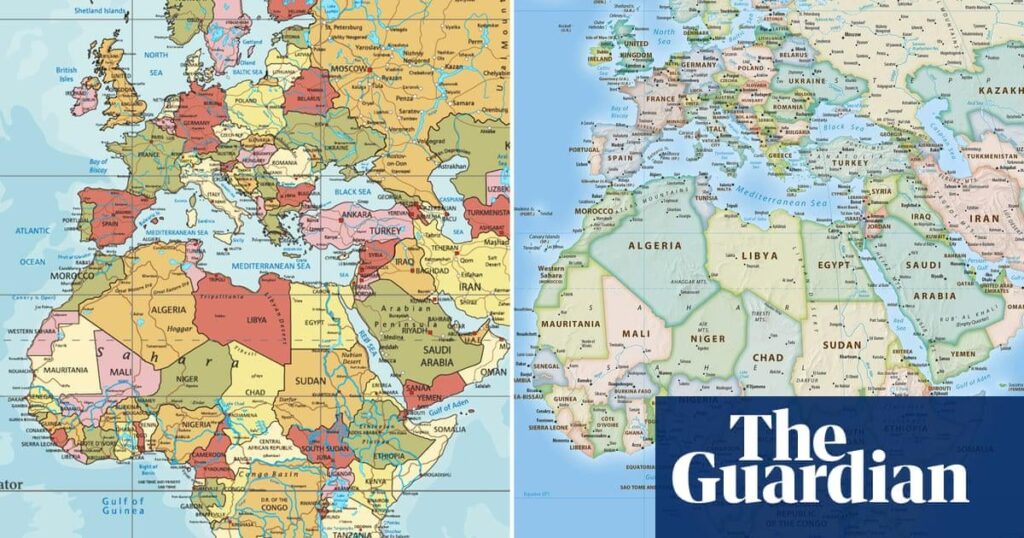
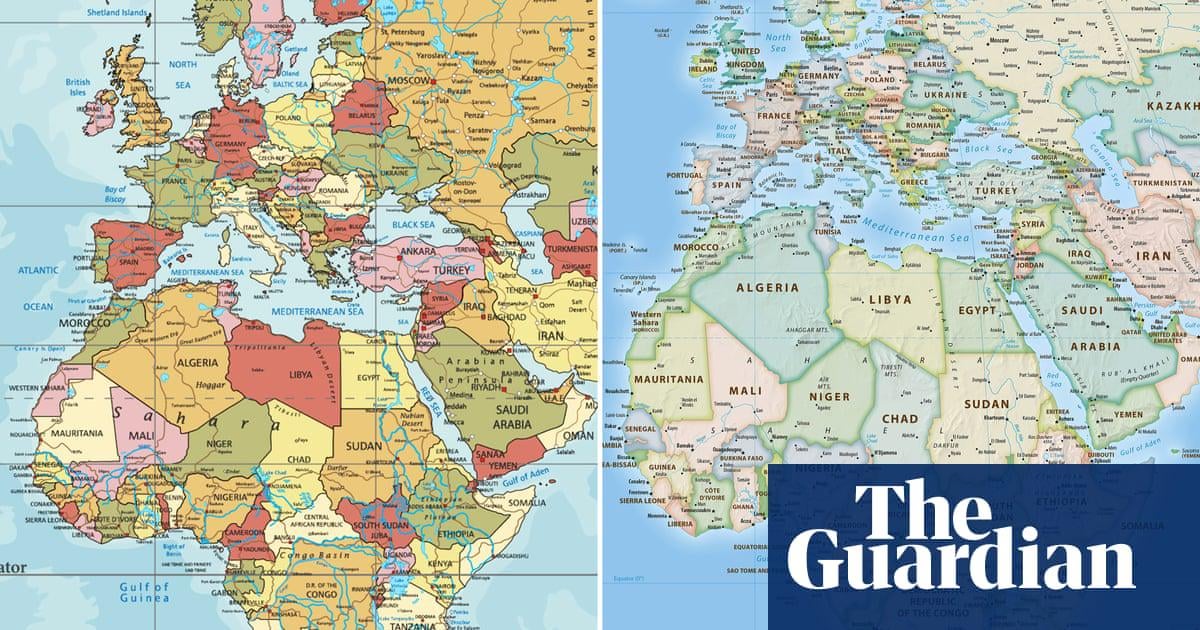
Africa is the big loser in the current system, as the Mercator map makes it look far smaller than it really is. Europe and Russia would look far smaller (their true size) in a corrected map. Brazil is also a beneficiary with a corrected map; it looks far bigger in reality than the Mercator map represents it.
The campaign seems to be going places. The World Bank says it is phasing out the use of the Mercator map, and various UN bodies are looking at doing the same.
African Union joins calls to end use of Mercator map that shrinks continent’s size
There's a growing campaign to replace the use of the Mercator map by governments and international bodies with one that more accurately reflects countries' true sizes.
byu/lughnasadh inFuturology
4 Comments
I would be really interested to know if anyone has published a study on the actual effect of the Mercator map’s distortion. Has Brazil been on the losing side of ‘my country is bigger than yours’ contests with Greenland?
I think most people wont even notice or care. I support it. Its nice to see a true representation, but it hasn’t made any difference to anything.
I am surprised to see how common Mercator is in other countries
In my western European experience, I very rarely see it anywhere, as the standard here is the Plate carrée
Sure, it doesn’t have perfect size conservation, the poles still are bigger unlike in the Gall Peters, and it also doesn’t have the correct shape and angles of the Mercator
But it is the mid point between the two, and it seems to be the simplest and best one
It’s been a long time since I’ve seen a Mercator in the wild
> “A growing campaign…”
This is nothing new!
There’s been a VERY strong call for this since at least the 1980’s!
So I guess you could say it’s been “growing since the 1980’s”!?
——————————–
Anyways… Look:
The current Mercator map is so highly distortive, it actually makes Greenland look like a decent portion of the size of South America or Africa! Lol!
Like that’s a serious distortion of reality, right?
——————————–
But that said, remember:
That was NOT the goal or original intention of the Mercator projection map. There was nothing racist or biased intended in the Mercator map.
Those developing and utilizing it were doing so not not “to get Africans and diminish them” or to try to promote “Greenlanders” as super sized power areas of land masses! (Well, ok: probably the original Mercator map workers did not like Africans and were probably racist! But that’s not what drove their map projections.)
——————————–
INSTEAD:
The reality of trying to project a 3 dimensional object down to a 2 dimensional presentation is HIGHLY mathematically complicated.
Like seriously: it’s a complex mathematical problem, that’s taken decades to analyze, and perfect, and try to correct for.
——————————–
But in the end… even now:
We still do not have a perfect solution about how to project a complex 3 dimensional sphere, into a flat 2 dimensional representation.
Yes, we have much better algorithms and ways today.
And so yes: we should embrace those ways and new representations. (But they’re still not perfect!)
——————————–
TANGENT NOTE:
When it comes to spatial-geography, there are so many other surprising problems with representing it as a map.
For example, there is the Coastline Paradox.
Nobody has ever, not even to this day with satellites equipped with precision laser measuring abilities… has ever been able to truely measure the area of a coastline of a country, or continent region.
That’s because you can continuously keep on measuring and imaging the coastline down to ever finer detail–detail which is also constantly changing.
This mathematical problem dissolves into an ever decreasing fractal.
——————————–
I guess it’s kinda a bit like the spatial-problem first realized by ancient greeks…
In which they wondered: how is it possible that you can walk across a room!?
Because in order to walk across a room, you must:
——————————–
A) first reach the half way point.
B) But at that point, there’s a new half way point, between your new position and the opposite wall of the room.
C) So you then must walk through to that new half way point,
D) And this process continues and repeats, in which there is essentially an infinite number of half way points between your new location and the opposite wall.
E) Ergo: it would take infinity of time to cross an infinity of spacial half way points!
F) Yet, in real life, people actually do walk across a room! So how do they do it!
——————————–
Fast forward to today…
And we have the mathematics of Calculus, specifically designed to smooth over these conundrums and perplexities of spacial paradoxes.
But… while Calculus may smooth over them… It doesn’t exactly answer the core paradox fully?… At least not to my personal satisfaction! But sure: it gives us a way to deal with them, and make plans, and do some engineering and remain sane in the face of the core unsolved spacial paradox!